Owner’s manual
 Error Codes


How to raise a refrigerator off the floor?
To raise your Kenmore Elite refrigerator model 79577549600 off the floor, we level it by lifting the front with the adjustable leveling legs and, if needed, adjusting the rear leveling system so the cabinet sits stable and the doors seal correctly. Use the steps in the 79577549600 owner's manual.
Safe way to raise and level the refrigerator
- Unplug the refrigerator or switch off power at the breaker.
- Pull the unit forward enough to access the front leveling legs.
- Use a wrench or pliers to turn both front leveling legs down (clockwise on most models) to raise the front.
- Adjust in small turns, alternating left and right, until the cabinet feels solid.
- Recheck door swing and gasket contact; the refrigerator should not rock.
- Slide the unit back carefully, keeping the water line from kinking.
Quick checks after you raise it
| What to check | What “good” looks like | What to do if it’s not right |
|---|---|---|
| Cabinet stability | No rocking at corners | Lower one leg slightly or raise the opposite leg |
| Door self-close | Doors gently close from a small open angle | Raise the front a bit more |
| Door seal | Gasket contacts evenly all around | Clean gasket and confirm cabinet is level |
| Water line | No pinches or sharp bends | Re-route line; replace damaged line if needed |
If you need extra clearance
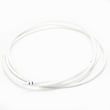
If your floor is uneven or you need a little more lift, we use a thin, solid shim under a low spot (never stack soft materials). For water-line issues while moving the refrigerator, inspect the refrigerator water tubing MJU62070602 for kinks or cracks.
Why it matters
Correct leveling helps the doors seal, prevents warm air leaks that cause frost, and reduces strain on hinges and drawer alignment.
Last updated: January 2026
What are the common problems with Kenmore Elite refrigerators?
Common problems on the Kenmore Elite 79577549600 bottom-mount refrigerator include warm temperatures (airflow or sealed-system issues), frost buildup (defrost or door-seal problems), water leaks (drain or water line issues), and unusual noises (fan, relay, or compressor-related). Use the 79577549600 owner's manual to match symptoms to the correct checks.
Most common symptoms and what usually causes them
- Not cooling or weak cooling: dirty condenser coils, evaporator fan not running, blocked vents, or a failing compressor/start relay
- Frost or ice buildup: defrost heater failure, door left ajar, torn/warped gasket, or poor door alignment
- Water under the fridge or in the freezer: clogged/iced defrost drain, cracked drain tube, or loose water tubing connections
- Ice maker or water dispenser issues: restricted filter, low house water pressure, kinked tubing, or a failing inlet valve
- Buzzing/clicking: compressor start relay cycling, fan blade hitting ice, or a vibrating grille/panel
Quick checks we recommend before replacing parts
- Set temps to 37°F (fridge) and 0°F (freezer); wait 24 hours for stabilization.
- Confirm doors close fully; check for gaps and torn seals.
- Clean condenser coils and make sure airflow around the cabinet is not blocked.
- Listen for the evaporator fan in the freezer; no fan sound often points to a fan or frost blockage.
- If you see water or ice at the bottom of the freezer, inspect the drain path and drain tube.
Parts that commonly solve these problems on this model
| Symptom | Part to inspect | What it affects |
|---|---|---|
| Water leaks or ice under freezer | Refrigerator drain tube 5251JA3003D | Carries defrost water to the drain pan |
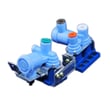
| No water to dispenser/ice maker | Lg refrigerator water inlet valve 5221JB2006K | Opens to supply water to the fridge |
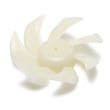
| Warm temps, fan noise, or rubbing | Refrigerator evaporator fan blade 5901JA1021A | Moves cold air through compartments |
Why it matters
Catching airflow, defrost, and drain problems early helps prevent food spoilage, recurring ice buildup, and water damage. It also reduces strain on the compressor, which is one of the most expensive repairs.
Last updated: January 2026
What size is Kenmore refrigerator model 79577549600?
Kenmore Elite refrigerator model 79577549600 is a bottom-mount refrigerator; the exact width, height, depth, and required clearances are listed in the 79577549600 owner's manual. For planning purposes, most Kenmore 795 bottom-mount units are built around a 33-inch class cabinet with depth and height varying by door style and handles.
What “size” usually means (and what to check)
When customers ask for size, we recommend confirming these measurements for your kitchen opening and delivery path:
- Overall width (cabinet and door edges)
- Overall height (floor to top hinge cover)
- Overall depth (without handles and with handles)
- Door swing and drawer clearance (space needed to fully open)
- Ventilation clearance (space behind and above for airflow)
Typical planning ranges for Kenmore 795 bottom-mount refrigerators
Use these as a starting point for rough planning; then match your numbers to the manual specs.
| Measurement | Typical planning range | Notes |
|---|---|---|
| Width | About 33 inches | Often called “33-inch class” |
| Height | About 67 to 70 inches | Changes with hinge cover and leveling legs |
| Depth | About 30 to 34 inches | Handles and door thickness change this most |
How we recommend measuring
Measure in three places and use the largest number.
- Width: across the widest point (often near hinges)
- Height: floor to top of hinge cover
- Depth: back wall to front edge; record without handles and with handles
Why it matters
Correct sizing prevents delivery issues, avoids doors or the freezer drawer hitting walls or cabinets, and helps maintain proper airflow so the refrigerator cools correctly.
Last updated: January 2026