 Owner’s manual
 Error Codes



Are bottom mount fridges better?
Yes for most households; a bottom-mount design on your Kenmore 59672913200 typically feels “better” because the fresh-food section sits at eye and waist level, so you reach less for everyday items while the freezer stays in a lower pull-out drawer.
- More ergonomic access: milk, produce, and leftovers are easier to grab without bending.
- Better organization for fresh food: shelves and crispers are front-and-center.
- Freezer is still roomy: deep lower drawers hold bulky items, but you bend more often.
- Good fit for cooks: you spend more time in the refrigerator section than the freezer.
- Often quieter in the kitchen: many bottom-mount layouts keep airflow and storage more separated (varies by model).
| Feature | Bottom-mount refrigerator | Top-freezer refrigerator |
|---|---|---|
| Most-used items | Easier to reach | Requires more bending |
| Freezer access | More bending | Easier to reach |
| Freezer organization | Drawer-style, stackable | Shelf-style, more visible |
| Typical cost | Higher | Lower |
A bottom-mount refrigerator is usually the right pick if you:
- Cook often and use fresh ingredients daily
- Prefer wide shelves for platters and meal prep containers
- Want a freezer drawer for bags, boxes, and bulk items
Most people open the refrigerator section far more than the freezer. With a bottom-mount layout, the items you use most are positioned where your back and shoulders do less work. For model-specific features and storage guidance, use the owner's manual.
Last updated: February 2026
What are the most common problems with Kenmore refrigerators?
The most common issues we see on Kenmore refrigerators like model 59672913200 are warm temperatures from airflow or dirty condenser coils, ice maker problems, water leaks from a clogged drain, frost buildup from defrost or door-seal issues, and unusual noises from fans or the compressor. For model-specific checks and settings, use the 59672913200 owner's manual.
- Not cooling or temps too warm: make sure vents are not blocked, clean condenser coils, and confirm the doors seal tightly.
- Ice maker not making ice: verify the ice maker is turned on, the freezer is cold enough, and the fill tube is not frozen.
- Water leaking or puddles: check for a clogged defrost drain and confirm the unit is level.
- Frost buildup: look for a door left ajar, torn gasket, or heavy humidity from frequent openings.
- Noisy operation: listen for fan noise (evaporator/condenser) versus a louder sealed-system or compressor sound.
| Symptom | Most common cause | Good first step |
|---|---|---|
| Fresh food warm, freezer OK | Airflow restriction or evaporator fan issue | Clear vents; check for strong airflow |
| Both sections warm | Dirty coils, condenser fan issue, or sealed-system problem | Clean coils; verify condenser area airflow |
| Water on floor | Defrost drain clog or door not sealing | Clear drain path; inspect gasket |
| Frost on back wall/freezer | Door seal leak or defrost issue | Check gasket seal; reduce door openings |
If troubleshooting points to a failed component, these are common replacements for this model:
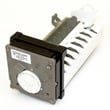
- Ice production issues: refrigerator ice maker D7824706Q
- Door not closing or warm temps from air leaks: refrigerator freezer door gasket WPW10436247
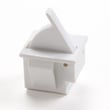
- Interior light not working (can affect door switch behavior on some designs): refrigerator switch W11396033
Cooling, ice production, and leak issues usually trace back to airflow, sealing, or drainage. Fixing those early helps protect food temperatures, reduces frost, and prevents water damage around the refrigerator.
Last updated: February 2026
What is the average life expectancy of a Kenmore refrigerator?
Most Kenmore refrigerators, including bottom-mount models like 59672913200, typically last 12 to 15 years with normal household use. Regular maintenance (cleaning, airflow, and sealing) helps you reach the high end of that range and avoid early failures.
A refrigerator’s life is mostly determined by how hard the sealed system and airflow components have to work day to day.
- Condenser coil cleanliness: dirty coils make the compressor run hotter and longer
- Door gasket condition: air leaks force longer run times and can cause frosting
- Ventilation around the cabinet: poor airflow traps heat and reduces efficiency
- Defrost performance: heavy frost reduces cooling and strains fans and the compressor
- Water and ice system upkeep (if equipped): prevents clogs, leaks, and ice maker issues
Use this as a simple routine for Kenmore refrigerators.
- Vacuum or brush condenser coils every 6 to 12 months
- Keep food from blocking interior air vents (especially in the freezer)
- Confirm doors close on their own and sit level; adjust leveling feet if needed
- Wipe gaskets clean; check for gaps with the “paper test” (paper should drag when pulled)
- Set temps to about 37°F fresh food and 0°F freezer
| Symptom | Often fixable? | What it commonly points to |
|---|---|---|
| Warm fridge, freezer OK | Yes | airflow or evaporator fan/defrost issue |
| Frost buildup on back freezer wall | Yes | defrost problem or door seal leak |
| Clicking, won’t start cooling | Sometimes | start components or compressor circuit |
| Water under fridge | Yes | drain restriction or water line issue |
When a refrigerator is near the end of its typical lifespan, small issues like a weak door seal or dirty coils can push the compressor to run nonstop. That extra strain can shorten the remaining life and increase energy use.
For model-specific care and maintenance intervals, follow the 59672913200 owner’s manual.
Last updated: February 2026
What is the bottom part of a refrigerator called?
On a Kenmore bottom-mount refrigerator like model 59672913200, the “bottom part” most people mean is the toe grille (kick plate) at the very front, or the machine compartment behind it that houses key cooling components such as the compressor. For diagrams and access steps, use the 59672913200 owner's manual.
- Toe grille (kick plate): The vented cover at the lower front; it helps airflow and provides access for cleaning.
- Machine compartment: The area behind the toe grille where cooling-system parts sit.
- Compressor: The pump that circulates refrigerant; it is typically located low and toward the back.
- Condenser area: Where heat is released; keeping it clean helps cooling performance.
- Leveling legs/rollers: Used to level the refrigerator so doors seal and close properly.
| What you see at the bottom | What it is usually called | Why it matters |
|---|---|---|
| Vented panel across the front | Toe grille | Airflow, cleaning access |
| Metal canister-like motor area (often rear-lower) | Compressor | Main cooling function |
| Adjustable feet at the front corners | Leveling legs | Door alignment and sealing |
If you are troubleshooting noise, poor cooling, or door sealing, the bottom area is often involved. We recommend these checks:
- Vacuum dust from the lower vents and condenser area.
- Confirm the refrigerator is level (front slightly higher than back is common for proper door closing).
- Listen for clicking or humming near the compressor area.
- Check for water puddles near the front that could indicate a drain issue.
The bottom area controls airflow, heat removal, and stability. A blocked toe grille, dirty condenser area, or an issue with the compressor can lead to warm temperatures, longer run times, and excess noise.
Last updated: February 2026





