Error Codes


Do 110v dryers work well?
Yes, 110V dryers can work well for small loads and light-duty drying, but they typically dry slower than 240V electric dryers. For a Kenmore electric dryer like model 11086574110, a 240V supply is the normal setup for full-size performance and faster heat recovery.
Most 110V dryers use a smaller heater, so they remove moisture more slowly. That can be fine in an apartment, RV, or for occasional use, but it changes cycle time and load size.
- Drying speed: 240V is typically faster for full loads
- Load capacity: 110V units are often designed for smaller loads
- Heat output: 110V usually produces less heat, so heavy fabrics take longer
- Energy use: 110V may run longer per load; total cost depends on runtime and local rates
- Installation: 240V requires a dedicated dryer circuit and correct cord/terminal block setup
| Feature | 110V dryer | 240V electric dryer (typical full-size) |
|---|---|---|
| Typical use | Compact, light-duty | Standard household laundry |
| Cycle time | Longer | Shorter |
| Best for | Small loads, thin fabrics | Towels, jeans, bedding |
Long dry times are usually airflow-related, not a “voltage problem.” Before assuming you need a different dryer, we recommend these checks:
- Clean the lint screen and confirm it is not coated with fabric softener residue
- Inspect and clear the vent duct for lint buildup or crushing behind the dryer
- Confirm strong airflow at the outside vent hood
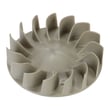
- Check for a damaged blower wheel (common cause of weak airflow) such as the dryer blower wheel WP694089
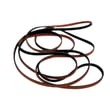
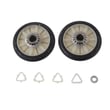
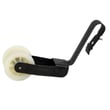
- If the drum is not tumbling normally, inspect the belt and idler system, including the drum belt 341241 and dryer idler pulley WP691366
Dryers remove moisture by combining heat + airflow + tumbling. Even a properly powered dryer will struggle if airflow is restricted or the drum drive system is slipping, so fixing those basics often restores normal performance.
Last updated: February 2026
How do I get my dryer out of lock mode?
To take your Kenmore electric dryer model 11086574110 out of lock mode, press and hold the button labeled Control Lock (or the key with a lock icon) for about 3 to 5 seconds until the lock indicator turns off. If the panel stays locked, reset power for 1 minute.
- Press and hold Control Lock for 3 to 5 seconds.
- If there is no Control Lock button, press and hold Start/Pause for 3 to 5 seconds.
- Watch for the lock light/icon to turn off or for “CL” to clear.
- If nothing changes, unplug the dryer (or switch the breaker off) for 1 minute, then restore power.
- Try the button-hold again after power is restored.
A stuck key, a failing user interface, or a door-latch issue can make the control act “locked” even when it is not.
- Make sure the door is fully closed and latching firmly.
- Press each key once to check for a stuck button.
- Avoid leaning on the console; constant pressure can trigger lock behavior.
- If the dryer will not start after unlocking, check the door switch circuit and latch alignment.
If the door is not latching consistently, inspect the door catch/latch kit: catch 279570.
Control lock (child lock) disables most buttons so cycles cannot be changed accidentally. The dryer can look “dead” even though it has power.
| Symptom | What it points to | What to do next |
|---|---|---|
| Lock icon or “CL” shows | Control lock is on | Hold Control Lock (or Start/Pause) 3 to 5 seconds |
| No response to any keys | Control needs reset | Power reset for 1 minute |
| Unlock works but won’t start | Door not sensed closed | Check door closure and latch/catch |
Unlocking the controls restores normal operation and helps you avoid unnecessary part replacements when the dryer is actually working as designed.
Last updated: February 2026
How to hard reset a Kenmore dryer?
To hard reset your Kenmore electric dryer model 11086574110, unplug it (or switch the breaker off) for 5 minutes, then restore power and start a timed dry cycle. This clears many control glitches and restores normal keypad response.
- Turn the dryer OFF.
- Unplug the power cord; if it is hardwired, turn the dryer breaker OFF.
- Wait 5 minutes (minimum 1 minute; 5 minutes is more reliable).
- Restore power.
- Open and close the door once, then run Timed Dry for 2 to 3 minutes.
- If the panel is still unresponsive, repeat once and then move to the checks below.
A reset only clears the symptom; it does not fix a failed part. On model 11086574110, these are the most common items to check next:
- Door fully closes and latches; inspect the door catch and strike
- House power: confirm the dryer has full 240V (a tripped half-breaker can leave you with lights but no heat)
- Airflow: clean lint screen and venting to prevent overheating shutdowns
- Door switch operation (a bad switch can prevent the motor from running)
- Drive system drag or squeal (belt, idler pulley, drum support) that can stall the motor
| Symptom | Most likely area | Example part for this model |
|---|---|---|
| Drum will not turn, motor runs or hums | Belt or idler | Drum belt 341241, dryer idler pulley WP691366 |
| Loud rumble/scrape at front of drum | Drum support | Whirlpool dryer drum front bearing 279441 |
| Burning smell or poor drying | Venting or blower | Dryer blower wheel WP694089 |
Hard resets are useful for clearing a stuck control state, but repeated “needs a reset” behavior usually points to a real issue such as restricted airflow, a failing door switch, or a dragging drum drive system that overloads the motor.
Last updated: February 2026
Is it worth repairing an old Kenmore dryer?
Yes, a Kenmore electric dryer like model 11086574110 is worth repairing when the cabinet is solid, the drum turns smoothly, and the problem is a common wear item (belt, idler pulley, blower wheel, door latch). If the repair involves multiple major drive parts or repeated failures, replacement usually makes more sense.
- The dryer heats and tumbles but is noisy, squeals, or slips: repair is typically worthwhile.
- The drum will not turn and you suspect a broken belt: repair is typically worthwhile.
- The dryer runs but airflow is weak (long dry times): repair is typically worthwhile after vent cleaning.
- The dryer will not start and you suspect a motor issue: compare repair cost to replacement.
- You have rusted panels, a damaged drum, or multiple recent breakdowns: replacement is typically the better value.
| Symptom | Likely area | Example part for this model |
|---|---|---|
| Drum not turning, motor runs | Belt or idler system | Drum belt 341241 or dryer idler pulley WP691366 |
| Loud rumble or scraping | Drum support or seals | Whirlpool dryer drum front bearing 279441 or seal W10906683 |
| Thumping or poor tumbling | Drum baffles | Dryer drum baffle WP692490 |
| Loud roaring, weak airflow | Blower wheel | Dryer blower wheel WP694089 |
| Will not start, hums or trips | Drive motor or wiring | Motor 279827 |
A dryer repair is usually a good investment when you are replacing a single wear component (like a belt or pulley). Those fixes restore safe, efficient tumbling and airflow, which helps prevent overheating, long dry times, and extra strain on the motor.
- Clean the lint screen every load and clear the vent duct regularly.
- If you open the cabinet for a belt issue, inspect the idler pulley and blower wheel at the same time.
- If you are diagnosing an electronic display or beeping issue, use Kenmore 110 series electronic control model dryer error codes to narrow the failure before buying parts.
Last updated: February 2026
What are common problems with Kenmore dryers?
Common problems we see with the Kenmore 11086574110 electric dryer include not starting, not heating, long dry times, loud squealing or thumping, and the door not latching. Many of these issues trace back to airflow restrictions, a worn drive system, or a failing motor or switch.
- Dryer will not start: door not fully closed, failed start/door switch, or a failing drive motor
- Runs but no heat: heating circuit issue (wiring, element, or power supply problem)
- Takes too long to dry: clogged lint screen, blocked venting, or a damaged blower wheel
- Loud squeal or rumble: worn belt, idler pulley, drum bearing, or drum support components
- Door will not latch: worn latch/catch hardware
- Clean the lint screen and confirm strong airflow at the outside vent hood.
- Verify the dryer is getting full power (electric dryers typically need 240V; a tripped breaker can leave you with partial power).
- Listen for the motor: a hum with no drum movement often points to a belt or motor issue.
- Check the door closure: if the door does not click shut, the dryer may not run.
| Symptom | Commonly involved part | What it does |
|---|---|---|
| Drum not turning | Drum belt 341241 | Drives the drum from the motor pulley |
| Squealing, drum slips | Dryer idler pulley WP691366 | Maintains belt tension |
| Weak airflow, noise | Dryer blower wheel WP694089 | Moves air through the drum and vent |
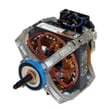
| Won’t start or stops | Motor 279827 | Turns the drum and blower |
| Door won’t latch | Catch 279570 | Helps the door close and engage the door switch |
A Kenmore dryer that runs with poor airflow can overheat and shut down on safety limits, and it will always dry slower. Catching a worn belt, idler pulley, or blower wheel early also prevents secondary damage and reduces noise.
If your dryer is showing a code or you suspect an electronic control issue, use our Kenmore 110 series electronic control model dryer error codes guide to narrow the problem to a specific circuit or component.
Last updated: February 2026
What is an AF code?
On the Kenmore 11086574110 electric dryer, an AF code means restricted airflow. The dryer senses poor venting (usually from a clogged lint screen, blocked vent duct, or a crushed or kinked vent) and may keep running, but drying times increase.
- Clean the lint screen completely; wash it with warm water and a soft brush if you see fabric softener residue.
- Inspect the vent hose behind the dryer for crushing, kinks, or sagging.
- Check the outside vent hood; remove lint buildup and confirm the damper opens freely.
- Reduce excessive vent length and too many elbows; straighter and shorter vents move air better.
- Run a timed dry cycle and confirm strong airflow at the outside vent.
| What you notice | What it usually means |
|---|---|
| Loads take much longer to dry | Vent restriction or lint buildup |
| Dryer feels hot but clothes stay damp | Air cannot move moisture out |
| Burning smell or very hot cabinet | Severe restriction; stop and clean venting |
| AF comes and goes | Partial blockage or vent hose shifting |
If airflow is clear but drying is still weak, internal lint buildup or a damaged air-moving component can be involved.
- A worn or broken dryer blower wheel WP694089 can reduce airflow.
- A loose or slipping drum belt 341241 can prevent proper tumbling, which also hurts drying performance.
Restricted airflow makes the dryer work harder, increases energy use, and can overheat components like the heating circuit and motor. Restoring proper venting is the most effective way to clear AF and get normal dry times back.
Last updated: February 2026
What size is a Kenmore Model 11086574110 dryer?
Kenmore model 11086574110 is a full-size electric dryer; most Kenmore 110-series dryers are about 27 inches wide, 36 to 39 inches tall, and 29 to 31 inches deep. Capacity is typically 6.5 to 7.0 cu. ft. for this style.
Use these as planning numbers for a laundry closet, pedestal clearance, or a stacking area (electric dryers like this are usually not stackable unless specifically designed for it).
- Width: ~27 in.
- Height: ~36 to 39 in. (varies with leveling legs and control console)
- Depth: ~29 to 31 in. (add room for the cord and vent)
- Door swing clearance: allow 20 to 24 in. in front
We recommend measuring your specific unit because small variations happen across Kenmore 110-series builds.
- Measure width at the widest point of the cabinet (side to side)
- Measure height from floor to the top of the cabinet (include leveling legs)
- Measure depth from the back panel to the front edge (exclude the door handle, then include it as a second number)
- Add at least 4 to 6 inches behind the dryer for the vent connection and bend radius
| What you are sizing for | Use this number | Add this clearance |
|---|---|---|
| Closet opening width | 27 in. dryer width | +1 to 2 in. each side |
| Depth to back wall | 29 to 31 in. dryer depth | +4 to 6 in. for vent |
| Height under shelving | 36 to 39 in. dryer height | +1 in. for vibration |
Correct sizing prevents crushed venting (slow drying and overheating risk), makes installation easier, and helps avoid door clearance problems.
If you are troubleshooting long dry times after moving or reinstalling, start with airflow and venting checks in how to keep a dryer clean and economical.
Last updated: February 2026