Owner’s manual
 Error Codes



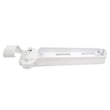
How to remove bottom grill from KitchenAid refrigerator?
On KitchenAid model KBFS25EWMS6, the bottom grill (toe kick) typically snaps onto the lower front frame. We remove it by gripping the grill at the ends and pulling straight forward to release the retaining clips; then lift it away from the frame.
Step-by-step: remove the toe kick (bottom grill)
- Unplug the refrigerator or switch off power at the breaker (recommended when working near wiring).
- Open both fresh food doors for better access.
- Grip the grill firmly near the left and right ends.
- Pull the grill straight toward you to pop it off the clips.
- If it feels stuck, work one side loose first, then the other (avoid twisting hard).
- Set the grill aside where it will not bend.
Reinstalling the grill
Align the grill with the lower frame tabs/clips, then press evenly until it snaps into place.
| What you feel | What it usually means | What to do |
|---|---|---|
| Pops off with a firm tug | Clips released normally | Reinstall by snapping back on |
| Won’t release on one side | Clip is still engaged or grill is slightly flexed | Pull from that end again, straight out |
| Rattles after reinstall | Not fully seated on clips | Press along the length until fully snapped |
Why it matters
We remove the bottom grill to access and clean the condenser area, check for debris, and inspect for water leaks or airflow issues. Keeping this area clear helps the compressor and condenser run efficiently.
Helpful references
- Use the KBFS25EWMS6 owner’s manual for model-specific access points and safety notes.
Last updated: January 2026
What is the most common problem with a KitchenAid refrigerator?
The most common KitchenAid refrigerator problems are cooling and ice-making related: warm fresh-food temperatures, weak or no ice production, and noisy fan operation. On the KitchenAid KBFS25EWMS6 bottom-mount refrigerator, these symptoms usually trace back to airflow, door sealing, or water supply issues; see the KBFS25EWMS6 owner's manual for model-specific checks.
Most common issues we see (and what they look like)
- Not cooling evenly: fridge warm but freezer cold, or temperature swings
- Ice maker slow or not making ice: small cubes, hollow cubes, or no harvest
- Noisy operation: buzzing, rattling, or a loud whir from the freezer area
- Water leaks or puddles: water under crisper drawers or on the floor
- Frost buildup: heavy frost on the freezer back wall, reduced airflow
Quick troubleshooting checklist (KBFS25EWMS6)
- Set temps to typical targets: 37°F fresh food and 0°F freezer.
- Make sure vents are not blocked by food packages.
- Check door closing and gasket contact all the way around.
- If ice is slow, confirm the household shutoff valve is fully open and the supply line is not kinked.
- Clean condenser area and confirm the unit has airflow around it.
Parts that commonly relate to these symptoms
| Symptom | Common cause | Example part for this model |
|---|---|---|
| Warm temps, noisy freezer | Evaporator airflow problem | Refrigerator evaporator fan motor WPW10128551 |
| Slow or no ice | Ice maker failure or water supply issue | Refrigerator ice maker assembly W10884390 |
| Leaks inside fridge | Clogged/iced drain path | Refrigerator drain tube W10619951 |
| Poor sealing, moisture | Worn door gasket | Refrigerator gasket panel W10443320 |
Why it matters
Cooling, airflow, and water supply problems can snowball into food spoilage, frost buildup, and compressor overwork. Catching the early signs (noise changes, slow ice, temperature swings) helps prevent bigger repairs.
Last updated: January 2026
What is the average lifespan of a KitchenAid refrigerator?
A KitchenAid refrigerator typically lasts about 13 years on average. For your KitchenAid KBFS25EWMS6 bottom-mount refrigerator, good airflow, correct temperatures, and routine cleaning usually make the biggest difference in reaching (or exceeding) that lifespan; see the KBFS25EWMS6 owner's manual for model-specific care guidance.
Typical lifespan and what to expect
Most full-size refrigerators fall into a similar range, and KitchenAid units commonly land near the middle of it.
- Average: ~13 years
- Typical range: 10 to 15 years
- Often shorter when the condenser is clogged with dust or the doors do not seal well
- Often longer when temperatures are stable and the unit has good ventilation
What shortens refrigerator life fastest
These are the most common “wear accelerators” we see on bottom-mount and French door style refrigerators:
- Dirty condenser area causing higher compressor run time
- Door gasket leaks letting warm, moist air in
- Overpacked compartments blocking air circulation
- Frequent temperature swings (warm garage, doors opened often)
- Water leaks or ice buildup from a restricted drain
Quick maintenance checklist (high impact)
Use this as a simple routine to help your KBFS25EWMS6 run efficiently.
- Keep refrigerator at 37°F and freezer at 0°F (common recommended targets)
- Clean dust from the condenser area regularly
- Check door seal contact all the way around; replace if torn or warped
- Replace the water filter on schedule; follow how to replace the water filter in a KitchenAid refrigerator
- Clear clogs that cause puddles; a blocked drain can lead to icing and airflow problems
Parts that commonly affect longevity
If performance issues show up (warm temps, loud running, frost, leaks), these parts are often involved:
| Symptom | Common area to check | Example part for KBFS25EWMS6 |
|---|---|---|
| Warm fresh food section | Evaporator airflow | Refrigerator evaporator fan motor WPW10128551 |
| Poor door sealing, sweating | Door seal | Refrigerator gasket panel W10443320 |
| No ice or slow ice | Ice maker system | Refrigerator ice maker assembly W10884390 |
Why it matters
A refrigerator that is running hot, leaking air at the doors, or struggling to move air will run longer cycles. That extra run time increases wear on the sealed system and can shorten the overall service life.
Last updated: January 2026
Why is water collecting in the bottom of my KitchenAid refrigerator?
Water collecting in the bottom of your KitchenAid KBFS25EWMS6 refrigerator almost always points to a defrost drain problem: the drain hole or drain tube is clogged with debris or frozen, so defrost water cannot flow to the drain pan and instead pools inside the fresh food section.
Most common causes (and what to check first)
- Clogged defrost drain hole under the evaporator cover; food particles and sludge block flow.
- Frozen drain trough; ice forms and dams the drain during defrost.
- Restricted drain tube leading to the drain pan; gunk buildup slows drainage.
- Door not sealing well; excess humidity creates heavier frost and more meltwater.
- Drain pan shifted or overflowing (less common); water misses the pan.
Quick fix steps we recommend
- Unplug the refrigerator and protect the floor with towels.
- Remove the bins and locate the drain trough/hole at the back bottom of the fresh food compartment.
- Melt any ice with warm water (a turkey baster works well) and flush the drain until it flows freely.
- If water backs up, clear the tube from the rear access area; a flexible plastic tube or pipe cleaner helps.
- Check door sealing and alignment; correct gaps so warm air is not feeding frost.
For model-specific access points and panel removal details, follow the KBFS25EWMS6 owner's manual.
Parts that commonly solve repeat puddles
If the drain keeps clogging or you find a damaged tube, these model-matched parts are often involved:
- Refrigerator drain tube W10619951 (replaces a split, kinked, or restricted drain line)
- Refrigerator gasket panel W10443320 (helps stop warm-air leaks that increase frost and meltwater)
Symptom-to-likely-cause guide
| What you see | Most likely cause | Best next step |
|---|---|---|
| Water under crisper drawers | Clogged/frozen defrost drain | Flush drain with warm water |
| Sheet of ice on fridge floor | Frozen drain trough | Defrost and clear drain path |
| Water after heavy door use | Door seal leak, humidity | Inspect gasket, align doors |
| Water near front edge | Spill, condensation, or door gap | Check leveling and gasket contact |
Why it matters
Standing water can lead to odors, ice buildup, and temperature swings that stress the evaporator fan and cooling system. Keeping the defrost drain clear helps your bottom-mount refrigerator run efficiently and prevents repeat leaks.
Related DIY help
Last updated: January 2026