Installation guide
 Owner’s manual



How do I reset my Kenmore washer control board?
For Kenmore washer model 11028102310, the most reliable “reset” is a power reset: cancel the cycle, unplug the washer for about 1 minute, then restore power and start a new cycle. This clears many temporary control glitches without replacing parts. See the 11028102310 use & care manual.
- Press POWER once to cancel the current cycle.
- Unplug the washer (or switch off the breaker) for 60 seconds.
- Plug back in (or turn breaker on).
- Press POWER, select a cycle, then press START/PAUSE/UNLOCK LID.
- If the display shows an error code, clear it by pressing START/PAUSE/UNLOCK LID once, then try restarting.
These checks often solve what looks like a bad control board:
- Confirm the lid is fully closed; the washer will not run with the lid open.
- Reduce excess suds (use only HE detergent and the correct amount).
- Redistribute the load if you see an unbalanced load condition.
- Run Rinse & Spin to clear leftover detergent or suds.
| Symptom | Likely issue | What to do next |
|---|---|---|
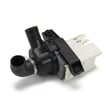
| Won’t drain or stops mid-cycle | Drain restriction or weak pump | Inspect drain path; consider washer drain pump WPW10409079 if the pump hums but won’t move water |
| Lid won’t lock/unlock | Lid lock problem | Check lid area for obstructions; test lid lock operation |
| Random stopping with heavy suds | Too much or non-HE detergent | Switch to HE detergent; run Rinse & Spin |
A power reset restores normal operation after brief power interruptions, control “hang-ups,” or suds-related pauses. If problems return quickly, the washer is usually reacting to a drain, lid-lock, or load-balance condition rather than a failed control board.
Last updated: January 2026
Does my Kenmore top load washer have a filter?
Kenmore top-load washer model 11028102310 does not use a customer-cleanable “lint filter” like many older agitator washers. Instead, it relies on self-cleaning wash action and the drain pump path; routine cleaning is handled through the maintenance steps in the 11028102310 use & care manual.
Even without a traditional filter, there are a few maintenance items that help prevent odors, slow draining, and residue buildup:
- Run the Clean Washer cycle about every 30 loads (or monthly)
- Wipe dispenser areas with a damp cloth (the dispensers are not designed to be removed)
- Check pockets for coins, screws, and small items that can end up in the drain system
- Use only HE detergent and avoid over-dosing (excess suds can affect draining)
- Leave the lid open between loads to help the tub dry
On model 11028102310, symptoms that feel like a clogged filter are usually caused by debris in the drain path or a weak pump.
- Run Drain & Spin with the tub empty
- Listen for the drain pump running during drain (steady hum is normal; loud grinding is not)
- Look for kinks or clogs in the drain hose and standpipe setup
If the washer won’t drain, drains slowly, or leaves water behind, the drain pump may need inspection or replacement. A compatible replacement for this model is the washer drain pump WPW10409079.
| Symptom | More likely cause | Less likely cause |
|---|---|---|
| Slow drain / standing water | Drain hose restriction, pump obstruction | Control issue |
| Loud grinding during drain | Debris in pump, failing pump | Normal operation |
| Excess suds + stopping | Too much detergent / non-HE detergent | Pump failure |
Knowing whether your washer has a serviceable filter helps you avoid unnecessary disassembly. For 11028102310, the best results come from proper HE detergent use, monthly cleaning, and addressing drain issues at the pump or hose when symptoms show up.
Last updated: January 2026
What is the average lifespan of a Kenmore washer?
For Kenmore washer model 11028102310, an exact “average lifespan” is not specified in the model’s documentation, so we can’t confirm a single number for this washer. In general, many household washers last roughly a decade or more, depending on use, installation, and maintenance.
The model’s care and installation instructions focus on practices that help prevent early wear and failures. For example, the installation guidance calls out periodic hose replacement and proper leveling.
- Use High Efficiency (HE) detergent (this washer is designed for low-water washing)
- Load items in loose heaps around the washplate to reduce strain and imbalance
- Run the Clean Washer cycle regularly (the guide recommends about every 30 washes)
- Leave the lid open between uses to help reduce odor-causing residue
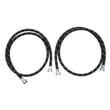
- Replace inlet hoses after 5 years of use and inspect for bulges, kinks, cuts, wear, or leaks
For the exact operating and maintenance steps for this model, follow the 11028102310 use & care manual and the 11028102310 installation instructions.
These issues tend to cause earlier breakdowns across top-load washers like the Kenmore 11028102310:
- Frequent overloading or washing single bulky items (more vibration and suspension wear)
- Too much detergent or non-HE detergent (excess suds, residue buildup)
- Poor leveling (increased “walking,” noise, and component stress)
- Ignoring small leaks (hose, clamp, pump area) until damage spreads
| Item to check | Suggested timing | Why it matters |
|---|---|---|
| Clean Washer cycle | About every 30 washes | Helps control residue and odors |
| Inlet hoses | Replace at 5 years | Reduces risk of hose failure and leaks |
| Leveling/feet stability | When vibration starts | Helps prevent wear from shaking |
If your 11028102310 is already showing repeated leaks, loud bearing noise, or chronic unbalanced loads, the cost of multiple repairs can add up. Good maintenance helps you get the most years out of the washer before major repairs become likely.
Last updated: January 2026