Owner’s manual
 Error Codes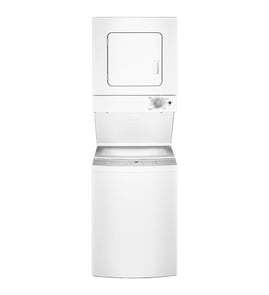


Can a Kenmore washer and dryer be stacked?
Yes, Kenmore washer and dryer units can be stacked, but only when they are designed to stack and installed using the correct stacking hardware. Your Kenmore 41794814301 is already a stacked laundry center (washer and dryer built into one vertical unit), so it is not meant to be “stacked” like a separate washer and dryer pair.
How stacking works (and when it does not)
Stacking applies to two separate appliances (a washer plus a dryer) that are engineered to mount together. A stacked laundry center like Kenmore 41794814301 is a single integrated cabinet, so there is no separate stacking kit step.
Use stacking only when:
- The washer and dryer are a matched, stackable pair
- The manufacturer specifies a compatible stacking kit for those exact models
- The dryer is secured to the washer using the kit brackets and hardware
- The installation location supports safe venting (for the dryer) and proper clearances
Do not stack when:
- The washer or dryer is not labeled as stackable
- You are mixing brands or unmatched model families
- The dryer would sit unsecured (no approved kit)
What to check for your Kenmore 41794814301
We recommend confirming the configuration and safety instructions in the 41794814301 owner's manual. This is also where you will find operating, care, and service guidance for the integrated washer and dryer.
| Setup type | What it means | What you need |
|---|---|---|
| Stacked laundry center (this model) | One combined vertical unit | Standard installation requirements (not a stacking kit) |
| Stackable laundry pair | Separate washer and dryer designed to mount together | Model-specific stacking kit and correct installation |
Why it matters
Using the wrong stacking method can lead to vibration, noise, cabinet damage, and unsafe operation. With a laundry center like Kenmore 41794814301, stability and alignment are built into the cabinet, so you get the space-saving design without the risks of an improvised stack.
Last updated: February 2026
What plugs do stackable washer and dryers use?
Most stacked laundry centers like Kenmore model 41794814301 use a standard 120V grounded plug for the washer section, while the dryer plug depends on whether the dryer is electric (typically a 240V 3-prong or 4-prong) or gas (typically a 120V grounded plug). Confirm your exact configuration in the 41794814301 owner's manual.
Common plug types you will see
The plug style is driven by dryer fuel type and home wiring, not just the fact that the unit is stackable.
- Washer (almost always): 120V, 3-prong grounded (NEMA 5-15)
- Electric dryer: 240V, usually 4-prong (NEMA 14-30) in newer installs
- Older electric dryer installs: 240V, 3-prong (NEMA 10-30)
- Gas dryer: 120V, 3-prong grounded (NEMA 5-15) for the motor and controls
- Do not use adapters as a permanent solution; match the cord to the outlet and appliance terminal block
Quick identification checklist
Use these fast checks before buying a cord.
- Look for a gas shutoff valve and flexible gas connector behind the unit (gas dryer)
- Check the wall outlet: large 240V receptacle usually means electric dryer
- Count prongs on the dryer outlet: 3 vs 4
- Verify the laundry center is plugged into a properly grounded outlet (the manual calls this out for safe operation)
- If the breaker trips or the unit will not start, check for loose plug connection and tripped breaker/fuse per the manual’s troubleshooting guidance
Plug and circuit comparison
| Appliance section | Typical voltage | Typical plug/outlet | Typical circuit |
|---|---|---|---|
| Washer | 120V | NEMA 5-15 | 15A or 20A |
| Electric dryer | 240V | NEMA 14-30 (common) | 30A |
| Gas dryer | 120V | NEMA 5-15 | 15A or 20A |
Why it matters
Using the correct plug and dedicated circuit helps prevent nuisance breaker trips, no-start conditions, and overheating. Your Kenmore laundry center’s care and troubleshooting sections also emphasize unplugging before cleaning and ensuring the plug fits tightly in the outlet for safe operation.
Last updated: February 2026
What model Kenmore washer do I have?
For Kenmore stacked laundry center model 41794814301, the model and serial number are located inside the dryer door opening on the rating label. Once you have that model number, we can match the correct Kenmore washer and dryer parts for your exact unit using the 41794814301 owner's manual.
Where to find the model number on 41794814301
On this Kenmore laundry center, the rating label is not on the washer lid or back panel like many standalone washers.
- Open the dryer door (top section)
- Look inside the dryer door opening for a sticker or metal plate
- Record both the model number and serial number
- Keep the numbers for parts lookup and service
What the model number looks like (and why it matters)
Kenmore model numbers are typically a long numeric string. For this unit, the model number format matches 41794814301.
Quick ID guide
| What you see on the label | What it tells you |
|---|---|
| Model number (example: 41794814301) | The exact laundry center version for correct parts |
| Serial number | Production run details used for service and compatibility |
| Purchase date (if you wrote it down) | Helps with maintenance timing and troubleshooting |
Tips to avoid ordering the wrong part
Even one digit off can point to a different Kenmore 417-series design.
- Match every digit of the model number exactly
- Use the model number when selecting common wear items like a belt or drain pump
- If you are fixing dryer noise or rubbing, confirm the dryer section parts (for example, the dryer drum bearing 131825900) match your model
Why it matters
Kenmore laundry centers combine a washer and dryer in one cabinet, so parts fitment depends heavily on the exact model and serial range. Using the correct model number helps ensure the right timer, motor, drain pump, belt, and dryer drum support components.
Last updated: February 2026
How many cubic feet is a Kenmore 300 series washer?
Kenmore “300 series” washers come in several designs, so cubic-foot capacity depends on the exact model number. For the Kenmore stacked laundry center model 41794814301, the capacity is listed in the 41794814301 owner's manual; use the model and serial tag inside the dryer door to match specs to your unit.
How to find the correct capacity for your Kenmore 300 series
Because “300 series” is a series name (not a single model), we recommend confirming capacity by model number first.
- Open the dryer door on your laundry center and locate the model/serial label.
- Write down the full model number exactly as shown (for example, 41794814301).
- Check the specifications section in the 41794814301 owner's manual.
- If you are shopping for a replacement unit, compare capacity and tub size, not just series name.
- If you are troubleshooting performance, load size and water level selection matter as much as capacity.
Typical capacity ranges (helpful for comparison shopping)
Most Kenmore top-load washers commonly fall into these ranges:
| Washer type | Typical capacity range | What it’s best for |
|---|---|---|
| Compact top-load | 2.0 to 3.0 cu. ft. | Small loads, tight spaces |
| Standard top-load | 3.5 to 4.3 cu. ft. | Everyday family laundry |
| Large-capacity top-load | 4.4 to 5.5 cu. ft. | Bulky items, fewer loads |
Why it matters
Capacity affects how much you can wash per load, but it also impacts cleaning and spinning. Overloading can reduce wash action and cause poor spinning; our manual guidance for this laundry center emphasizes proper load size and water level selection for best results.
Last updated: February 2026
Why is my Kenmore dryer not spinning?
If the dryer in your Kenmore 41794814301 stacked laundry center runs but the drum will not turn, the most common causes are a broken drive belt, a failed drum bearing or glide, or a motor issue. Start with simple checks, then inspect the drum support parts.
Quick checks first (no disassembly)
- Confirm the door fully closes and latches; a door switch issue can stop operation.
- Try a different cycle and press Start firmly.
- If the unit hums but will not tumble, stop it right away to prevent motor overheating.
- If the drum turns by hand with very little resistance, the belt is often broken.
- If you hear scraping, squealing, or grinding, the drum bearing or glides are usually worn.
Parts that commonly stop the drum from turning
These are the most frequent spin and tumble related failures on this model family.
| Symptom | Most likely cause | What you typically notice |
|---|---|---|
| Drum will not move, motor runs/hums | Drive belt problem | Drum turns freely by hand, no tumbling |
| Loud squeal or grind while tumbling | Drum bearing or support | Noise gets worse as load size increases |
| Thumping, rubbing at front | Drum glide or felt wear | Marks on clothes, uneven drum support |
| Starts then stops | Motor overheating or drag | Works again after a cool-down period |
Model-matched parts we often replace for this issue include the belt 134511600, dryer drum bearing 131825900, and dryer drum glide 137513300.
Why it matters
A dryer that will not spin usually means the drum is not supported correctly or the belt is not driving it. Continuing to run it can overheat the motor and increase wear on the drum support shaft and bearing bracket.
What we recommend next
- Use the 41794814301 owner's manual to confirm basic operating checks and safety steps.
- If the drum is hard to turn by hand, inspect for a seized bearing or damaged glide.
- If the drum spins freely by hand, inspect the belt for breaks or slipping.
- If you find heavy drag or burning smell, stop and check for binding drum support parts.
Last updated: February 2026
How to remove Kenmore dryer front panel?
To remove the dryer front panel on Kenmore stacked laundry center model 41794814301, we disconnect power first, then release the top, remove the door-opening and upper front-panel screws, and lift the panel off the lower tabs. Use the 41794814301 owner's manual for the exact screw locations and wire-routing.
Before you start (safety and prep)
- Unplug the laundry center or switch off the breaker.
- Let the dryer cool completely.
- Wear cut-resistant gloves; cabinet edges are sharp.
- Keep a cup or tray for screws.
- Take a quick photo of any wire connectors before you unplug them.
Typical front panel removal steps
- Open the dryer door and remove screws around the door opening that secure the front panel.
- Release and lift the top panel: many Kenmore 417-series units use spring clips near the front corners; slide a putty knife under the front edge to pop the clips.
- Remove the upper screws along the top edge of the front panel (now accessible with the top raised).
- Disconnect wiring attached to the front panel (commonly the door switch harness) and move it aside.
- Lift the front panel up to clear the lower retaining tabs, then pull the panel forward and off.
If you are removing the panel to fix drum noise
Front-panel removal is often the first step to inspect the drum support parts. These are separate components, not one “kit” on this model.
| Symptom after opening the cabinet | What to inspect | Example part for this model |
|---|---|---|
| Squealing, scraping, thumping | Front glides and bearing surfaces | Dryer drum glide 137513300 |
| Rumbling or rear support wear | Rear bearing and support hardware | Dryer drum bearing 131825900 |
| Excess play at rear support point | Support shaft and bracket alignment | Dryer drum support shaft 5303281153 |
Why it matters
Removing the front panel the right way prevents bent cabinet rails, broken clips, and pinched wiring. It also gives safe access to lint buildup areas that affect airflow, drying time, and overheating risk.
Last updated: February 2026
Is Kenmore Elite high end?
Yes. Kenmore Elite is Kenmore’s higher-end line; it typically includes more premium features, upgraded controls, and higher price points than standard Kenmore models. Your Kenmore stacked laundry center model 41794814301 is identified by its model number for parts and service, regardless of whether a product is marketed as “Elite.”
What “Kenmore Elite” means in practice
Kenmore Elite generally sits above base and mid-tier Kenmore offerings.
- More cycle and option selections (varies by appliance type)
- More sensors and electronic controls on some models
- Higher-capacity or higher-output configurations in some categories
- More premium styling and control layouts
- Higher typical purchase price than non-Elite Kenmore
What to use for parts and repairs on model 41794814301
For ordering parts and troubleshooting, the model number and symptom matter most.
- Match the full model number: 41794814301
- Use the parts diagram callouts and part IDs for exact fit
- Use the symptom (won’t drain, won’t heat, won’t start) to narrow likely causes
- Check operating and safety details before disassembly
| What to match | Why it matters | Example for this laundry center |
|---|---|---|
| Model number | Ensures correct fit and diagrams | 41794814301 |
| Part ID | Identifies the exact replacement | Washer drain pump 137221600 |
| Error code or symptom | Speeds diagnosis | Kenmore 417 laundry center -washer error codes |
Why it matters
“Elite” is a marketing tier; it does not determine part compatibility. For your Kenmore 41794814301, always match the model number and confirm procedures and safety steps in the 41794814301 owner's manual.
Last updated: February 2026