 Owner’s manual
 Error Codes



How to lower wheels on Kenmore refrigerator?
To lower the front wheels (rollers) on your Kenmore 59672212200 bottom-mount refrigerator, turn the left and right roller adjustment screws counterclockwise. The screws do not come out; they simply raise or lower the front of the refrigerator. See the leveling steps in the owner's manual.
- If the refrigerator has an ice maker water line, connect the water supply first, then level.
- Pull off the toe grille and any bottom bracket cover(s) to access the adjustment screws.
- Use a 3/8-inch hex head driver (no power tools).
- Turn the left and right roller adjustment screws counterclockwise to lower the front.
- Recheck level side-to-side; adjust each side as needed.
- Turn the stabilizing leg clockwise until it is firmly against the floor.
- Reinstall the toe grille and bracket cover(s).
Most bottom-mount refrigerators level best when the front is slightly higher than the back so the doors self-close.
| Check | What you want | Why it matters |
|---|---|---|
| Side-to-side | Cabinet level | Prevents door swing and uneven sealing |
| Front-to-back | Front about 1/4 inch higher (about 1/2 bubble) | Helps doors close and reduces warm air leaks |
| Stabilizing legs | Firm contact with floor | Reduces rocking and vibration |
Correctly lowering or raising the front rollers on model 59672212200 helps the door gaskets seal, keeps temperatures stable, and reduces issues like moisture buildup, frost, and compressor run time.
Last updated: February 2026
How to tell if a Kenmore refrigerator compressor is bad?
If your Kenmore 59672212200 refrigerator isn’t cooling and you hear repeated clicking, buzzing, or a brief hum followed by shutdown, the compressor may be failing to start or may be tripping its overload. First rule out normal operating sounds and basic power and control issues using the owner's manual.
- Refrigerator and freezer are warm but interior lights work
- You hear a click when the unit tries to start, then it goes quiet (repeats every few minutes)
- Compressor is very hot to the touch or you hear a loud, unusual hum
- Fans may run, but cooling does not improve
- Unit seems to “try” to start, then stops (overload protection behavior)
These checks catch the most common look-alikes:
- Confirm power: Make sure the cord is fully seated and the breaker is not tripped.
- Verify controls: Ensure temperature controls are set correctly (not turned off or set too warm).
- Allow for defrost: If the refrigerator is in a defrost cycle, the compressor can be off temporarily; waiting about 40 minutes can confirm it restarts.
- Listen for normal sounds: Clicking at start/stop and fan airflow noises can be normal during operation.
- Clean airflow path: Dirty condenser coils can cause poor cooling and longer run times.
| What you notice | Most likely cause | What it means |
|---|---|---|
| Clicks when starting/stopping | Normal operation | Not a failure by itself |
| Fans run, no cooling, repeated click | Start device/overload issue or compressor not starting | Needs electrical diagnosis |
| Compressor runs but cooling is weak | Sealed system or airflow issue | Check coils, fans, frost pattern |
| Loud humming, then shutdown | Overload tripping | Often start components or compressor |
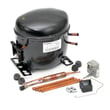
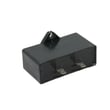
A compressor diagnosis is electrical and sealed-system related; it typically involves checking the start components and measuring compressor windings and current draw. If testing confirms a failed compressor or start circuit, the model-specific replacement is the refrigerator compressor W10160407.
A compressor that cannot start or cannot pump refrigerant will leave both compartments warm and can mimic other problems (controls, defrost, airflow). Using the manual’s normal-sound chart and basic checks helps you avoid replacing expensive sealed-system parts unnecessarily.
Last updated: February 2026
How to tell what model Kenmore refrigerator?
For your Kenmore refrigerator, the most reliable way to identify the model is to read the model and serial number sticker inside the fresh food (refrigerator) section. On Kenmore model 59672212200, that sticker is located on the left wall of the refrigerator compartment; confirm it against your paperwork in the owner's manual.
Check these common model tag locations (start with the first one):
- Left wall inside the refrigerator section (most common for this model)
- Side wall near the crisper drawers
- Ceiling of the fresh food compartment
- Behind the lower kick plate or toe grille
- On the cabinet frame near the door hinge area (door open)
Kenmore model numbers are usually a long string of numbers (sometimes with a prefix). For parts lookup, use the full model number exactly as printed, including any leading digits.
| What you see | What to do | Why it helps |
|---|---|---|
| Model number | Use it to match parts diagrams and compatible replacement parts | Prevents ordering the wrong shelf, switch, or ice maker |
| Serial number | Keep it for service history and age reference | Helps track production run details |
| Purchase date | Record it with the model and serial | Useful for maintenance planning |
The model number is the key to getting the right Kenmore refrigerator parts and instructions. Even small design changes between similar-looking refrigerators can affect fitment for items like an ice maker, light bulb, or door hardware.
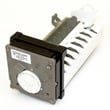
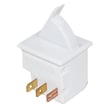
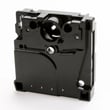
Once you confirm the model number, match parts by description and ID. For example, this model has an available refrigerator ice maker D7824706Q and refrigerator switch W11396033; using the exact model number helps ensure compatibility.
Last updated: February 2026
What are the most common problems with Kenmore refrigerators?
Common problems we see with Kenmore refrigerators (including model 59672212200) are weak or no cooling, water leaks, ice maker issues, excess frost, and unusual noises. Many of these trace back to dirty condenser coils, doors not sealing, blocked airflow, or normal operating sounds described in the owner's manual.
- Not cooling or warm temperatures: dirty condenser coils, blocked rear air grille/vents, doors opened often, controls set incorrectly
- Runs too often: high room heat/humidity, dirty coils, door not closing or sealing
- Water droplets inside or outside: high humidity, frequent door openings, gasket not sealing
- Water leak: water line connection issues (plastic tubing is less durable than copper), drain or ice maker fill problems
- Noisy operation: fan airflow, refrigerant movement, defrost timer and control clicks (often normal)
- Confirm doors seal and close fully; look for bins/drawers preventing closure.
- Clean the condenser coils; the manual recommends cleaning about every 3 months for efficiency and cooling performance.
- Check airflow; avoid blocking vents and the rear air grille with food packages.
- Adjust temperature controls and give recently added food time to cool.
- Listen for “normal” sounds (clicking, whirring, gurgling) that can be part of normal operation.
| Symptom | Most likely cause | What to do next |
|---|---|---|
| Fridge too warm | Dirty coils, blocked airflow, door not sealing | Clean coils; clear vents; check gasket seal and leveling |
| Runs constantly | Heat/humidity, dirty coils, door not closing | Improve ventilation; clean coils; check door alignment |
| Water droplets | High humidity, frequent openings | Reduce door openings; verify gasket seal |
| Ice maker not working | Ice maker module or ejector issue | Inspect ice maker; consider replacing refrigerator ice maker D7824706Q or refrigerator ice ejector WP627843 |
These issues affect food safety, energy use, and compressor workload. Keeping coils clean and doors sealing properly helps your Kenmore 59672212200 cool consistently and run more efficiently.
Last updated: February 2026





