Owner’s manual
 Error Codes


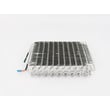
Does KitchenAid replace broken parts?
Yes. For a KitchenAid KSBS25FKBL01 refrigerator, KitchenAid warranty coverage can include replacement parts (and sometimes repair labor) for defects in materials or workmanship, depending on the part and how long you have owned the refrigerator. For non-warranty issues, you can still replace failed components using factory specified parts listed for this model.
What’s typically covered (and what isn’t)
KitchenAid’s warranty for this refrigerator type commonly separates coverage by part group and time since purchase.
- Years 2 through 5: cavity liner and sealed refrigeration system parts can be covered for defects (with repair labor included for sealed system defects when service is performed by a designated servicer).
- Years 6 through 10: sealed refrigeration system parts can be covered for defects (parts coverage).
- Lifetime (limited): certain door bins and can racks can be covered for defects.
- Not typically covered: routine items like replacement water filters and light bulbs.
| Part or system | Typical warranty category | Examples |
|---|---|---|
| Sealed refrigeration system | Multi-year coverage (varies by year) | Compressor, evaporator, condenser, dryer, connecting tubing |
| Wear and maintenance items | Usually not covered | Water filter, light bulbs |
| Storage components | Limited lifetime coverage (select items) | Door bins, can racks (model-specific design) |
What to do if a part breaks on KSBS25FKBL01
We recommend these steps before you buy anything:
- Check the troubleshooting section in the owner's manual first.
- Confirm your purchase date and your refrigerator’s model and serial number.
- Identify whether the failed item is a sealed system component (compressor, evaporator, condenser, dryer, tubing) or a serviceable part.
- If you’re doing a DIY repair, use factory specified replacement parts for best fit and performance.
Common replacement parts customers order for this model
If the issue is not warranty-related, these are common parts customers replace on KSBS25FKBL01:
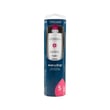
- Refrigerator water filter EDR5RXD1 for taste, odor, and flow issues
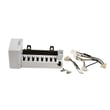
- Ice maker assembly 4317943 for no-ice or small/irregular cubes
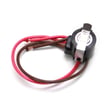
- Refrigerator thermistor WP2188820 for temperature-sensing problems
Why it matters
Using the correct model-specific part helps prevent leaks, poor cooling, and repeat failures. It also keeps troubleshooting focused, especially on a side-by-side refrigerator where ice maker and water dispenser issues can overlap.
Last updated: February 2026
How do I contact KitchenAid about parts?
For your KitchenAid KSBS25FKBL01 side-by-side refrigerator, use the parts list for this model to find factory-specified replacement parts, or contact Sears PartsDirect support for help identifying the correct part. Have your model and serial number ready.
What to have ready before you reach out
Having the right details speeds up parts identification and avoids ordering the wrong component.
- Complete model number: KSBS25FKBL01
- Serial number (from the label inside the refrigerator compartment)
- Purchase date (or installation date)
- A short description of the issue (water dispenser, ice maker, cooling, etc.)
- Any part name you suspect (water filter, ice maker assembly, thermistor)
Where to find the model and serial number
On this model, the model and serial label is typically located on the inside wall of the refrigerator compartment. Check that label and write the numbers down before ordering parts or requesting help. See the KSBS25FKBL01 owner's manual.
Ordering parts without calling
If you already know what you need, you can order replacement parts for KSBS25FKBL01 directly from the parts list for this model. Common examples include the refrigerator water filter EDR5RXD1 and the ice maker assembly 4317943.
Quick examples (from this model’s parts list)
| Need | Example part to look up | What it affects |
|---|---|---|
| Better tasting water, slow dispensing | Refrigerator water filter (EDR5RXD1) | Water quality and flow |
| No ice, small cubes, intermittent ice | Ice maker assembly (4317943) | Ice production |
Why it matters
KitchenAid refrigerators like KSBS25FKBL01 work best with correctly matched parts; the right fit helps prevent leaks, poor cooling, and repeat repairs.
Last updated: March 2026
How to clean coils on KitchenAid side by side refrigerator?
On your KitchenAid KSBS25FKBL01 side-by-side refrigerator, we clean the condenser coils by removing the base grille, vacuuming dust from the grille and the open area behind it with a soft brush attachment, then reinstalling the grille and restoring power. Use the steps in the owner's manual.
Steps to clean the condenser coils
- Unplug the refrigerator (or disconnect power at the breaker).
- Pull the refrigerator straight out if you need more access; protect the floor.
- Remove the base grille (the kick plate at the bottom front).
- Vacuum the grille, the open areas behind the grille, and the front face of the condenser using a soft brush.
- Reinstall the base grille.
- Plug the refrigerator back in.
How often should we clean the coils?
In normal home conditions, routine condenser cleaning is not needed. If your home is dusty, greasy (near cooking), or you have pets, clean the condenser about every 2 to 3 months.
What to use (and what to avoid)
| Item | Recommended? | Why |
|---|---|---|
| Vacuum with soft brush | Yes | Removes dust without bending fins |
| Coil brush (soft) | Yes | Helps loosen packed lint |
| Compressed air | Sometimes | Can blow dust deeper if used aggressively |
| Water or wet cleaning | No | Risk of electrical damage and mess |
Why it matters
Dirty condenser coils make the refrigerator work harder, which can cause warmer temperatures, longer run times, and reduced efficiency. Keeping airflow clear helps the sealed system reject heat properly.
Last updated: February 2026
What is the most common problem with KitchenAid refrigerators?
The most common problems we see on KitchenAid refrigerators like model KSBS25FKBL01 are ice maker and water dispenser issues, followed closely by cooling and temperature-control problems. These often trace back to airflow (dirty condenser coils, a failing evaporator fan) or water supply and filtration restrictions.
Most common symptoms (and what they usually point to)
- Ice maker not making ice or slow ice: restricted water flow, a clogged filter, or an ice maker fault
- Water dispenser slow or stops: filter restriction, air in the water line, or a dispenser switch issue
- Fridge warm but freezer cold (or uneven temps): evaporator fan or airflow/damper problems
- Frost buildup on the back wall or poor cooling after a few days: defrost system trouble
- Puddles or water under the refrigerator: defrost drain issues or water line leaks
Quick checks we recommend first
- Confirm water supply is in range: this model’s water system is designed for 30 to 120 psig water pressure (typical household range). See the owner's manual.
- Replace the water filter on schedule: a restricted filter is one of the fastest ways to cause weak dispensing and ice maker fill problems. Use the refrigerator water filter EDR5RXD1.
- Clean condenser coils: dirty coils commonly cause warm temperatures and longer run times.
- Listen for the evaporator fan: if the freezer fan is noisy or not running, cooling performance drops.
- Check the dispenser lever and switch feel: a sticky lever or failed switch can stop dispensing.
Common problem areas and matching parts
| Problem area | What you notice | Parts that often apply on KSBS25FKBL01 |
|---|---|---|
| Water filtration | Slow water, small/slow ice cubes | Refrigerator water filter (EDR5RXD1) |
| Ice production | No ice, intermittent ice | Ice maker assembly (4317943) |
| Defrost control | Frost, warm temps, blocked airflow | Defrost bi-metal (WPW10225581) |
| Dispenser controls | No water/ice when pressed | Dispenser switch (WP2162361) |
Why it matters
Ice maker, water, and cooling complaints are often connected. A restricted filter or weak water supply can reduce ice production, while airflow or defrost problems can cause temperature swings that melt and refreeze ice, jam the chute, or create frost that blocks circulation.
Last updated: February 2026