Owner’s manual
 Error Codes



Are top mount or bottom mount fridges better?
Bottom-mount refrigerators like the Maytag MFF2557HEW are usually “better” for everyday convenience because fresh food sits at eye level, but top-mount models are often simpler and can use less energy. The best choice depends on how you shop, cook, and what you access most.
Quick comparison
| Feature | Top mount (freezer on top) | Bottom mount (freezer on bottom) |
|---|---|---|
| Fresh food access | Lower, more bending | Higher, less bending |
| Freezer access | Easy reach | More bending or drawer pull-out |
| Typical efficiency | Often slightly better | Often slightly lower |
| Storage style | Shelves plus top freezer | Freezer drawer/baskets |
| Repair complexity | Often simpler | Can be more complex (drawers, rails) |
How to decide for your kitchen
- Choose bottom mount if you use the refrigerator section most and want less bending for daily items.
- Choose top mount if you want a simpler layout and typically prioritize efficiency and value.
- Measure your opening and plan clearances; most installations need about 1/2 inch at the top and 1/2 inch behind for airflow.
- Avoid installing where temperatures drop below 55°F or rise above 110°F, since performance issues can occur.
- If you must move the unit, keep it upright; if it was laid on its back, let it sit upright about 30 minutes before plugging in.
For model-specific installation and clearance guidance, follow the MFF2557HEW owner's manual.
Why it matters
Choosing the right mount style affects daily ergonomics, food visibility (which reduces waste), and long-term operating cost. Installation clearances and room temperature also directly impact cooling performance and compressor run time.
Last updated: January 2026
What is the average lifespan of a Maytag refrigerator?
Most Maytag refrigerators, including the Maytag MFF2557HEW bottom-mount refrigerator, typically last 12 to 15 years with normal household use and basic maintenance. Keeping airflow clear, cleaning the condenser area, and fixing door-seal leaks early are the biggest factors that help a refrigerator reach its full service life.
What affects lifespan the most
- Condenser cleanliness and airflow: Dust buildup and blocked ventilation make the compressor run hotter and longer.
- Door gasket condition: Leaks cause long run times, frost issues, and temperature swings.
- Ice maker and water system upkeep: Mineral buildup and low water pressure can create repeated service issues.
- Temperature settings and loading: Overpacking restricts air circulation; warm food loads increase run time.
- Power quality: Frequent outages or surges can stress the control board and compressor start components.
Typical lifespan by major component
| Component | Typical service life | What you notice when it’s failing |
|---|---|---|
| Compressor | 10 to 20 years | Warm temps, long run times, clicking, not cooling |
| Electronic control board | 8 to 15 years | Erratic temps, defrost problems, fans not running |
| Door gasket | 5 to 10 years | Moisture, frost, warm spots at door edge |
| Ice maker | 5 to 10 years | No ice, small cubes, leaking, jammed harvest |
Maintenance steps that extend life
- Vacuum dust from the condenser area and keep clearance around the cabinet for ventilation.
- Check for gasket leaks using the paper test; replace the gasket if it will not hold a sheet of paper snugly.
- Keep fresh food around 37°F and freezer around 0°F (common targets for food safety and performance).
- If you have slow ice production, confirm the shutoff arm is down and the water supply valve is fully open.
- Follow the filter replacement schedule for your model’s water system; see MFF2557HEW owner's manual.
Why it matters
A refrigerator that is running longer than normal to hold temperature uses more electricity and puts extra wear on the compressor, control board, and defrost system. Simple maintenance and quick repairs often add years to the life of a Maytag bottom-mount refrigerator.
Last updated: January 2026
How to lower wheels on Maytag refrigerator?
On the Maytag MFF2557HEW bottom-mount refrigerator, you lower the front by turning the front adjustment screws with a 5/16-inch hex head driver; you then set the stabilizing legs down to the floor so the cabinet is supported and the doors close correctly. See the leveling steps in the MFF2557HEW owner's manual.
Steps to lower the front (and level it correctly)
- Unplug the refrigerator for safety.
- Remove the toe grille (grasp firmly and pull outward to unclip).
- Remove the bottom hinge cover(s) if they block access to the adjusters.
- Use a 5/16-inch hex head driver to turn the front adjustment screws (A) on each side to raise or lower the front.
- If your unit has them, turn the rear adjustment screws (B) to raise or lower the rear.
- Use a carpenter’s level and set the cabinet so the front is about 1/4 inch (6 mm) higher than the back, and level side-to-side.
- Turn the stabilizing legs (C) clockwise until they are firmly against the floor.
- Turn the front adjustment screws (A) counterclockwise so the refrigerator’s weight rests on the stabilizing legs.
- Reinstall the hinge cover(s) and toe grille.
Quick reference: what each adjuster does
| Adjuster | What it changes | What you use |
|---|---|---|
| Front adjustment screws (A) | Raises/lowers the front | 5/16-inch hex head driver |
| Rear adjustment screws (B) (some models) | Raises/lowers the rear | 5/16-inch hex head driver |
| Stabilizing legs (C) | Locks cabinet to floor (reduces rocking) | Hand or wrench as needed |
Why it matters
Proper leveling helps the doors self-close, reduces vibration noise, and keeps the sealed system and ice maker operating more consistently.
If the refrigerator still rocks after lowering
- Confirm the toe grille is fully removed so you can reach both sides evenly.
- Make sure both stabilizing legs (C) are firmly on the floor.
- Recheck that the cabinet is level side-to-side.
- Inspect the floor for dips; a thin, solid shim under a stabilizing leg can help.
Last updated: January 2026
What is the most common problem with Maytag refrigerators?
For the Maytag MFF2557HEW refrigerator, the most common problems we see are cooling complaints (not cold enough or running too often) and ice maker or water flow issues. In many cases, the fix starts with airflow and sealing basics: dirty condenser coils, doors not closing tightly, or a clogged water filter. See the MFF2557HEW owner's manual for the model’s troubleshooting steps and control settings.
Most common symptoms and what usually causes them
- Refrigerator runs too frequently: warm room, frequent door openings, recently added food, or dirty condenser coils
- Fresh food section warm but freezer OK: restricted airflow, damper issue, or evaporator fan problem
- Ice maker not making ice: water supply issue, frozen fill tube, or ice maker failure
- Water flow slower than normal: clogged filter or low water pressure
- Door not sealing: dirty gasket, misleveling, or drawers/containers blocking closure
Quick checks we recommend first (fast, high-impact)
- Confirm temperatures and settings: adjust controls and allow time to stabilize after changes.
- Clean condenser coils: dirty coils commonly cause long run times and weak cooling.
- Check door closing and gasket seal: look for gaps, food packages, or drawers preventing closure.
- Reduce door-open time and overcrowding: poor air circulation makes the unit run longer.
- For ice and water issues: verify water pressure, look for kinks in copper tubing, and replace a clogged filter.
Common problem areas and related parts for MFF2557HEW
| Problem area | What you may notice | Example model-matched part |
|---|---|---|
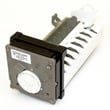
| Ice maker system | No ice, small cubes, slow production | Refrigerator ice maker D7824706Q |
| Airflow control | Warm fridge section, uneven temps | Refrigerator electronic damper WPW10196393 |
| Temperature sensing | Temps swing, cooling seems inconsistent | Refrigerator temperature sensor 12002355 |
| Door sealing | Moisture, warm spots, long run times | Refrigerator door gasket W11368721 |
Why it matters
Cooling and ice maker complaints often trace back to airflow, sealing, and heat removal. When coils are dirty or doors leak air, the compressor runs longer, temperatures drift, and ice production drops.
Last updated: January 2026