Owner’s manual
 Error Codes




How many cubic feet is my Kenmore refrigerator model 79579042313?
Your Kenmore Elite bottom-mount refrigerator model 79579042313 is covered by a Use & Care Guide that applies to the 795.7902* and 795.7904* series; the exact cubic-foot capacity is printed on your refrigerator’s rating label. Use the 79579042313 owner's manual to locate the label and confirm the capacity for your specific unit.
The rating label lists the official capacity (often shown as “Total capacity” in cu. ft.).
- Open the fresh food (refrigerator) compartment.
- Look on a side wall near the crisper drawers, or near the ceiling light area.
- Find “Total capacity” or “Capacity” followed by cu. ft.
- Write down the full model number and serial number from the same label.
- Use that information when ordering shelves, bins, or cooling parts.
The manual for this model family focuses on operation, installation clearances, and troubleshooting; capacity is typically confirmed from the rating label.
| Source | What you get | Best for |
|---|---|---|
| Rating label inside the refrigerator | Exact total cubic feet | Confirming capacity for your exact unit |
| 79579042313 owner's manual | Model family coverage (795.7902*/795.7904*) and label location guidance | Verifying you are using the correct guide |
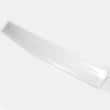
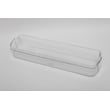
Cubic-foot capacity affects how much usable storage you have and helps us match correct-fit storage components and accessories. It also helps when comparing replacement parts such as a refrigerator door bin MAN62749601 across similar Kenmore Elite configurations.
Last updated: February 2026
How to tell if a Kenmore refrigerator compressor is bad?
On the Kenmore Elite refrigerator model 79579042313, a “bad compressor” usually shows up as poor cooling with long run times, repeated clicking or overheating, or the unit tripping a breaker. Before condemning the compressor, we verify basics like airflow, door sealing, and condenser cleanliness using the 79579042313 owner's manual.
Look for a pattern of symptoms (not just one):
- Refrigerator and freezer temperatures stay warm even after 24 hours of continuous operation
- Compressor area is very hot and the refrigerator still does not cool
- Repeated clicking as the compressor tries to start, then stops
- Breaker or fuse trips when the compressor attempts to run (115V, 15 or 20A circuit)
- You do not hear normal airflow sounds from the fans while cooling is demanded
Your manual notes several conditions that make a healthy compressor run longer, especially after power loss, frequent door openings, adding warm food, or warm room temperatures (normal at 70°F is often 40% to 80% run time). It also calls out a clogged condenser cover/vents as a common cooling issue.
- Wait a full 24 hours after plugging in or restoring power
- Confirm doors close fully and nothing blocks bins or drawers
- Clean condenser cover and vents with a vacuum attachment (do not remove the condenser panel)
- Check room temperature is within 55°F to 110°F
- Listen for “normal operation” noises (whooshing, gurgling, occasional clicking)
If cooling is still poor after the basics:
| What you check | What it suggests |
|---|---|
| Condenser fan running when compressor runs | If not, airflow issue can mimic compressor failure |
| Evaporator fan sound (“whooshing”) | No airflow can cause warm temps even with a good compressor |
| Start/overload components condition | A failed protector can prevent compressor start |
If the compressor is not starting reliably, the overload protector is a common related part to inspect or replace before moving to a sealed-system repair. For this model, see the refrigerator compressor overload protector 6750CL0001D.
Compressors are expensive and sealed-system work often requires specialized tools. Ruling out airflow, temperature settings, and start components first prevents unnecessary part replacement and gets you back to stable refrigerator temperatures faster.
Last updated: February 2026
What are the common problems with Kenmore Elite refrigerators?
Common problems on the Kenmore Elite 79579042313 bottom-mount refrigerator include not cooling or running warm (often from blocked air vents, frequent door openings, or a defrost cycle), ice maker not producing ice until the freezer is cold enough, and doors not closing correctly due to loading or leveling issues. Use the 79579042313 owner's manual troubleshooting section to match symptoms to the right fix.
- Refrigerator or freezer not cooling after a move or install (allow up to 24 hours to stabilize)
- Refrigerator or freezer too warm from blocked vents or frequent door openings
- Food freezing in the fresh food section from items placed near an air vent or a control set too cold
- Ice maker not making ice because the freezer is not at 15°F (-9°C) or below
- Doors popping open or not closing because bins, shelves, or food packages are out of position
- Confirm it is not in demo mode (demo mode runs lights and display but disables cooling).
- Wait out a defrost cycle; temperatures can rise briefly, then recover.
- Check airflow; make sure vents are not blocked by food containers.
- Reduce door-open time; warm, humid air quickly raises compartment temps.
- Verify room temperature; this model is designed to operate in roughly 55°F to 110°F ambient conditions.
If the quick checks do not resolve the issue, these parts are frequently involved in cooling, ice, and temperature complaints:
| Symptom | Common area to inspect | Example part for this model |
|---|---|---|
| Warm temps, poor airflow | Evaporator area | Refrigerator evaporator fan motor EAU65058315 |
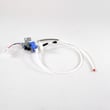
| Ice maker not filling or no ice | Water supply/valve | Lg refrigerator water inlet valve AJU73753101 |
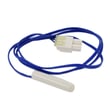
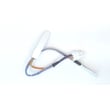
| Frost buildup, temp swings | Defrost sensing | Refrigerator defrost sensor assembly 6615JB2005N |
Cooling and ice maker complaints often come from airflow, door sealing, or control settings, not just a failed compressor. Doing the basic checks first prevents unnecessary part replacement and helps you pinpoint whether the issue is temperature control, airflow, or water supply.
Last updated: February 2026
What does DH mean on Kenmore Elite refrigerator?
On the Kenmore Elite refrigerator model 79579042313, DH indicates a defrost heater (defrost heating) problem. The refrigerator is detecting that the defrost system is not warming the evaporator as expected, which can lead to frost buildup and poor cooling if it continues.
- Power reset: unplug the refrigerator (or turn off the breaker) for 5 minutes, then restore power.
- Look for symptoms: heavy frost on the freezer back wall, warmer-than-normal fresh food section, or reduced airflow.
- Confirm doors seal well and close fully; warm air leaks can worsen frost and trigger defrost issues.
- Make sure vents are not blocked by food packages.
- If the unit is not cooling normally, move perishables to a safe location.
A DH condition is typically caused by one of these issues:
- Failed defrost heater circuit (heater not heating)
- Failed defrost sensor/thermistor reading incorrectly
- Wiring/connector problem in the defrost circuit
- Control not driving defrost properly
If you are comfortable using a meter, follow the diagnostic and troubleshooting steps in the 79579042313 owner's manual to identify the exact test points and access locations.
These parts are often involved when a defrost problem causes frost buildup or temperature swings:
| What you notice | Common area to inspect | Example part for this model |
|---|---|---|
| Frost buildup, fan noise changes, warming temps | Defrost sensing and evaporator area | Refrigerator defrost sensor assembly 6615JB2005N |
| Temps fluctuate or readings seem wrong | Temperature sensing | Refrigerator temperature sensor 6500JB2002X |
When the defrost heater system is not working, frost can blanket the evaporator coil and restrict airflow. That makes the refrigerator run longer, cool unevenly, and can eventually stop cooling effectively.
Last updated: February 2026
What is the average lifespan of a Kenmore Elite refrigerator?
Most Kenmore Elite refrigerators average 10 to 15 years of service life with normal household use. For your Kenmore Elite bottom-mount refrigerator model 79579042313, consistent maintenance (especially airflow and door sealing) is what most often determines whether you land closer to 10 years or closer to 15.
A refrigerator’s lifespan is mainly driven by compressor run time, heat removal efficiency, and how well the cabinet stays sealed.
- Condenser cleanliness: dusty coils make the compressor work harder
- Door gasket condition: air leaks cause longer run times and frost issues
- Ice maker and water system health: leaks or valve problems can create repeat failures
- Defrost performance: poor defrosting can restrict airflow and warm the fresh-food section
- Room conditions: hot garages and tight built-ins shorten life
We recommend these habits for Kenmore Elite bottom-freezer models like 79579042313:
- Vacuum condenser area and vents every 6 to 12 months
- Keep doors closing squarely; avoid overloading door bins
- Set temps to 37°F fresh food and 0°F freezer (typical targets)
- Replace clogged water filters on schedule (if equipped)
- Address frost buildup, unusual fan noise, or water under the unit quickly
Use this quick comparison when deciding what to do as the unit ages.
| If your refrigerator is… | Usually makes sense to… | Why |
|---|---|---|
| Under 8 years old | Repair | Major components often have useful life left |
| 10 to 15 years old | Compare costs | Multiple repairs can add up |
| Over 15 years old | Replace (often) | Efficiency and reliability typically drop |
Knowing the typical lifespan helps you plan for high-wear parts (ice maker, fans, sensors) and avoid food-loss events. For example, a failing water valve can cause no-ice complaints or leaks; the lg refrigerator water inlet valve AJU73753101 is one common component tied to water and ice performance.
Your 79579042313 owner’s manual includes model-family guidance for installation, water line connection, and troubleshooting steps that help prevent premature wear.
Last updated: February 2026
Where to find model number on Kenmore Elite fridge?
On Kenmore Elite model 79579042313, the model and serial number are printed on an identification label inside the fresh food (refrigerator) compartment, on the interior liner. We use that label to match the correct parts, diagrams, and service information in the 79579042313 owner's manual.
Look for a paper or silver rating label in one of these spots:
- Inside the refrigerator compartment on the side wall (interior liner)
- Near the crisper drawers (often on the wall above or beside them)
- Along the door opening frame (hinge side area)
- On the ceiling of the fresh food compartment (less common)
- On the back exterior panel (least common for day-to-day access)
Record both numbers exactly as shown; they are used for different things.
| Item on label | What it’s used for | Example format |
|---|---|---|
| Model number | Correct part fit and diagrams | 795.7904* style family, or full model like 79579042313 |
| Serial number | Production run details and service history | Letters and numbers |
- Use a flashlight; the label print can be small.
- Remove the crisper drawers if they block your view.
- Wipe condensation off the liner so the text is readable.
- Take a photo of the label so you can zoom in.
Kenmore Elite refrigerators often share similar styling across multiple 795.78** and 795.79** series models, but parts like the ice maker, water inlet valve, and sensors can vary by exact model and serial range. Using the label information prevents ordering the wrong replacement part.
Last updated: February 2026
Why is my Kenmore Elite refrigerator leaking water out of the bottom?
On Kenmore Elite refrigerator model 79579042313, water leaking from the bottom is most often caused by a defrost drain that is clogged and overflowing into the fresh food section, then running down to the floor. Less commonly, the leak comes from the water supply side (icemaker or dispenser) or a drain pan issue; use the 79579042313 owner's manual to locate access points and safety steps.
- Look for ice or standing water under the crisper drawers; this points to a defrost drain clog.
- Check the freezer floor for a sheet of ice; that also supports a drain restriction.
- Inspect the water line connections at the back of the refrigerator for drips.
- Watch for leaking only during icemaker fills; that points to a valve or tubing issue.
- Confirm the refrigerator is level; poor leveling can make water miss the drain pan.
During normal operation, water from defrosting is supposed to run through a drain to the drain pan. If the drain is blocked by ice or debris, water backs up and leaks out.
- Unplug the refrigerator.
- Remove items and drawers as needed to access the drain area.
- Melt any visible ice with warm air (hair dryer on low, kept moving) and flush the drain with warm water.
- Clear the drain tube if it is restricted; if the tube is damaged or won’t clear, replace it.
If you need the replacement part for this model, use the refrigerator drain tube 5251JA3003D.
If the leak happens when the icemaker cycles or you see moisture near the rear lower area, check the inlet valve and fittings.
| Symptom | Most likely area | What to check |
|---|---|---|
| Leak only during ice making | Water inlet valve or tubing | Loose fitting, cracked line, valve seepage |
| Constant slow drip | Valve not sealing | Replace valve if it seeps when idle |
For this model, the fill system component to consider is the lg refrigerator water inlet valve AJU73753101.
Leaks can lead to ice buildup, warm temperatures, and water damage around the refrigerator. Fixing a drain restriction early also helps prevent repeat freezing and overflow.
Last updated: February 2026
Why is my refrigerator not getting cold at the bottom?
If your Kenmore Elite refrigerator model 79579042313 is warmer at the bottom, the most common cause is restricted airflow (blocked vents or overpacked shelves) that keeps cold air from circulating down into the fresh-food compartment. Door-opening habits and recent installation can also make the lower area feel warm.
- Clear the air vents in the refrigerator and freezer; move food packages away from vent openings.
- Avoid overpacking; leave space along the back wall and between shelves for air circulation.
- Limit door openings; frequent or long openings let warm, humid air in and raise temperatures.
- Give it time after setup; after installation, cooling can take up to 24 hours to stabilize.
- Confirm room temperature; this model is designed to run in roughly 55°F to 110°F ambient conditions.
For the airflow diagram and control-setting details, use the 79579042313 owner's manual.
Bottom-mount refrigerators rely on fans and ducts to move cold air where it is needed. If vents are blocked, the top may cool while the bottom stays warm.
| Symptom | Most likely cause | What to do first |
|---|---|---|
| Bottom shelves warm, top OK | Blocked air vents or overpacked fridge | Clear vents, reorganize food |
| Whole fridge warm | Doors opened often, hot food load, recent install | Reduce openings, wait 24 hours |
| Some items freezing near vents | Food placed too close to vent | Move high-water-content foods away |
If airflow is clear and settings are correct but the bottom still will not cool, a failed fan, sensor, or defrost-related issue can prevent proper circulation.
Start with these common checks:
- Listen for the evaporator fan running (often heard when the door switch is pressed).
- Look for heavy frost on the freezer back panel (can indicate a defrost problem).
- Verify the temperature setting is not accidentally set too warm.
Parts that are often involved in cooling and airflow issues on this model include the refrigerator evaporator fan motor EAU65058315 and the refrigerator defrost sensor assembly 6615JB2005N.
Poor cooling at the bottom can push food into the unsafe temperature range and also forces the compressor to run longer, which increases wear and energy use.
Last updated: February 2026