Installation guide
 Owner’s manual
 Error Codes



How many cubic feet is my Frigidaire refrigerator?
Your Frigidaire FGUS2642LF1 refrigerator’s cubic-foot capacity is the total usable interior volume of the fresh food and freezer sections combined. To get an accurate number, we measure the interior width, height, and depth of each compartment, then convert cubic inches to cubic feet.
How to measure cubic feet (quick method)
Use a tape measure and measure inside the compartment, not the outside cabinet.
- Empty or move items so you can measure wall-to-wall
- Measure width (left wall to right wall)
- Measure height (floor to ceiling of the compartment)
- Measure depth (back wall to the inside front edge, not the door bins)
- Multiply:
width × height × depth = cubic inches - Convert to cubic feet:
cubic inches ÷ 1,728 = cubic feet
Measure each section separately (recommended)
Side-by-side models like the FGUS2642LF1 have two compartments; measure both and add them.
| Compartment | What to measure | Notes |
|---|---|---|
| Fresh food (refrigerator) | W × H × D | Exclude door bins for consistency |
| Freezer | W × H × D | Exclude ice bin space if it blocks depth |
Total capacity = (fresh food cubic feet) + (freezer cubic feet)
Tips to keep your measurement accurate
- Measure to the nearest 1/8 inch if possible
- Use the same “depth rule” for both sides (stop at the same front reference point)
- If shelves or drawers reduce usable space, measure the open cavity, then note that “usable” space may feel smaller
- For model-specific specs and layout diagrams, check the FGUS2642LF1 owner's manual
Why it matters
Knowing cubic feet helps us choose the right replacement parts and accessories (like bins and drawers), compare capacity to other refrigerators, and set realistic expectations for storage, airflow, and temperature stability.
Last updated: January 2026
What does EF stand for on a Frigidaire refrigerator?
On a Frigidaire FGUS2642LF1 refrigerator, EF commonly points to an evaporator fan circuit problem (often shown as SY EF or 5Y EF). The refrigerator may not circulate cold air correctly, so temperatures can rise even if the compressor is running.
What to check first (quick, safe steps)
- Power-cycle the refrigerator: unplug for 5 minutes, then plug back in.
- Listen for the evaporator fan: it should run when the unit is cooling (door switch held closed).
- Check for heavy frost on the freezer back panel (a sign of a defrost airflow restriction).
- Make sure vents are not blocked by food packages.
- Confirm the doors close and seal fully; warm air leaks can trigger airflow and fan-related symptoms.
Likely causes and what they mean
| What’s happening | What it usually points to | Common next step |
|---|---|---|
| No fan sound, warm freezer | Failed fan motor or seized blade | Inspect fan area; replace failed component |
| Fan runs but code returns | Wiring issue or control not sensing fan feedback | Check harness connections; test components |
| Frost buildup, weak airflow | Defrost problem (heater/thermostat/control) | Defrost diagnosis and part testing |
| Intermittent cooling | Loose connector or failing control board | Reseat connectors; evaluate control |
Parts that are often involved
If troubleshooting confirms a fan or defrost-related failure, these model-compatible parts are commonly involved:
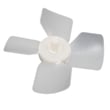
- Refrigerator evaporator fan blade 5308000010 (damaged or slipping blade can reduce airflow)
- Refrigerator defrost bi-metal thermostat 5303918214 (can affect defrost cycling and airflow)
- Main control board (if the fan circuit is not being powered or read correctly)
Why it matters
The evaporator fan moves cold air through the freezer and into the fresh food section. When the fan circuit has a problem, the refrigerator can run longer, temperatures drift warmer, and frost or airflow issues can get worse.
Where to find model-specific diagnostics
Use the error code and diagnostic guidance in the FGUS2642LF1 owner's manual, then compare symptoms to the troubleshooting steps above. For code definitions across Frigidaire models, we also recommend Frigidaire refrigerator error codes.
Last updated: January 2026
What's the best refrigerator side by side?
The best side-by-side refrigerator is the one that fits your kitchen opening, holds temperature steadily, and matches the features you will actually use every day. For a Frigidaire FGUS2642LF1, we focus on reliable cooling, a solid ice and water system, and correct installation clearances from the start (see the FGUS2642LF1 installation guide).
What “best” means for most side-by-side shoppers
We recommend choosing based on performance and ownership basics, not just capacity:
- Consistent temperatures in both compartments (fewer warm spots)
- Strong door sealing and easy door alignment
- Dependable ice maker and water dispenser performance
- Reasonable noise level during normal cycling
- Parts support for common wear items (filters, gaskets, bulbs)
Quick checklist before you decide
Use this to compare any side-by-side models, including Frigidaire options:
| What to compare | What to look for | Why it matters |
|---|---|---|
| Fit and ventilation | Proper clearances (typical: 3/8 in sides/top, 1 in rear) | Prevents poor cooling and overheating |
| Water supply | Cold water line, 30 to 100 psi | Helps avoid weak dispensing and ice issues |
| Door alignment | Doors level; cabinet slightly tilted back about 1/4 in | Improves sealing and reduces frost |
| Filtration | Uses a common, available filter | Easier maintenance and better water taste |
Best practices that make any side-by-side work better
Even a top-rated refrigerator will disappoint if setup and maintenance are skipped:
- Level the cabinet so all four corners sit firmly on the floor
- Keep the toe grille unblocked for airflow
- Recheck water connections for leaks after 24 hours
- Replace the water filter on schedule; for this model, the refrigerator water filter WF3CB is a common maintenance item
- If you are not connecting water, keep the ice maker switched off
Why it matters
Side-by-side refrigerators depend on good airflow, correct leveling, and stable water pressure to deliver steady cooling and reliable ice. Getting those basics right usually matters more than small differences between brands or feature lists.
Last updated: January 2026