Installation guide
 Owner’s manual
 Error Codes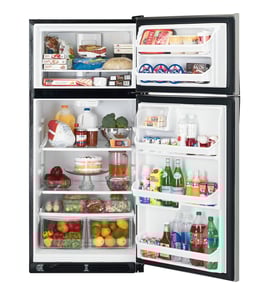


Is top mounted refrigerator better than bottom mounted?
A top-mount refrigerator like the Frigidaire LFHT1713LW3 is better when you want strong energy efficiency, simpler design, and lower purchase and repair costs; a bottom-mount is better when you want the fresh-food section at eye level and easier access to everyday items.
| Feature | Top-mount (freezer on top) | Bottom-mount (freezer on bottom) |
|---|---|---|
| Everyday access | Freezer is easiest to reach | Fresh food is easiest to reach |
| Energy use | Typically lower | Typically slightly higher |
| Repair complexity | Usually simpler | Often more complex |
| Organization | Basic, straightforward | Often more drawers and bins |
A top-mount refrigerator is usually the right fit when these matter most:
- Lower energy use and steady cooling performance
- Fewer features to maintain (simpler controls and airflow)
- Lower long-term repair costs (fewer specialty components)
- You use the freezer often (it is at a comfortable height)
- You want a lighter door load (fresh-food door is typically smaller)
A bottom-mount refrigerator is usually the right fit when:
- You access fresh food many times per day and want it at eye level
- You prefer wide refrigerator drawers and easier produce organization
- You do not mind bending for freezer access
- You want a more “kitchen workflow” friendly layout
Layout affects how often doors stay open, how well food stays organized, and how consistently temperatures hold. For any style, correct setup helps performance; our LFHT1713LW3 installation guide covers basics like leveling, door seal checks, and recommended clearances.
Use these installation best practices (especially after moving the refrigerator):
- Level the cabinet side-to-side and tilt it slightly back (about 1/4 inch)
- Confirm the door seals fully on all sides
- Allow airflow clearances (typically 3/8 inch at sides and top, 1 inch at the back)
- Wait 24 hours between temperature control adjustments
Last updated: January 2026
What is the upper part of a fridge called?
On the Frigidaire LFHT1713LW3 top-mount refrigerator, the upper section is the freezer compartment. It’s the colder area designed to keep foods frozen and, on some setups, it can also support an ice maker when the water supply is connected and the ice maker is turned on (if equipped).
- Maintains temperatures cold enough to freeze food for long-term storage
- Helps cool the fresh food section by supplying cold air through internal airflow paths
- Often houses key cooling components behind the rear panel (evaporator area)
- May include an ice maker location on compatible configurations
| What people call it | What it usually means | Where it is on LFHT1713LW3 |
|---|---|---|
| Upper part / top section | Freezer compartment | Top of the cabinet |
| Freezer | Frozen-food compartment | Upper door |
| Fresh food section | Refrigerator compartment | Lower door |
Knowing the correct name helps when you’re ordering parts, reading diagrams, or following setup steps like leveling and door sealing. For example, the installation checklist calls out that the freezer door should be level across the top and that the door seals completely on all sides. See the LFHT1713LW3 installation guide for the leveling and door-seal check steps.
- Make sure the cabinet is level and tilted slightly front-to-back (so doors self-close)
- Confirm both doors seal fully to the cabinet on all sides
- Allow recommended clearances for airflow (sides/top and back)
- After changing temperature controls, wait about 24 hours before adjusting again
- If your unit has an ice maker, keep it OFF until the water supply is connected
Last updated: January 2026
What is the most common problem with a Frigidaire refrigerator?
Cooling problems are the most common issue we see with Frigidaire refrigerators, including the Frigidaire LFHT1713LW3. Most “not cold enough” complaints trace back to restricted airflow (dirty condenser coils, blocked vents), a weak fan, or warm air leaking in through a door seal.
- Fresh food section is warm but freezer seems closer to normal
- Freezer has frost buildup on the back wall
- Refrigerator runs a lot or seems to never shut off
- Food freezes in the refrigerator section
- Unusual fan noise or no fan sound when the compressor is running
Start with these basics before replacing parts:
- Set controls to a normal range and wait 24 hours after any adjustment for temperatures to stabilize (this is standard guidance for this style of refrigerator). See the LFHT1713LW3 installation guide.
- Make sure vents inside both compartments are not blocked by food packages.
- Clean condenser coils and confirm the condenser fan area is clear of dust.
- Confirm doors close and seal fully on all sides; the installation checklist calls out that the door seals should completely contact the cabinet. See the LFHT1713LW3 installation guide.
If the basic checks do not solve it, these parts are frequent culprits on top-mount refrigerators:
| What you observe | Likely area | Example part for LFHT1713LW3 |
|---|---|---|
| Warm fridge, freezer OK-ish | Airflow from freezer to fridge | Refrigerator air damper 241542001 |
| Frosted freezer back panel | Defrost system issue | Refrigerator defrost bi-metal thermostat 5303918202 |
| Noisy or stalled fan | Evaporator airflow problem | Refrigerator evaporator fan motor 241854301 |
Cooling problems usually get worse over time. Fixing airflow, door sealing, or a defrost issue early helps prevent food spoilage, excessive frost, and compressor overwork.
Last updated: January 2026
Why is my Frigidaire top mount freezer not freezing?
If your Frigidaire LFHT1713LW3 top-mount freezer is not freezing, the most common causes are incorrect control settings, poor airflow from frost buildup, dirty condenser area, or a fan/defrost problem. Start by confirming the controls, then check for frost and fan operation using the steps in the LFHT1713LW3 installation guide.
- Make sure the freezer control was not accidentally turned warmer; after changing controls, wait 24 hours before adjusting again.
- Verify the freezer door closes fully and the gasket seals all the way around.
- Look for heavy frost on the freezer back wall (a strong sign of a defrost issue).
- Listen for the evaporator fan running when the freezer door switch is pressed.
- Clean dust from the condenser area (restricted heat release reduces cooling).
- Confirm the refrigerator is level and slightly tilted back so doors self-close.
| What you notice | Most likely cause | What to do next |
|---|---|---|
| Freezer warm, fridge also warm | Cooling system not running efficiently | Clean condenser area; listen for compressor and fans |
| Freezer has thick frost on back wall | Defrost system problem | Check defrost components such as the refrigerator defrost bi-metal thermostat 5303918202 |
| Freezer cold near vents only | Airflow problem | Check evaporator fan and air passages |
| Door won’t seal, frost near door | Air leak | Inspect gasket and door alignment |
These are frequent culprits when basic checks do not restore freezing:
- Refrigerator defrost bi-metal thermostat 5303918202 (can stop defrost from working correctly)
- Refrigerator defrost timer 215846604 (can prevent the unit from entering defrost or returning to cooling)
- Refrigerator evaporator fan blade 5308000010 (damaged blade can reduce airflow)
- Refrigerator condenser fan motor 242018301 (poor condenser cooling can reduce freezer performance)
A freezer that is not freezing is usually an airflow or heat-removal problem. Fixing it quickly prevents food spoilage and helps avoid longer compressor run times that can shorten the life of major components.
Last updated: January 2026