Installation guide
 Owner’s manual
 Error Codes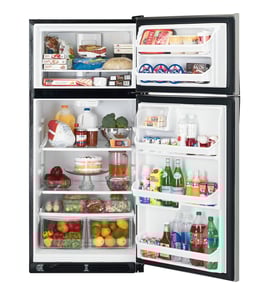


Which is better, top mount or bottom mount refrigerator?
A top-mount refrigerator like Kenmore 2537482340G is usually the better pick for value and efficiency, while a bottom-mount is usually better for everyday convenience because fresh food sits at eye level. The “better” choice depends on how you shop, cook, and use freezer space.
Quick comparison
| Feature | Top-mount (freezer on top) | Bottom-mount (freezer on bottom) |
|---|---|---|
| Fresh food access | Lower, more bending | Higher, less bending |
| Freezer access | Easy, at eye level | Lower, more bending |
| Typical cost | Lower | Higher |
| Energy use (typical) | Often lower | Often higher |
| Best for | Budget, simple storage | Frequent fresh-food use |
When a top-mount is the better choice
- You want a straightforward layout with fewer moving parts
- You use the freezer often (frozen meals, bulk meat, ice trays)
- You want strong value for the price
- You prefer a lighter door swing and simpler organization
- You have tighter kitchen space and want a classic footprint
For installation and airflow, follow the clearance and leveling guidance in the 2537482340G owner's manual.
When a bottom-mount is the better choice
- You cook with fresh ingredients daily and want them at eye level
- You want wider refrigerator shelves and easier produce access
- You prefer freezer drawers/baskets for organization
- You are trying to reduce bending for the items you use most
Why it matters
Choosing the right layout affects daily comfort and food quality. A refrigerator that fits your habits helps maintain stable temperatures, reduces door-open time, and makes it easier to keep airflow clear and shelves organized.
Last updated: January 2026
What is the upper part of a fridge called?
On the Kenmore 2537482340G top-mount refrigerator, the upper section is the freezer compartment. It’s the coldest area of the appliance, designed to keep foods frozen and, on ice-maker-equipped models, support automatic ice production (if installed). See the 2537482340G owner's manual for compartment features and temperature control guidance.
What the freezer compartment includes
Depending on how your 2537482340G is equipped, the upper freezer area commonly includes:
- Freezer shelves and door bins for frozen food storage
- Cold air vents that circulate air between freezer and fresh food sections
- A defrost system (you may notice normal sounds during defrost)
- An optional automatic ice maker system (if your model has one installed)
- Temperature controls that help maintain safe storage temperatures
Freezer vs. refrigerator compartment (quick comparison)
| Compartment | Location on this model | Primary purpose | Typical items |
|---|---|---|---|
| Freezer compartment | Top | Long-term frozen storage | Meat, frozen meals, ice cream |
| Fresh food compartment | Bottom | Chilled storage above freezing | Produce, dairy, leftovers |
Why it matters
Knowing the correct compartment name helps when you’re troubleshooting cooling issues, reading temperature-setting instructions, or ordering parts for the right section (for example, a freezer door gasket vs. a fresh food door gasket).
Helpful tips for using the upper freezer
We recommend these best practices for steady temperatures and better food quality:
- Avoid overloading the freezer with warm food at one time
- Leave space between packages so cold air can circulate
- Store temperature-sensitive items (like ice cream) toward the interior, not the door
- Keep vents clear so airflow is not blocked
- Level the refrigerator so doors close tightly (helps prevent frost and temperature swings)
Last updated: January 2026
What are the disadvantages of a top mount fridge?
A top-mount refrigerator like Kenmore 2537482340G typically makes fresh-food access less convenient because the refrigerator section sits lower, and it usually offers fewer premium organization and dispenser features than many bottom-freezer designs. For model-specific features and setup limits, use the 2537482340G owner's manual.
Common disadvantages (what you notice day to day)
- More bending for fresh food: the most-used items are in the lower compartment.
- Less “at-a-glance” organization: many top-mount designs have simpler bins and shelf layouts.
- Fewer built-in dispenser options: many top-mount models do not include external water or ice dispensing.
- Freezer convenience tradeoff: frozen items are easy to reach, but fresh items are not.
- Door swing and clearance needs: hinge-side wall placement can limit how wide the door opens.
Setup and space considerations (often overlooked)
Even when the layout works for you, installation details can be a downside in tight kitchens. The Kenmore 2537482340G guidance calls for clearances that support airflow and service access.
| Item | Typical top-mount consideration | What to plan for |
|---|---|---|
| Fresh-food access | Lower compartment | Store daily items higher on shelves to reduce bending |
| Door clearance | Can be tight near walls | Leave extra hinge-side space if needed |
| Air circulation | Needs breathing room | Keep side/top and rear clearances per the manual |
Why it matters
Choosing a top-mount refrigerator is usually a value and simplicity decision. Knowing the tradeoffs helps you avoid frustration with daily ergonomics, kitchen layout constraints, and feature expectations.
Last updated: January 2026
What water filter fits my Kenmore fridge?
For Kenmore model 2537482340G, the correct water filter is the one specified for your exact model and configuration; we match it using the full model number on the rating label and the filter location shown in the 2537482340G owner's manual. This prevents leaks, low water flow, and poor-tasting water.
How to identify the right filter for 2537482340G
Start with the model number (you already have it) and then confirm the filter style used in your refrigerator:
- Check inside the fresh food compartment for a filter housing (often in the upper right, upper left, or base grille area)
- Look for a filter part number printed on the old filter or on the filter head label
- Confirm whether your refrigerator uses an internal cartridge filter or an inline filter on the water line
- If you have an ice maker connected to a water line, confirm the water supply setup and shutoff valve location
- Replace the filter on schedule (most households replace about every 6 months)
If your refrigerator has an ice maker but no internal filter
Many top-mount refrigerators use an ice maker water line without an internal water filter. In that case, filtration is typically handled by:
- A separate inline filter installed on the household water line
- A filtered water supply (such as a dedicated filtered tap)
- A refrigerator-compatible inline filter kit
The installation guidance for connecting the optional ice maker water supply (including recommended tubing and water pressure range) is covered in the 2537482340G installation guide.
Quick compatibility checklist
Use this checklist before ordering a replacement filter:
| What you see | What it usually means | What to do |
|---|---|---|
| Twist-in or push-in cartridge inside the fridge | Internal refrigerator water filter | Match the filter number printed on the old filter or housing |
| No filter housing inside, but a water line to the ice maker | No internal filter | Consider an inline filter on the supply line |
| Low ice production or slow fill after filter change | Air in line or restricted filter | Flush water line, recheck seating, replace if needed |
Why it matters
Using the correct filter for your Kenmore 2537482340G keeps water flow steady to the ice maker, helps protect the water system from debris, and avoids fit issues that can cause leaks or bypass filtration.
Last updated: January 2026