Owner’s manual
 Error Codes




How to move a JennAir refrigerator?
To move your Jenn-Air JBR2088HES bottom-mount refrigerator safely, we recommend unloading it, securing shelves and doors, and moving it with an appliance dolly from the side or back (never the front). Keep it upright whenever possible to protect the compressor.
Step-by-step: moving it safely
- Unplug the power cord.
- Remove food and any loose items.
- Tape shelves and drawers in place so they cannot slide.
- Tape the doors shut.
- Use an appliance dolly; truck the refrigerator from its side or back, not from the front.
- Keep the refrigerator upright during the move.
- Protect the finish with blankets or padding between the cabinet and the dolly; strap it securely without overtightening.
If it must be laid down
The preferred position is upright. If you cannot keep it upright, lay it on its back (not its side), then stand it upright for about 30 minutes before plugging it in so compressor oil can return where it belongs. See the JBR2088HES owner's manual for the full transporting guidance.
Leveling legs and clearance tips
If you need a little extra clearance to slide the refrigerator out, use the leveling procedure (toe grille off, adjust front and rear screws, then set stabilizing legs). This helps you move the unit without dragging or damaging flooring.
| Task | Best practice | Why it matters |
|---|---|---|
| Rolling it out | Use a dolly; move from side/back | Prevents cabinet and hinge damage |
| Securing inside | Tape shelves/drawers; tape doors | Prevents breakage and dents |
| After transport | Keep upright; wait before plugging in if laid down | Protects compressor and internal parts |
Why it matters
Refrigerators are top-heavy and the sealed system depends on proper oil return in the compressor. Moving the JBR2088HES the right way reduces the risk of cooling problems, dents, and door alignment issues.
Last updated: January 2026
What is the life expectancy of a JennAir refrigerator?
Most Jenn-Air refrigerators, including the JENN-AIR JBR2088HES bottom-mount model, typically last 12 to 20 years with normal household use. Lifespan depends most on compressor health, clean airflow through the condenser area, and keeping door seals and temperatures in the correct range.
Typical lifespan ranges (what to expect)
- Average overall lifespan: 12 to 20 years
- Common “make-or-break” systems: sealed system (compressor and refrigerant loop), defrost system, airflow components
- Wear items that often need service sooner: ice maker, door gaskets, fans, sensors
| Item | Typical service timing | What you may notice |
|---|---|---|
| Compressor/sealed system | 10 to 20 years | Warm fridge/freezer, long run times |
| Evaporator fan system | 8 to 15 years | Poor cooling, warm spots, noise |
| Ice maker | 5 to 10 years | No ice, small cubes, leaking |
| Door gaskets | 5 to 15 years | Frost, sweating, temperature swings |
What shortens refrigerator life fastest
- Dirty condenser area causing high operating temperatures
- Door left ajar or weak door seal letting in humid air
- Overpacked compartments blocking vents and airflow
- Incorrect temperature settings (too warm or too cold)
- Skipping water filter maintenance on filter-equipped units
Model-relevant parts that commonly affect longevity
If cooling performance or ice production is declining, these model-matched parts are often involved:
- Refrigerator compressor W10160407
- Evaporator motor WPW10128551
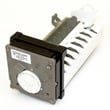
- Refrigerator ice maker D7824706Q
- Refrigerator door gasket W10849442
Why it matters
Once a refrigerator reaches the mid-to-late part of its lifespan, small airflow or sealing problems can snowball into bigger issues (long run times, frost buildup, temperature swings). Keeping temperatures stable and airflow clear helps protect the compressor, which is the most expensive system to repair.
For model-specific care, temperature guidance, and maintenance intervals, follow the JBR2088HES owner's manual.
Last updated: January 2026
What are common problems with JennAir refrigerators?
Common problems we see on the Jenn-Air JBR2088HES bottom-mount refrigerator include warm refrigerator temperatures, water leaks, doors not sealing or closing, and louder-than-usual operating sounds. Many of these issues trace back to airflow restrictions, dirty condenser coils, or a failing cooling or defrost component.
Most common symptoms and what they usually point to
- Fridge warm, freezer OK: blocked vents, controls need adjustment, or an air damper issue (often the damper control).
- Unit runs too often: dirty condenser coils, frequent door openings, warm room conditions, or door not sealing.
- Water inside or under the refrigerator: high humidity and frequent door openings (droplets), or a water connection/pressure issue (leaks).
- Door not closing well: refrigerator not level, gasket not sealing, or drawers/containers obstructing the door.
- Unfamiliar sounds: often normal operation, but persistent loud noise can relate to fan or ice maker components.
Quick checks we recommend first (before replacing parts)
Use these steps to narrow the cause fast:
- Confirm the temperature controls are set correctly (see JBR2088HES owner's manual).
- Check that interior air vents are not blocked by food packages.
- Clean the condenser coils; dirty coils can cause long run times and poor cooling.
- Inspect door gaskets for gaps; clean gaskets regularly so the door seals properly.
- Make sure the refrigerator is level and drawers are fully seated so doors close squarely.
Parts that commonly relate to these problems (for JBR2088HES)
If the basic checks do not resolve the symptom, these model-matched parts are often involved:
| Symptom | Common part involved | Example part for this model |
|---|---|---|
| Fridge warm, airflow inconsistent | Damper control | Refrigerator electronic damper WPW10196393 |
| Loud buzzing or clicking from ice maker area | Ice maker | Refrigerator ice maker D7824706Q |
| Warm temps, weak airflow noise | Evaporator fan system | Evaporator motor WPW10128551 |
| Frost buildup, warming, or defrost issues | Defrost system | Refrigerator defrost heater WP67002493 |
Why it matters
Cooling and leak complaints often get worse when airflow is restricted or the door does not seal. Keeping coils clean, avoiding overcrowding, and minimizing door-open time helps the JBR2088HES run efficiently and maintain stable refrigerator and freezer temperatures.
Last updated: January 2026
What is the storage capacity of JBR2088HES?
The Jenn-Air JBR2088HES bottom-mount refrigerator is a 20 cu. ft. class unit; most models in this size range provide about 19 to 20 cu. ft. of total interior capacity. For the exact rated capacity for your specific configuration, use the JBR2088HES owner's manual.
What “storage capacity” means
Capacity is the manufacturer’s rated interior volume; usable space is always a bit less once shelves, drawers, and the ice maker area are accounted for.
- Total capacity is measured in cubic feet (cu. ft.)
- Usable space changes with shelf and bin positions
- Ice maker and freezer baskets reduce usable volume
- Frost buildup reduces usable freezer space
- Blocking vents reduces effective storage and cooling
Typical capacity ranges for this refrigerator type
These are common ranges for bottom-mount refrigerators like the JBR2088HES.
| Measurement | Typical range |
|---|---|
| Total capacity | 19 to 21 cu. ft. |
| Fresh food section | 13 to 15 cu. ft. |
| Freezer section | 5 to 7 cu. ft. |
Why it matters
Capacity helps you compare refrigerators, but day-to-day storage depends on airflow and organization. Keeping vents clear and maintaining steady temperatures prevents warm spots that can force you to leave extra space around items.
For cooling-related storage issues (warm fresh food, freezing in the crisper), checking the air damper operation is a common next step; see the refrigerator electronic damper WPW10196393 if you are diagnosing airflow problems.
Last updated: January 2026