Owner’s manual
 Error Codes


How to tell cubic feet of Kenmore refrigerator by model number?
For Kenmore model 10659123801, the most reliable way to get cubic feet is to look up the capacity in the 10659123801 owner's manual. Model numbers sometimes hint at size, but they are not a consistent “capacity code” across Kenmore 106 refrigerators.
- Check the specifications section in the 10659123801 owner's manual.
- Look for a rating plate inside the fresh food section (often on a side wall or near the crisper area); some units list capacity there.
- If you have the original sales paperwork, capacity is often printed on the product description.
- If you only need an estimate, calculate interior volume (next section).
- Empty the compartment you are measuring (refrigerator and freezer can be estimated separately).
- Measure usable interior:
- Width (inches)
- Depth (inches)
- Height (inches)
- Multiply:
W × D × Hto get cubic inches. - Divide by 1728 to convert to cubic feet.
| What you have | Convert to | Formula |
|---|---|---|
| Cubic inches | Cubic feet | cubic inches ÷ 1728 |
| Inches (W×D×H) | Cubic inches | W × D × H |
Capacity helps you compare refrigerators accurately and choose correctly sized parts and accessories (for example, storage bins and shelves). It also helps set expectations for cooling recovery after door openings and loading.
Last updated: January 2026
What are the most common issues with 10659123801?
The most common issues we see with the Kenmore 10659123801 side-by-side refrigerator involve cooling performance, ice maker and water dispenser problems, and door sealing or alignment concerns. These symptoms usually trace back to airflow, defrost, or water-supply components and can often be confirmed with a few quick checks.
- Warm refrigerator or freezer: restricted airflow, evaporator fan issue, dirty condenser area, or defrost problem
- Ice maker not making ice: water supply restriction, inlet valve problem, or ice maker failure
- Water dispenser slow or not dispensing: clogged filter, frozen water tube, or inlet valve issue
- Frost buildup on back wall or in freezer: defrost system issue (control, thermostat, or airflow)
- Door not closing well or leaks air: gasket sealing issue or door cam/hinge wear
- Set temperatures to typical targets: 0°F freezer, 37°F fresh food.
- Confirm strong airflow from vents; avoid blocking vents with food packages.
- Replace the water filter on schedule; a clogged filter commonly reduces water flow.
- Inspect door seals for gaps, tears, or areas that do not grip paper when closed.
- Listen for the evaporator fan running when the doors are closed.
| Problem area | Common fix | Example part for this model |
|---|---|---|
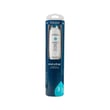
| Water flow, ice maker fill | Replace clogged filter | Genuine Kenmore refrigerator water filter EDR3RXD1 |
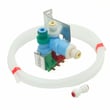
| No water to dispenser/ice maker | Test and replace inlet valve | Refrigerator water inlet valve W10408179 |
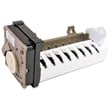
| Ice production issues | Replace ice maker assembly | Refrigerator ice maker WPW10190965 |
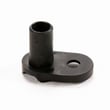
| Door closing and alignment | Replace worn cam | Refrigerator door cam (black) WP2182179 |
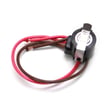
| Defrost and temperature control | Diagnose defrost controls/thermostat | Refrigerator adaptive defrost control board WPW10366605 |
Cooling, defrost, and water-delivery issues can cascade: poor airflow causes warm temps and frost; frost reduces airflow even more; and restricted water flow leads to small cubes, hollow cubes, or no ice. Catching the root cause early helps protect food and reduces strain on the compressor.
For control locations, temperature setting details, and component access steps specific to Kenmore 10659123801, use the 10659123801 owner’s manual. For dispenser trim and control panel access, we also recommend how to disassemble a Kenmore refrigerator dispenser.
Last updated: March 2026
What is the average lifespan of 10659123801?
A Kenmore side-by-side refrigerator like model 10659123801 typically lasts 13 years with normal household use and basic maintenance. Keeping airflow clear, doors sealing tightly, and the water system maintained helps you reach that average.
- Condenser cleanliness: Dust buildup makes the compressor run hotter and longer.
- Door seal condition: Air leaks create constant run time and frost issues.
- Defrost performance: A weak defrost system can cause ice buildup and poor cooling.
- Water and ice system care: Clogged filters and low water flow strain valves and the ice maker.
- Temperature settings: Aim for about 37°F in the fresh food section and 0°F in the freezer.
| Task | How often | Why it matters |
|---|---|---|
| Replace water filter | Every 6 months | Protects water flow and ice maker performance |
| Clean condenser area | Every 6 to 12 months | Reduces compressor workload |
| Check door gaskets for gaps | Every 3 months | Prevents warm air intrusion and frost |
| Verify temps with a thermometer | Seasonally | Confirms safe food temps and efficient run time |
If you are seeing warm temps, heavy frost, or no ice, these are common wear-related items for this style of refrigerator:
- Genuine Kenmore refrigerator water filter EDR3RXD1 (water taste, slow dispenser, small ice)
- Refrigerator water inlet valve W10408179 (no water to dispenser or ice maker)
- Refrigerator ice maker WPW10190965 (no ice production)
- Refrigerator adaptive defrost control board WPW10366605 (frost buildup, warming)
Knowing the typical 13-year lifespan helps you decide whether to maintain and repair (filters, valves, ice maker) or plan for replacement if major sealed-system issues develop.
For model-specific care steps and operating guidance, use the owner's manual.
Last updated: March 2026