Installation guide
 Owner’s manual
 Error Codes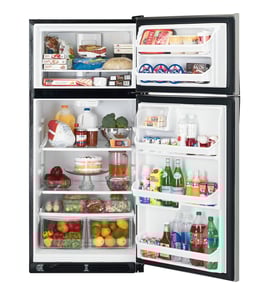


What are the advantages of a top mount fridge?
A top-mount refrigerator like the Frigidaire LFHT2131QE0 gives you a traditional layout with the freezer on top, typically offering strong fresh-food storage value, straightforward organization, and simpler installation needs (clearances, leveling, and airflow) when set up per the LFHT2131QE0 installation guide.
Key advantages you will notice day to day
- More usable fresh-food space for the footprint: Many top-mount designs prioritize the refrigerator compartment volume.
- Simple, familiar organization: Full-width shelves, door bins, and crisper drawers are easy to access and rearrange.
- Often lower purchase and repair complexity: Fewer specialty mechanisms than many premium configurations.
- Efficient airflow when installed correctly: Proper clearances help the condenser and compressor shed heat.
- Easy door sealing and alignment checks: Leveling and a slight backward tilt help doors close and seal.
Installation and placement benefits (often overlooked)
Top-mount refrigerators are usually forgiving in standard kitchens, but correct setup still matters for performance.
We recommend these setup basics:
- Keep the refrigerator on a level floor that supports a fully loaded unit.
- Maintain typical clearances for airflow: about 3/8 inch at the sides and top, and about 1 inch at the back.
- Avoid placing it in direct sunlight or near heat sources (range, dishwasher).
- Keep room temperature in a normal range; very cold or very hot rooms can reduce cooling performance.
- Do not block the toe grille; it is part of the airflow path.
Quick comparison: top mount vs. bottom freezer
| Feature | Top mount (freezer on top) | Bottom freezer |
|---|---|---|
| Fresh-food access | Good | Often best |
| Freezer access | Higher up | Lower down |
| Layout complexity | Typically simpler | Often more complex |
| Value for capacity | Often strong | Varies |
Why it matters
A top-mount refrigerator can be a great choice when you want dependable cooling, practical storage, and fewer “extras” to maintain. On the LFHT2131QE0, correct leveling and clearances are especially important because they help doors seal properly and support steady compressor operation.
Last updated: January 2026
What is the upper part of a fridge called?
On the Frigidaire LFHT2131QE0 top-mount refrigerator, the upper section is the freezer compartment. It’s the coldest area of the appliance, designed to keep food frozen and to supply cold air that helps maintain proper temperatures in the fresh food (refrigerator) compartment.
What the freezer compartment does
- Keeps foods frozen for long-term storage
- Helps cool the refrigerator section through shared airflow
- Houses cold-air vents that should not be blocked by food packages
- May include an ice maker on some configurations (moving parts require care)
Freezer vs. refrigerator: quick comparison
| Compartment | Typical purpose | Typical temperature setting |
|---|---|---|
| Freezer (upper) | Frozen storage | About 0°F |
| Refrigerator (lower) | Fresh food storage | About 37°F |
Tips for better cooling and fewer temperature swings
The manual notes that a fan circulates air in both compartments; airflow matters.
- Keep items away from cold-air vents so air can circulate
- Adjust temperatures gradually and wait about 24 hours for changes to stabilize
- If doors do not seal well, cooling performance drops and frost can increase
- Keep the toe grille area clear for proper air circulation
Why it matters
Knowing the freezer compartment’s role helps with common troubleshooting. If the refrigerator section is warm but the freezer is cold, the issue is often airflow (blocked vents, frost buildup, or a fan problem) rather than the temperature control setting.
For model-specific operating and temperature-control details, use the LFHT2131QE0 owner's manual.
Last updated: January 2026
Why is my Frigidaire top mount freezer not freezing?
If your Frigidaire LFHT2131QE0 top-mount freezer is not freezing, the most common causes are an incorrect temperature control setting (including being set to “0/OFF”), blocked air vents, dirty condenser coils, or a failed fan that is not circulating cold air. Use the LFHT2131QE0 owner's manual to confirm the correct control settings and airflow locations.
Quick checks we recommend first
- Make sure the refrigerator/freezer control is not set to “0” (this stops cooling even though lights may still work).
- Adjust temperatures gradually and wait 24 hours for the freezer to stabilize after changes.
- Confirm food packages are not blocking cold air vents in the freezer or fresh food section.
- Listen for the evaporator fan running when the compressor is on (a quiet freezer can indicate no airflow).
- Check that doors close fully and the gasket seals all the way around.
Temperature controls: what to set and what to expect
The manual notes that adjusting the main refrigerator/freezer control changes temperatures in both compartments, and the auxiliary freezer control can usually stay at the factory “Normal” setting. After any adjustment, allow time for temperatures to stabilize.
| What you do | What it affects | What to expect |
|---|---|---|
| Turn main control colder | Fridge and freezer | Freezer should improve within 24 hours |
| Set main control to “0” | Compressor stops | No cooling, but power is still present |
| Move auxiliary freezer control | Freezer airflow/temperature balance | Fine-tunes freezer performance |
Airflow and fan problems that stop freezing
A top-mount refrigerator depends on a fan to circulate air; without airflow, the freezer warms up and the refrigerator section often gets too warm too.
If you suspect a fan issue, these parts are commonly involved:
- Refrigerator evaporator motor 242077705 (moves cold air through the freezer and into the refrigerator)
- Refrigerator evaporator fan blade 242219302 (can crack or slip and reduce airflow)
Why it matters
When the freezer cannot hold temperature, food safety is at risk and the refrigerator may also warm up because both compartments share the cooling system. Fixing airflow, control settings, and heat removal (condenser cleanliness) restores normal operation faster and prevents compressor overwork.
Last updated: January 2026
What is the most common problem with a Frigidaire refrigerator?
The most common problem we see with Frigidaire refrigerators like model LFHT2131QE0 is a cooling complaint: the refrigerator or freezer is too warm, temperatures swing, or food spoils early. The most frequent causes are airflow restrictions (dirty condenser area, blocked vents), fan problems, and door seal leaks; water and ice issues are also common.
Most common symptoms and what they usually point to
- Fresh food warm, freezer OK: restricted airflow between compartments, evaporator fan issue, or a control setting problem
- Freezer warm, refrigerator warm: condenser airflow problem, condenser fan issue, or sealed-system/refrigerant problem
- Frost buildup on freezer back wall: defrost system problem or door left ajar
- Unit not running at all: control set to OFF/0, power supply issue, or start component problem
- Water leaks or ice maker trouble: water line connection issue, low water pressure, or frozen line
For model-specific operating and control details, use the LFHT2131QE0 owner's manual.
Quick checks we recommend first (no parts required)
- Confirm the temperature controls are not set to OFF/0 (turning cooling off does not remove power to lights).
- Make sure the door closes tightly and nothing is holding it open.
- Check for blocked air vents inside the refrigerator and freezer (avoid packing items against vents).
- Listen for fan noise: evaporator fan noise is typically heard from the freezer area.
- If the refrigerator is not running, check the outlet, breaker, and fuse (a 15-amp time-delay fuse is commonly specified).
Parts that commonly solve cooling complaints on this model
If the quick checks point to airflow or fan failure, these are common repair paths:
| Symptom | Common fix | Example part for LFHT2131QE0 |
|---|---|---|
| Warm temps, weak airflow | Replace evaporator fan motor | Refrigerator evaporator motor 242077705 |
| Noisy or damaged fan blade | Replace fan blade | Refrigerator evaporator fan blade 242219302 |
| Warm temps, poor heat removal | Check condenser fan operation | Refrigerator condenser fan motor 242018301 |
Why it matters
Cooling problems usually get worse over time. A small airflow restriction or a weak fan can lead to longer run times, temperature swings, frost buildup, and premature food spoilage.
Last updated: January 2026