Owner’s manual
 Error Codes



What is the capacity of LFDS22520S?
The LG LFDS22520S bottom-mount refrigerator has a total capacity of 21.8 cu. ft., with 14.5 cu. ft. in the fresh food (refrigerator) section. For model-specific feature details and use recommendations, see the LFDS22520S owner's manual.
Here is how the space is typically divided in the LFDS22520S:
- Total capacity: 21.8 cu. ft.
- Fresh food capacity: 14.5 cu. ft.
- Freezer capacity: The remaining space (total minus fresh food)
| Section | Capacity (cu. ft.) | What it’s used for |
|---|---|---|
| Fresh food (refrigerator) | 14.5 | Everyday refrigerated items, produce, deli drawer |
| Freezer (bottom) | Remainder of 21.8 | Frozen foods, ice storage |
Capacity helps you compare refrigerators and plan storage, but it also affects real-world performance. Overpacking can restrict airflow and lead to warm spots, frost, or longer run times.
- Keep air vents clear so cold air can circulate properly.
- Avoid pushing items tight against the back wall.
- Use the deli/pantry area for frequently accessed items to reduce door-open time.
- Set shelves to match your tallest items instead of stacking.
- Keep the freezer organized so the drawer closes fully and seals correctly.
Last updated: January 2026
What is the problem with the LG bottom freezer refrigerator?
On the LG LFDS22520S bottom-mount refrigerator, the most common “problem” customers notice is uneven cooling: the fresh food section gets too warm while the freezer stays very cold. This is usually caused by restricted airflow, a fan issue, or a temperature-sensing/control problem (not a single universal defect).
We typically focus on these checks first because they match how cold air moves from the freezer to the refrigerator section (and back through return vents) as described in the LFDS22520S manual.
- Air vents blocked by food packages (especially at the back wall)
- Frost or ice buildup restricting airflow behind the freezer evaporator cover
- Evaporator fan not running consistently
- Temperature sensor (thermistor) reading incorrectly
- Control settings changed recently (needs time to stabilize)
- Confirm doors close and seal fully; warm air leaks can mimic a cooling failure.
- Make sure nothing is covering interior vents in either compartment.
- Set temperatures to a normal range and wait a full 24 hours before adjusting again.
- Listen for the evaporator fan when the doors are closed (a steady fan sound is typical).
- If the unit has an error code, use the LG bottom freezer refrigerator error codes guide to narrow the failure.
If airflow is restricted or the fan is failing, these model-compatible parts are common suspects:
| Symptom | What it often points to | Model-compatible part example |
|---|---|---|
| Freezer cold, fridge warm | Poor airflow from freezer | Refrigerator evaporator fan motor EAU65058315 |
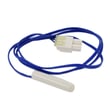
| Temps swing up/down | Bad temperature feedback | Refrigerator temperature sensor 6500JB2002E |
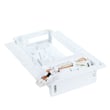
| Frost behind rear freezer panel | Fan/airflow issue or defrost-related restriction | Refrigerator freezer evaporator cover and fan assembly AEB73865906 |
Uneven cooling can spoil food in the refrigerator section even while the freezer seems “fine.” Catching airflow and sensor issues early can prevent longer compressor run times and reduce temperature swings.
Last updated: January 2026
Why is my LG refrigerator leaking from the bottom?
On LG model LFDS22520S, a leak that shows up at the bottom is most often caused by a defrost drain problem (water cannot flow to the drain pan) or a water supply leak (filter, tubing, or inlet valve). We start by checking the drain path and the water line connections. See the LFDS22520S manual for safety and access guidance.
- Unplug the refrigerator before inspecting behind panels or near wiring.
- Look for a sheet of ice or standing water under the crisper drawers (common with a clogged defrost drain).
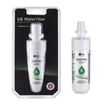
- Check the water filter area for drips after dispensing water.
- Inspect the water line at the back for wet fittings or a slow drip.
- Confirm doors close fully; warm air leaks can increase frost and drain icing.
During defrost, water should run through a drain hole and down to the drain pan. If the drain is blocked or frozen, water can overflow and end up on the floor.
If you suspect the drain tube is restricted or damaged, the compatible replacement for this model is the refrigerator drain tube 5251JA3003D.
A small leak at the valve, reservoir, or tubing can run down the cabinet and appear as a “bottom leak.” For this model, a common part to inspect is the refrigerator water inlet valve AJU73672505.
| What you see | Most likely cause | Where to check |
|---|---|---|
| Water under crispers, then onto floor | Defrost drain clogged/frozen | Drain trough and drain tube |
| Water only after using dispenser | Filter housing or tubing seep | Filter cover area, tubing connections |
| Random puddles near back | Water inlet valve or supply line drip | Rear lower area, valve fittings |
| Frost buildup plus leaking | Door not sealing, excess frost overwhelms drain | Door gaskets, door alignment |
Bottom leaks can lead to floor damage and can also point to airflow or defrost drainage issues that may eventually cause temperature problems in the fresh food section.
Last updated: January 2026