Owner’s manual
 Error Codes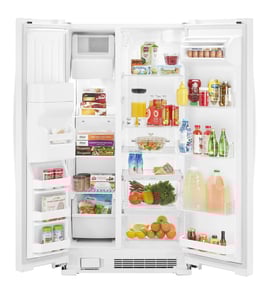



Is WRS321SDHZ counter depth?
No. Whirlpool refrigerator model WRS321SDHZ00 is a standard-depth side-by-side refrigerator, not a counter-depth model. For installation clearances and placement requirements, follow the guidance in the WRS321SDHZ00 installation instructions and owner’s manual.
Even with a standard-depth refrigerator, the best way to avoid surprises is to measure your space and compare it to the unit’s overall dimensions and required clearances.
- Measure the cabinet opening width, height, and depth
- Measure doorways and tight turns (entry door, hallway, kitchen doorway)
- Plan for door swing clearance next to walls
- Allow airflow space at the sides, top, and back
- Confirm space for the water line connection if you use the ice maker or dispenser
Counter-depth models are designed to reduce how far the cabinet sticks out past standard base cabinets.
| Type | Typical cabinet depth | Typical look in a 24-in cabinet run |
|---|---|---|
| Counter-depth | Shallower | More “built-in” appearance |
| Standard-depth | Deeper | Extends farther into the kitchen |
Depth affects more than appearance. It can change how easily doors open, whether drawers clear nearby walls, and how much ventilation space you have for efficient cooling.
Our manual for WRS321SDHZ00 calls out ventilation and placement needs (including clearance at the sides/top and space behind the refrigerator). Use those requirements when planning your install so the compressor and fans can cool properly.
Last updated: January 2026
Do they make refrigerators that are 32 inches wide?
Yes. Manufacturers do make refrigerators in the 32-inch width range, but the Whirlpool WRS321SDHZ00 side-by-side refrigerator is designed for a wider cabinet opening than 32 inches, so it typically will not be a fit for a true 32-inch space. For model-specific installation clearances, use the WRS321SDHZ00 installation instructions and owner’s manual.
We recommend measuring your opening and comparing it to the refrigerator’s required cutout and clearance needs.
- Measure the cabinet opening width at the front and back
- Measure height to the lowest cabinet or soffit point
- Measure depth to the wall and note baseboard trim
- Plan clearance for door swing and drawer removal
- Confirm space for ventilation and the water line (if you have an ice maker/dispenser)
For Whirlpool WRS321SDHZ00, the manual calls out ventilation clearances and also notes a normal minimum cabinet cut-out width required for product installation of 36 inches (with additional width recommended in some wall-adjacent situations). That means a 32-inch-wide opening is generally too narrow for this model.
| Item to check | What to compare | Why it matters |
|---|---|---|
| Opening width | Your cabinet cutout vs. required cutout | Prevents binding, vibration, and install failure |
| Side clearance | Door swing and bin clearance | Helps doors open fully and bins slide out |
| Rear clearance | Water line and airflow space | Reduces kinks, noise, and cooling issues |
A refrigerator that is even slightly too wide can damage cabinets, restrict airflow (leading to warm temps), and make doors hard to open or align. Choosing a unit that matches the required cutout avoids installation headaches.
If your opening is truly 32 inches wide, focus your shopping on models specifically listed as 32-inch class (often counter-depth or compact-width designs). For Whirlpool models, always verify the required cutout in the installation instructions before buying.
Last updated: January 2026
What is the most common problem with a Whirlpool refrigerator?
For the Whirlpool WRS321SDHZ00 side-by-side refrigerator, the most common customer-reported issue category is cooling performance (fridge or freezer too warm), often tied to airflow restrictions, dirty condenser areas, or a defrost/evaporator fan problem. The troubleshooting section in the WRS321SDHZ00 installation instructions and owner’s manual focuses heavily on these symptoms.
Start with the simplest, highest-impact checks before assuming a major failure:
- Make sure doors are fully closing and sealing; frequent openings quickly warm a side-by-side.
- Confirm air vents are not blocked by food packages.
- Allow 24 hours after a new install or major temperature change for stabilization.
- Clean the condenser area if your home is dusty, greasy, or has pets.
- Listen for the evaporator fan; loss of airflow can make the refrigerator section warm.
| Symptom | Most likely cause | Typical next step |
|---|---|---|
| Refrigerator too warm, freezer OK | Airflow issue (evaporator fan, blocked vents, frost buildup) | Check fan sound and vent blockage |
| Both sections too warm | Condenser airflow/dirty condenser, compressor start issues, control problem | Clean condenser, verify fans run |
| Ice maker not making ice | Water supply/pressure, ice maker off, filter/valve issue | Verify shutoff valve, flush system |
| Noisy operation | Normal compressor/fan sounds or fan blade interference | Identify noise type and location |
If troubleshooting points to a specific component, these model-matched parts are commonly involved:
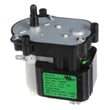
- Refrigerator evaporator fan motor WP2315549 (moves cold air through the freezer and into the fresh-food section)
- Refrigerator electronic, control W11196400 (manages temperatures and operating cycles)
- Refrigerator water inlet valve WPW10179146 (feeds water to the ice maker and dispenser)
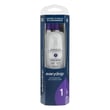
- Refrigerator cartridge EDR1RXD1 (can restrict water flow when clogged)
Cooling and airflow issues can cause food spoilage, excessive frost, long run times, and weak ice production. Catching simple causes (blocked vents, dirty condenser area, door sealing) early often prevents unnecessary part replacement.
Last updated: January 2026