Installation guide
 Owner’s manual
 Error Codes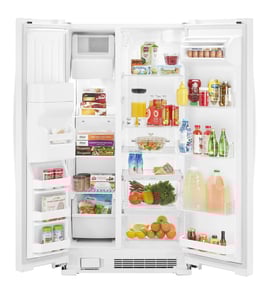

How old is my KitchenAid by serial number?
For your KitchenAid built-in refrigerator model KSSP42QTS00, we determine the age by reading the serial number on the model and serial tag, then decoding the date code embedded in that serial. The exact format varies by production era, so we use the decoding method shown in your owner's manual.
Where to find the serial number on KSSP42QTS00
On this KitchenAid built-in side-by-side, the model and serial number label is on the refrigerator itself (not on the packaging). Use the label to record both numbers before you start decoding.
- Open the refrigerator compartment and look along the inside cabinet walls
- Check near the top side walls or ceiling area inside the fresh food section
- Check behind the crisper drawers area if you do not see it up top
- Write down the full serial number exactly as shown (letters and numbers)
How serial number date codes typically work
KitchenAid serial formats have changed over time. Most systems include a year indicator and a week (or production sequence) indicator.
- One character indicates the production year (often a letter)
- One or two characters indicate the production week
- Some older formats use digits where the last two digits represent the year
- Some formats repeat on a cycle, so the same year code can map to more than one calendar year
Quick decode checklist
- Confirm you are reading the serial number (not the model number)
- Look for a letter that could represent the year
- Look for 2 digits that could represent the week (01 to 52)
- If the code repeats, use the refrigerator’s approximate age and styling to pick the correct decade
Why it matters
Knowing the build date helps us match the correct KitchenAid parts and revisions for KSSP42QTS00, especially for common service items like the water filter system, controls, and door switches.
| What you need | Why we need it | Where you’ll use it |
|---|---|---|
| Model number (KSSP42QTS00) | Identifies the exact product platform | Parts lookup and diagrams |
| Serial number | Contains the date code | Age decoding and parts revisions |
| Purchase/installation date (if known) | Helps resolve repeating year codes | Confirms the correct year |
Last updated: February 2026
What is holiday mode on a KitchenAid refrigerator?
Holiday Mode on your KitchenAid KSSP42QTS00 is a vacation and observance feature that keeps your temperature set points the same while turning off the interior lights and disabling the ice maker (and, on some models, disabling the dispenser levers and lights). See the KSSP42QTS00 owner's manual for the exact button steps for your control and dispenser panels.
What Holiday Mode changes (and what it does not)
When Holiday Mode is on, we expect these behaviors:
- Refrigerator and freezer temperature set points stay unchanged
- Interior lights turn off
- Ice maker is disabled
- On some models, dispenser levers are disabled and dispenser lights turn off
- You should exit Holiday Mode when you no longer need it for best overall operation
Quick behavior summary
| Feature | In Holiday Mode | Why you notice it |
|---|---|---|
| Temperature set points | Stay the same | Food stays at your chosen temps |
| Ice maker | Off/disabled | No new ice production |
| Interior lights | Off | Lights do not come on when doors open |
| Dispenser (some models) | Disabled, display shows “HOL” | No water/ice dispensing from the lever |
How to turn Holiday Mode on and off (KSSP42QTS00)
Holiday Mode can require activation in two places depending on your exact configuration.
- Control panel: press HOLIDAY MODE to turn it on; press again to turn it off.
- Dispenser panel (some models): press and hold ICE + LIGHT + LOCKOUT together for 3 seconds to turn it on; repeat for 3 seconds to turn it off.
Important note about Max Cool
If Max Cool was selected before Holiday Mode, the refrigerator can temporarily hold the Max Cool set points (commonly 34°F fresh food and -5°F freezer) until Max Cool times out; Holiday Mode still keeps the lights and ice maker off until you turn Holiday Mode off.
Why it matters
Holiday Mode is designed for travel and for situations where you want lights and ice production off without changing your temperature settings. That helps prevent unnecessary ice buildup and keeps the refrigerator operating normally while you are away.
Last updated: February 2026
How to read KitchenAid model number?
On your KitchenAid built-in refrigerator model KSSP42QTS00, the model number is printed on the appliance’s model and serial number label. We use that full model number to match the correct parts list, diagrams, and documentation for your exact refrigerator.
Where to find the model number label
Check these common locations on built-in side-by-side refrigerators:
- Inside the fresh food compartment on a side wall near the crisper area
- Along the cabinet frame near the top, behind the refrigerator door
- Inside the freezer compartment on a side wall
- Behind the toe grille or lower kickplate area (on some built-in designs)
- On the cabinet frame near the hinge side (door open)
For the exact label location and how it’s shown for this model, use the KSSP42QTS00 owner's manual.
How to “read” the model number for parts matching
For ordering parts and looking up diagrams, the most important rule is to use the entire model number exactly as printed.
- Copy it character-for-character (letters and numbers)
- Keep any suffixes (for example, “00”) because they can change the parts used
- Use the model number (not the serial number) to find parts like a water filter, door gasket, or control board
Quick guide
| What you see on the label | What it’s used for | Example for this unit |
|---|---|---|
| Model number | Identifies the exact design and parts | KSSP42QTS00 |
| Serial number | Identifies the production unit/date | Varies by unit |
Why it matters
KitchenAid built-in refrigerators often have multiple versions that look similar but use different components (controls, sensors, door parts, and water system parts). Using KSSP42QTS00 prevents ordering the wrong part and avoids fit or wiring mismatches.
Last updated: February 2026
What is the most common problem with a KitchenAid refrigerator?
The most common KitchenAid refrigerator problems are cooling complaints (warm fridge or freezer), ice maker or water dispenser issues, and water leaks. On the KitchenAid KSSP42QTS00, these symptoms most often trace back to airflow problems, defrost/drain issues, or water supply components; use the owner's manual for model-specific operating and care checks.
Most common symptoms and what usually causes them
- Warm refrigerator section: restricted airflow, evaporator fan issue, or a temperature sensor problem
- Frost buildup on the back wall or poor cooling: defrost system trouble (heater circuit, defrost thermostat/bi-metal)
- No ice or slow ice production: water supply restriction, filter blockage, or inlet valve problem
- Water leaking inside or under the unit: clogged/iced drain, loose water tube fitting, or valve seepage
- Unusual noises: fan blade rubbing ice, condenser fan noise, or vibration from panels/trim
Quick checks we recommend before replacing parts
- Confirm controls are set correctly and doors seal fully.
- Check for heavy frost in the freezer (points to a defrost/airflow issue).
- If water flow is weak, replace the filter and purge air from the dispenser.
- Inspect for leaks at tubing connections and the inlet valve area.
- Clean condenser coils and verify the condenser fan runs when the compressor runs.
Common parts that match these problems (KSSP42QTS00)
| Symptom | Likely system | Example part on this model |
|---|---|---|
| Weak water flow, bad taste/odor | Filtration | Refrigerator water filter EDR3RXD1 |
| Frost buildup, warm temps | Defrost | Refrigerator defrost bi-metal WPW10225581 |
| No water to dispenser/ice maker | Water supply | Refrigerator inlet valve W10876668 |
| Noisy or warm fridge section | Air circulation | Refrigerator evaporator fan blade WP2169142 |
Why it matters
Cooling, ice, and leak complaints usually share one root cause: airflow or water flow is being restricted. Fixing the restriction early helps protect food temperatures, reduces frost buildup, and prevents recurring puddles.
Last updated: February 2026
What is the average lifespan of a KitchenAid refrigerator?
Most KitchenAid refrigerators last about 14 to 17 years with normal household use and basic maintenance. For your KitchenAid KSSP42QTS00 built-in side-by-side refrigerator, keeping airflow clear and temperatures stable is the biggest factor in reaching that typical lifespan.
What affects lifespan the most
- Condenser coil cleanliness (dust buildup makes the sealed system work harder)
- Door seal condition (air leaks cause longer run times and temperature swings)
- Stable temperatures (avoid frequent warm-ups from propped doors or overloading)
- Good airflow inside the cabinet (don’t block vents with food packages)
- Water system upkeep if equipped (replace filters on schedule to maintain flow)
Typical lifespan ranges (what we see most often)
| Refrigerator type | Typical lifespan | Notes |
|---|---|---|
| Built-in refrigerator (like KSSP42QTS00) | 14 to 17 years | Often lasts longer when coils and seals are maintained |
| Standard freestanding refrigerator | 10 to 15 years | More variation by usage and environment |
Maintenance checklist that helps you reach the average
- Vacuum and brush the condenser area regularly (frequency depends on pets and dust)
- Confirm doors close and seal evenly; correct sagging or misalignment early
- Keep freezer around 0°F and fresh food around 37°F for balanced run time
- Replace the water filter when flow drops or taste changes; use the correct filter style
- Address unusual noises quickly (fan blade rubbing, clicking relays, or buzzing)
Why it matters
A refrigerator usually fails early from heat stress (dirty condenser, restricted airflow) or air leaks (worn gaskets). Reducing run time and keeping temperatures steady protects major components like the compressor and evaporator.
For model-specific care and settings, follow the maintenance guidance in the KSSP42QTS00 owner's manual.
Last updated: February 2026