Error Codes



How do you put the bottom grill on a GE refrigerator?
On your GE CYE22TP2MES1 bottom-mount refrigerator, the bottom grill (base grille or toe grille) installs by aligning it with the lower front mounting slots, snapping or sliding it into place, then reinstalling any retaining screws so it sits flush and doesn’t rattle.
- Unplug the refrigerator or switch off power at the breaker (safer around wiring and fans).
- Pull the refrigerator forward a few inches for working room.
- If your model uses screws, have a Phillips screwdriver ready.
- Check that the grill isn’t warped and that the tabs are intact.
- Position the grill at the bottom front of the cabinet.
- Line up the tabs/clips on the grill with the matching slots along the lower frame.
- Engage one side first, then work across the grill, pressing until it seats evenly.
- Reinstall screws (if your grill uses them) and tighten until snug.
- Confirm fit: the grill should be level, flush, and not pop loose when you tug lightly.
- Tabs not fully seated: remove and reinstall, pressing along the full length.
- Obstruction: make sure insulation, wiring, or the drain pan edge is not blocking the grill.
- Cabinet not level: leveling legs that are too high or low can twist the opening.
- Damaged mounting points: cracked slots or broken grill clips prevent a secure fit.
| What to check | What “good” looks like | What to do if it’s not right |
|---|---|---|
| Grill alignment | Even gap, sits flat | Re-seat tabs; start from one side |
| Rattling/vibration | Quiet during compressor run | Tighten screws; re-seat clips |
| Door clearance | Doors open freely | Reposition grill; verify level |
A properly installed base grille helps protect lower components, supports airflow, and reduces vibration noise. If you’re also chasing cooling or noise issues, checking airflow-related parts like the refrigerator fresh food fan motor assembly WR60X35205 can be a smart next step.
Last updated: February 2026
What is the most common problem with a GE refrigerator?
The most common GE refrigerator complaint is not cooling properly (fresh food warm, freezer warming, or temps swinging). On GE model CYE22TP2MES1, the usual causes are airflow problems, a defrost issue, or a failed sensor or fan that prevents the control from regulating temperature correctly.
- Fridge warm, freezer OK: fresh food airflow issue or a weak fresh food fan
- Freezer warm, fridge warm: sealed system or compressor-related cooling loss
- Temps swing up and down: temperature sensing or control problem
- Frost buildup on back wall/freezer: defrost system problem
- Clicking, buzzing, or humming changes: fan motor, compressor start components, or ice maker/dispenser area
- Confirm vents are not blocked by food packages (air must circulate).
- Set temps to normal targets: 37°F fresh food, 0°F freezer; wait 24 hours for stabilization.
- Clean condenser area (dust buildup raises temps and run time).
- Check door seal for gaps and make sure doors close fully.
- If you have an error code, use the model’s code list to narrow the failure.
| Symptom | Likely system | Example part on this page |
|---|---|---|
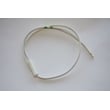
| Temps inaccurate or erratic | Temperature sensing | Refrigerator temperature sensor WR55X10025 |
| Fridge section warm, weak airflow | Fresh food fan | Refrigerator fresh food fan motor assembly WR60X35205 |
| Frost buildup, poor cooling | Defrost system | Refrigerator defrost heater WR51X10132 or refrigerator defrost bi-metal thermostat WR50X10108 |
| Random behavior, no response | Controls | Refrigerator main control board WR55X46805 |
When a refrigerator runs warm, food safety and compressor wear become immediate concerns. Catching airflow, defrost, or sensor problems early often prevents longer run times, ice buildup, and repeat temperature swings.
Last updated: February 2026
What is the CYE22TP2MES1?
The CYE22TP2MES1 is a GE bottom-mount refrigerator model number. We use this model number to match the correct replacement parts and diagrams for your specific refrigerator, such as the water filter, temperature sensor, control board, and door gasket.
For GE refrigerators, the model number is the fastest way to ensure part compatibility because similar-looking units can use different electronics, sensors, and door components.
Common items that are model-matched on CYE22TP2MES1 include:
- Water filtration parts (filter and housing style)
- Cooling system controls (main control board, sensors)
- Defrost system parts (heater, bi-metal thermostat)
- Door and dispenser components (switches, displays, gaskets)
- Fan motors that move air through the fresh food section
Here are examples of parts listed for GE model CYE22TP2MES1 on this page:
| What it does | Example part on this page | When you would replace it |
|---|---|---|
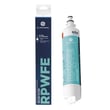
| Filters drinking water | GE refrigerator water filter RPWFE | Bad taste/odor, slow flow, filter light on |
| Senses temperature | Refrigerator temperature sensor WR55X10025 | Temps swing, warm fridge/freezer, error symptoms |
| Controls cooling functions | Refrigerator main control board WR55X46805 | No cooling, intermittent operation, multiple symptoms |
| Seals freezer door | Refrigerator freezer door gasket WR14X36194 | Frost buildup, moisture, door not sealing |
Using the exact model number CYE22TP2MES1 prevents ordering the wrong GE refrigerator parts. That saves time and helps ensure repairs like water filter changes, defrost fixes, and cooling troubleshooting go smoothly.
Last updated: February 2026
What's better, top mount or bottom mount fridge?
A bottom-mount refrigerator like the GE CYE22TP2MES1 is better when you want everyday fresh-food items at eye level and more flexible organization; a top-mount is better when you want a simpler layout and typically lower purchase and repair costs. The best choice depends on how you shop and cook.
| Feature | Top-mount (freezer on top) | Bottom-mount (freezer on bottom) |
|---|---|---|
| Fresh-food access | You bend more often | More convenient, less bending |
| Freezer access | Easier to reach | Often a pull-out drawer |
| Organization | Usually simpler | Often more bins, drawers, dividers |
| Energy use | Often slightly lower | Often slightly higher |
| Typical price | Usually lower | Usually higher |
- You use the refrigerator section far more than the freezer.
- You want wide shelves and better visibility for produce, leftovers, and drinks.
- You prefer freezer drawers and baskets for sorting frozen foods.
- You want a premium feature set (dispenser, controls, lighting) more often found on bottom-mount designs.
- You want the most straightforward layout with fewer moving parts.
- You want a lower upfront cost and often lower long-term repair cost.
- You do not mind bending to reach fresh-food shelves and drawers.
- You want a lighter door and simpler hinge setup.
The “better” fridge is the one that matches your daily habits. If you are constantly in the fresh-food section, a bottom-mount design like CYE22TP2MES1 reduces bending and makes organization easier. If you prioritize simplicity and value, a top-mount can be the smarter long-term choice.
If you are comparing designs because of maintenance or performance concerns, these parts are commonly involved in cooling, water, and usability on this model:
- Refrigerator temperature sensor WR55X10025 (temperature accuracy)
- GE refrigerator water filter RPWFE (water and ice quality)
- Refrigerator fresh food fan motor assembly WR60X35205 (airflow in the fresh-food section)
- Refrigerator freezer door gasket WR14X36194 (seal and efficiency)
Last updated: February 2026