Owner’s manual



What is the average lifespan of a Samsung dryer?
Most Samsung dryers, including model DV45K6500GV, typically last 10 to 15 years with normal household use. Consistent airflow maintenance (lint filter and venting) and avoiding overloads are the biggest factors that push lifespan toward the high end; neglected airflow shortens it.
- Airflow and heat management: clean the lint screen every load; keep venting clear
- Load size: repeated overloading strains the drum belt, rollers, and motor
- Cycle choices: high heat on every load increases wear on thermostats and sensors
- Installation quality: crushed or long vent runs increase drying time and heat stress
- Routine cleaning: lint buildup inside the cabinet can accelerate component wear
- Clean the lint screen every cycle.
- Inspect and clean the exhaust duct and outside hood regularly.
- Keep the dryer level to reduce drum and roller wear.
- Do not run with a blocked vent or weak airflow.
- If drying times increase, address airflow before replacing parts.
| Wear item | What you may notice | Why it matters |
|---|---|---|
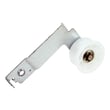
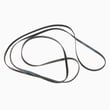
| Drum belt | Drum not turning, squealing | A slipping belt can stop the drum and overwork the motor |
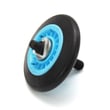
| Drum support rollers | Thumping, rumbling | Worn rollers stress the drum and can damage support surfaces |
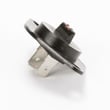
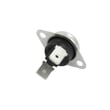
| Thermostats/sensors | Overheating, poor drying | Heat control problems shorten component life and can trip safety cutoffs |
If you are planning long-term upkeep for DV45K6500GV, the DV45K6500GV manual is the best place to confirm the recommended venting limits, cleaning intervals, and cycle guidance for your exact configuration.
A dryer that is forced to run longer (usually from restricted venting) racks up extra heat and run time on the motor, belt, and temperature controls. Fixing airflow early is the simplest way to extend service life and keep drying performance consistent.
Last updated: February 2026
How to find part number for Samsung dryer?
To find the correct part number for your Samsung dryer, we match parts to the exact model number on the appliance ID label. For Samsung model DV45K6500GV, the label is typically on the front frame behind the door; if it is missing or unreadable, check the back panel for a secondary label.
Check these common locations first:
- Open the dryer door and look on the front frame (door opening area)
- Check the rear panel for a second label
- Look for a label that lists MODEL and SERIAL
- Write the model number exactly as shown (letters and numbers)
Once you have the model number, use it to look up the part you need in the diagrams and parts list for your dryer.
- Confirm the model is DV45K6500GV (not a similar DV45K series model)
- Identify the failed part by symptom (no heat, won’t start, noisy, etc.)
- Use the parts diagram to find the part name, then match the manufacturer part number
- If multiple similar parts appear, match by location and description in the diagram
| Symptom | Common part involved | Example part number for this model |
|---|---|---|
| Thumping or rumbling | Drum support roller | DC97-16782A |
| Squealing or drum not turning | Drum belt | 6602-001655 |
Samsung dryers often have multiple versions that look alike, and parts can vary by revision. Using the exact model number from the ID label helps ensure the part number you order fits and installs correctly.
For label location details and model-specific diagrams, use the DV45K6500GV manual.
Last updated: February 2026
Is it worth replacing a heating element in a Samsung dryer?
Yes; replacing the heating element is usually worth it when the rest of your Samsung dryer is in good shape, because the part cost is typically far less than a new dryer. For the DV45K6500GV, it is most cost-effective when you confirm the no-heat problem is not being caused by airflow restrictions or a failed thermostat or sensor (see the DV45K6500GV manual).
We recommend replacing the heater when the dryer tumbles normally but produces little or no heat, and basic checks point to a heating circuit failure.
- The drum turns and the timer runs, but clothes stay cold or damp
- You have good airflow at the outside vent hood after cleaning lint buildup
- The dryer is otherwise reliable (no loud squealing, burning smell, or repeated shutdowns)
- You can test components with a multimeter (or you are paying for a diagnosis)
- The repair cost is comfortably below the cost of replacement
A “bad heating element” symptom is often caused by a safety device opening due to overheating or poor venting.
- Clean the lint screen and the entire vent run (including the outside hood)
- Check for crushed or kinked vent ducting behind the dryer
- Inspect and test the high-limit thermostat and thermal cut-off
- Test the temperature sensor (thermistor) used to regulate heat
- If the dryer will not start, check the door switch first
| Symptom | Often involved | Example part for DV45K6500GV |
|---|---|---|
| No heat or heat cuts out | Thermal cut-off / safety thermostat | Dryer thermal cut-off thermostat DC47-00016A |
| Overheats or shuts down on high heat | High-limit thermostat | Dryer high-limit thermostat DC47-00017A |
| Heat is erratic or cycles oddly | Thermistor (temperature sensor) | Dryer thermistor DC32-00007A |
A failed heater can be a straightforward fix, but restricted airflow can repeatedly trip safety thermostats and shorten the life of the heater and motor. Verifying venting and testing the heat-control parts first helps you avoid replacing the wrong component.
For code-based troubleshooting, we use the Samsung dryer error codes guide alongside the DV45K6500GV diagnostics.
Last updated: February 2026