 Owner’s manual
 Error Codes



What is the average lifespan of a Kenmore Elite refrigerator?
Most Kenmore Elite refrigerators, including model 59676523500, typically last 10 to 15 years with normal household use; strong maintenance habits can push service life longer, while heavy use, poor airflow, or neglected cleaning often shortens it.
Typical lifespan and what to expect
For a bottom-mount refrigerator like Kenmore Elite 59676523500, the “average” lifespan is mainly driven by compressor run time, door seal condition, and how clean the condenser area stays.
- Typical service life: 10 to 15 years
- Common midlife repairs: ice maker, door switch, lights, water system leaks
- Higher-cost late-life repairs: sealed system or compressor related issues
- Best way to extend life: keep airflow clear and temperatures stable
Maintenance that adds years
Use the care and cleaning guidance in the 59676523500 owner's manual as your baseline, then focus on these high-impact habits:
- Vacuum dust from the condenser area and toe-kick regularly
- Keep door gaskets clean so doors seal without gaps
- Avoid overpacking; blocked vents reduce airflow and cooling performance
- Replace water filters on schedule (if equipped) to protect the water system
- Level the refrigerator so doors close fully and consistently
Quick “repair or replace” guide
| Situation | What it usually means | Practical next step |
|---|---|---|
| Runs constantly, warm temps | Airflow, dirty coils, gasket leak | Clean, check seals, verify settings |
| Water under fridge | Drain or water line issue | Inspect tubing and fittings |
| No ice or small cubes | Water supply or ice maker issue | Check supply, then test ice maker |
| Cooling loss with loud clicking | Compressor start or sealed system | Professional diagnosis recommended |
Why it matters
Knowing the 10 to 15 year average helps us plan smart repairs. Lower-cost fixes (lights, switches, ice maker components) often make sense at almost any age, while sealed-system repairs are usually the tipping point where many owners compare repair cost vs. replacement.
Last updated: January 2026
What size is Kenmore refrigerator model 59676523500?
Kenmore Elite refrigerator model 59676523500 is a bottom-freezer (bottom-mount) refrigerator. For overall “size” (width, height, depth, and capacity), the exact measurements are listed in the specifications section of the 59676523500 owner's manual.
What “size” usually means (and what to check)
When customers ask for refrigerator size, it typically refers to one or more of these:
- Overall width (to confirm it fits between cabinets)
- Overall height (to clear upper cabinets)
- Overall depth (especially depth with doors and handles)
- Capacity in cubic feet (fresh food plus freezer)
- Door swing clearance (space needed to fully open doors and drawers)
Typical size range for this style
Most Kenmore bottom-freezer refrigerators of this era commonly fall into these ranges. Use this as planning guidance, then confirm the exact spec in the manual.
| Measurement | Typical range for bottom-freezer refrigerators |
|---|---|
| Width | 29 to 33 inches |
| Height | 66 to 70 inches |
| Depth (with doors) | 32 to 35 inches |
| Capacity | 18 to 25 cu. ft. |
How we recommend measuring your space
To avoid a tight fit, measure the opening and compare it to the refrigerator’s published dimensions.
- Measure width at the front and back of the cabinet opening
- Measure height to the lowest overhead obstruction
- Measure depth to the front edge of counters (note handle clearance)
- Leave air space around the cabinet for ventilation (use the manual’s guidance)
- Confirm water line access if you use the ice maker or dispenser
Why it matters
Correct sizing prevents installation headaches like doors that cannot open fully, drawers that hit trim, poor airflow that hurts cooling performance, and kinks in the water supply line that can reduce ice production.
Last updated: January 2026
What are the common problems with Kenmore Elite refrigerators?
Common problems on the Kenmore Elite 59676523500 bottom-mount refrigerator include warm temperatures from dirty condenser coils or a door not sealing, water or ice issues caused by low water pressure or a clogged filter, and “new” noises that are often normal operation. Use the 59676523500 owner's manual troubleshooting chart to match symptoms to the right fix.
Most common symptoms and what usually causes them
- Refrigerator runs too often: dirty condenser coils, doors opened frequently, controls set too cold, door not closing fully.
- Water droplets inside: high humidity or frequent door openings; gasket not sealing well.
- Unfamiliar sounds: normal operation sounds can seem louder as the unit cycles.
- Leaking water: improper water connection materials or valve type; low water pressure.
- Slow water flow or small/hollow ice: low water pressure, clogged water filter.
Quick checks we recommend first
- Confirm doors close fully and gaskets seal all the way around.
- Clean condenser coils and make sure airflow around the cabinet is not blocked.
- If you have dispenser or ice issues, verify household water pressure and look for kinked tubing.
- Avoid self-piercing or saddle valves; they commonly restrict flow and clog over time.
- If the ice maker is not producing ice after water supply checks, inspect the ice maker assembly.
| Problem | Most likely cause | Best first step |
|---|---|---|
| Runs too frequently | Dirty coils or door not sealing | Clean coils; check gasket seal |
| Slow dispenser flow | Low pressure or clogged filter | Check pressure; replace filter |
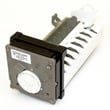
| Ice maker issues | Low pressure or ice maker fault | Check supply; inspect refrigerator ice maker D7824706Q |
| Water leak | Poor connection materials/valve | Recheck connection; use proper tubing |
Why it matters
These issues often stack together. For example, a door that is not sealing can make the refrigerator run too frequently, raise humidity (causing droplets), and worsen ice production by warming the freezer.
When a repair is more likely needed
If you have verified good airflow, good door seal, and good water pressure but symptoms continue, use the troubleshooting section in the 59676523500 owner's manual to pinpoint the next component to test.
Last updated: January 2026





