
How do I fix the loc on my dryer?
On your Whirlpool dryer model GEQ8811KT0, LOC means the control lock is turned on, so the controls will not respond and the dryer may not start. Press and hold the Control Lock button (or the key with a lock icon) for about 3 seconds to unlock.
- Press Power/Cancel once to wake the control panel.
- Press and hold Control Lock for 3 seconds.
- Wait for the indicator to turn off (or for a beep).
- Try Start.
- If it re-locks, check for a stuck key or moisture on the console.
Some Whirlpool dryers use a different key combination. Try these common options (hold for about 3 seconds):
- End of Cycle Signal
- Dryness Level
- Temp
If LOC appears with other symptoms (no heat, shuts off mid-cycle), check for airflow restrictions that can trigger safety shutoffs.
If the dryer still will not run after unlocking, these issues are more likely:
| Symptom | Common cause | What to check next |
|---|---|---|
| No start, no drum movement | Door not sensed closed | Door strike alignment, door switch |
| Starts then stops quickly | Overheating protection tripped | Lint screen, vent, blower housing |
| Runs but no heat | Heating circuit fault | Element, thermal fuse, cut-off kit |
Parts that commonly relate to “no heat” or “stops early” on this model include the dryer thermal fuse WP3390719 and the dryer heating element WP3387747.
Control Lock prevents accidental cycle changes, but it can look like a failure when the panel will not respond. Unlocking first saves time before troubleshooting parts like the timer, motor, or heating system.
Last updated: January 2026
Is my dryer 110 or 220?
For the Whirlpool GEQ8811KT0 electric dryer, the dryer itself runs on 240 volts (often called 220/230/240V). It uses a dedicated dryer receptacle and circuit; the motor and controls use 120V internally, but the heater needs 240V.
Check the outlet and breaker feeding the dryer circuit.
- Dryer outlet shape: Most electric dryers use a large 3-slot or 4-slot receptacle (not a standard 110/120V plug).
- Breaker size: Electric dryers are typically on a 30-amp double-pole breaker (two linked handles).
- Cord type: Newer installs commonly use a 4-wire cord; older installs may use a 3-wire cord.
- Label check: The model/serial tag on the dryer cabinet usually lists the required voltage and amperage.
The “110 vs 220” confusion often comes from the cord style, not the dryer voltage.
| What you see | Typical setup | What it tells you |
|---|---|---|
| 3-slot dryer outlet | Older 3-wire circuit | Still a 240V dryer circuit |
| 4-slot dryer outlet | Newer 4-wire circuit | Still a 240V dryer circuit |
Using the correct 240V, 30A supply prevents no-heat problems, nuisance breaker trips, and wiring damage. If the dryer tumbles but will not heat, power supply issues and heating circuit parts are common suspects, including the dryer heating element WP3387747 and the dryer thermal fuse WP3390719.
- Turn off the double breaker before inspecting the cord/terminal block area.
- Confirm the cord matches the outlet (3-wire vs 4-wire).
- If you smell burning or see melted wiring, stop and have the circuit inspected.
Last updated: January 2026
What does F1 mean on a dryer?
On a Whirlpool dryer model GEQ8811KT0, an F1 code typically points to an electronic control problem (often the main control or a stuck/failed input). Start with a power reset and basic checks; if the code returns, focus on the control and wiring.
- Unplug the dryer (or switch off the breaker) for 5 minutes, then restore power and try a cycle.
- If the dryer is running, stop using it until you confirm airflow is clear; overheating can trigger control faults.
- Check the terminal block area for a burnt smell or loose connections (power off first).
- If the code appears immediately at power-up, suspect the control or user interface input.
- If the code appears mid-cycle, suspect heat, vibration, or intermittent wiring.
- Failed electronic control (internal relay or logic fault)
- Stuck button or shorted input on the console
- Loose, damaged, or corroded wire connections
- Overheating from restricted venting (can stress controls)
If your GEQ8811KT0 also has heat or airflow symptoms, these parts are common checks:
- Dryer thermal fuse WP3390719 (opens if the dryer overheats)
- Dryer heating element WP3387747 (shorts can cause abnormal heating)
- Dryer blower wheel WP697772 (broken or slipping wheel reduces airflow)
| Symptom with F1 | Most likely area | What we check next |
|---|---|---|
| F1 right away | Control/console input | Inspect console buttons and harness plugs |
| F1 after heating | Airflow/overheat stress | Vent restriction, thermal fuse, heater wiring |
| F1 intermittent | Loose connection | Harness seating, rubbed wires, vibration points |
An F1 code is often the dryer telling you the control is seeing an invalid condition. Clearing airflow issues and confirming safe electrical connections helps prevent repeat failures and protects key components like the heater and thermal fuse.
For additional code patterns and what they mean across Whirlpool dryer platforms, use our Whirlpool duet dryer error codes reference.
Last updated: January 2026
What is the most common problem with whirlpool dryers?
The most common Whirlpool dryer problem (including model GEQ8811KT0) is no heat or poor drying, usually caused by restricted venting that overheats the dryer and trips safety parts. A close second is not starting or not tumbling, often tied to a failed fuse, switch, or drum support parts.
- Runs but no heat: failed heater circuit parts, blown safety fuse, or power supply issue (electric dryers)
- Takes too long to dry: clogged lint screen, crushed vent, blocked exterior hood, or weak airflow
- Won’t start: door switch issue, blown thermal fuse, timer/switch problem, or motor problem
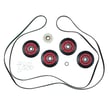
- Loud thumping/squealing: worn rollers, idler pulley, or blower wheel
- Stops mid-cycle: overheating from vent restriction, motor overheating, or failing timer
If your dryer is overheating or won’t run, these are frequent fixes for this model:
- Dryer thermal fuse WP3390719
- Dryer heating element WP3387747
- Dryer idler pulley 279640
- Support WPW10314173
- Dryer blower wheel WP697772
- Clean the lint screen and confirm strong airflow at the outside vent hood.
- Inspect the vent run for kinks, crushed flex duct, or heavy lint buildup.
- For electric dryers, confirm the outlet is supplying 240V (a dryer can run on 120V but not heat).
- If the drum turns but drying is weak, focus on airflow and the heating circuit.
| What you notice | Most likely cause | Typical next step |
|---|---|---|
| No heat | Heater circuit failure or blown safety fuse | Test heater and fuse; replace failed part |
| Long dry times | Vent restriction | Clean venting end-to-end |
| Won’t start | Door switch or thermal fuse | Check door closure; test fuse/switch |
| Loud noise | Rollers/idler/blower wheel | Inspect rotating parts; replace worn items |
Restricted venting is the root cause behind many “Whirlpool dryer problems” because it raises operating temperature, reduces drying performance, and can repeatedly blow safety components like the thermal fuse.
Related help: how to keep a dryer clean and economical
Last updated: January 2026