Installation guide
 Owner’s manual
 Error Codes


Are all refrigerators 70 inches high?
No. Refrigerator height varies a lot by style and capacity; many popular full-size models land near 70 inches, but plenty of top-freezer and top-mount refrigerators are shorter, and some built-in units are much taller. For exact fit planning, use the clearances and measuring guidance in the 2537481340G owner's manual.
Heights vary by brand and configuration, but these ranges are common when shopping or replacing a unit:
- Compact/mini refrigerators: about 20 to 36 inches
- Many top-freezer/top-mount models: about 61 to 67 inches
- Many side-by-side and French door models: about 68 to 71 inches
- Built-in/tall specialty units: 80 inches and up
Even if the cabinet opening is tall enough, you still need space for airflow and hookups. For Kenmore model 2537481340G, the installation guidance calls for:
| Location | Typical clearance to allow |
|---|---|
| Sides and top | 3/8 inch |
| Back | 1 inch |
Also plan extra room on the hinge side if the refrigerator sits against a wall so the door can open wider.
Use this checklist to avoid a tight fit or door-swing problems:
- Measure opening height, width, and depth in at least 3 spots (floors and cabinets are rarely perfectly square).
- Measure with baseboards, trim, and flooring in place.
- Confirm you have clearance behind the unit for the power cord and (if used) the water line.
- Check door swing and handle clearance; allow extra space if the hinge side is near a wall.
- Plan a path into the kitchen (doorways, turns, and ceiling height).
A refrigerator that is “about 70 inches” can still fail to fit once you account for leveling, airflow space, and door opening clearance. Planning for both the cabinet opening and the required clearances helps prevent cooling issues and installation headaches.
Last updated: February 2026
How many cubic feet is a Kenmore freezer model 2537481340G?
The Kenmore 2537481340G is a top-mount refrigerator (not a standalone freezer), and the exact cubic-foot capacity is listed on the model’s rating information and in the specifications section of the owner's manual. Use that spec to match storage needs and ensure the refrigerator fits your space.
Check these common places first (they are the fastest way to get the correct number for your exact configuration):
- The specifications section in the owner's manual
- The model and serial plate inside the fresh food compartment (the manual notes it’s located inside the refrigerator compartment)
- Any product label or spec page included with your purchase paperwork
- If you are measuring usable space, measure shelf and bin layout after you set temperatures and load normally
Cubic feet is the total interior volume (fresh food plus freezer). Usable space is always a bit less because shelves, drawers, the ice maker, and air channels take up room.
| Measurement | What it represents | Why it matters |
|---|---|---|
| Total capacity (cu ft) | Fresh food + freezer volume | Comparing models and fit for household size |
| Freezer capacity (cu ft) | Freezer compartment volume only | Frozen food planning and bulk storage |
| Usable space | What you can actually pack | Shelves, bins, ice maker reduce space |
Capacity affects food storage planning, energy use habits, and how quickly the refrigerator stabilizes after loading. For example, the manual recommends letting the refrigerator run with doors closed for 8 to 12 hours before loading food so temperatures can stabilize.
If your refrigerator has an ice maker installed, it can reduce usable freezer room. These model-compatible parts are commonly involved:
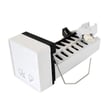
- Ice maker 5304458371 (ice maker assembly)
- Ice maker mold 241798231 (mold component used in ice production)
- Refrigerator spill-safe shelf 240358926 (fresh food shelf layout can shift what you store up top)
Last updated: February 2026
How to tell what model Kenmore refrigerator?
Your Kenmore refrigerator model number is printed on the serial plate inside the fresh food (refrigerator) compartment. For Kenmore model 2537481340G, the owner's manual also notes the serial plate location and is the best reference when you need the exact model number for parts.
Check these common spots inside the refrigerator compartment:
- On an interior side wall
- On the ceiling area near the light
- Behind or beside the crisper drawers
- Near the lower front frame (just above the kick plate area)
- On the serial plate inside the refrigerator compartment (common for Kenmore 253 and 970 prefixes)
Having the full model number (letters and numbers) matters because it lets us match the correct parts list, diagrams, and documentation.
| What you need | Why it matters | Example |
|---|---|---|
| Model number | Identifies the exact design and parts breakdown | 2537481340G |
| Serial number | Helps identify production run details | Found on same serial plate |
| Purchase date | Useful for maintenance and warranty paperwork | Your receipt or records |
- Write the model number exactly as shown, including any suffix letters.
- Take a clear photo of the serial plate before ordering parts.
- If the label is hard to read, copy it character-by-character; one digit off can pull the wrong Kenmore parts.
Kenmore refrigerators often share similar styling across multiple model families, but parts like door gaskets, shelves, and ice maker components can vary by model. Using the correct model number helps prevent ordering the wrong refrigerator parts and reduces downtime.
Last updated: February 2026
What are the disadvantages of a top mount fridge?
Top-mount refrigerators like the Kenmore 2537481340G put the freezer on top and the fresh-food section below, so the main tradeoffs are less convenient access to everyday items and fewer premium features compared with many bottom-freezer designs. The layout is simple and reliable, but it is not the most ergonomic.
- You bend more often to reach fresh foods in the refrigerator compartment.
- Fresh-food shelves and crisper drawers can feel less “at eye level” for organizing.
- Freezer space is typically narrower, which can limit bulky items like pizza boxes.
- Fewer built-in convenience features are common (for example, external water and ice dispensing).
- Door swing clearance can be more of a planning issue in tight kitchens.
Your installation setup can make the disadvantages feel bigger or smaller. For this style, we follow the clearance guidance in the installation guide so airflow and door opening are not restricted.
| Consideration | What it affects | Practical tip |
|---|---|---|
| Door swing near a wall | Access to shelves and crispers | Leave extra hinge-side space if the unit sits against a wall |
| Airflow clearance | Cooling performance and noise | Keep the toe grille area clear and allow recommended clearances |
| Room temperature | Temperature stability | Avoid installing where temps drop below 55°F or rise above 110°F |
Most households use the refrigerator section far more than the freezer. With a top-mount design, the most-used items sit lower, so comfort and organization become the main “cost” of the simpler layout.
- Keep everyday items on the upper refrigerator shelves to reduce bending.
- Use bins to group foods so you can pull items forward instead of reaching deep.
- Avoid overpacking the freezer so air can circulate and items stay accessible.
- Make sure the refrigerator is level to help doors close and seal consistently.
Last updated: February 2026