Owner’s manual
 Error Codes


How many cubic feet is a side-by-side refrigerator?
Most side-by-side refrigerators are about 21 to 25 cubic feet total capacity. For your Kenmore 10659262990, the exact cubic-foot rating is listed on the model’s capacity/specifications label and in the owner's manual.
Typical capacity ranges (what you can expect)
Side-by-side refrigerators are commonly grouped like this:
- Compact: about 18 to 20 cu. ft.
- Standard: about 21 to 25 cu. ft.
- Large: about 26 to 30 cu. ft.
How to find the exact capacity for Kenmore 10659262990
Use these quick checks to get the precise number for your refrigerator:
- Check the model and serial tag inside the fresh food section (often on a side wall or ceiling area).
- Look for a line that says “Capacity”, “Total volume”, or “cu. ft.”
- Confirm the value in the owner's manual.
- If you are measuring for fit, also plan for required clearance space around the cabinet.
Capacity vs. size: what changes in real life
Two refrigerators can have similar cubic feet but feel different inside because of shelving, ice maker space, and door bin layout.
| What you’re comparing | What it affects | What it does not tell you |
|---|---|---|
| Cubic feet (capacity) | How much food storage volume you get | Exact shelf layout and bin sizes |
| Width/height/depth | Whether it fits your kitchen opening | How much usable space is inside |
| Ice maker installed | Reduces usable freezer space | Overall cabinet size |
Why it matters
Capacity helps you choose the right refrigerator size for your household and kitchen. It also helps when you are planning storage (freezer vs. fresh food) and deciding whether features like an ice maker will take up space.
Last updated: February 2026
What are the most common problems with Kenmore refrigerators?
The most common problems we see on Kenmore refrigerators like model 10659262990 are no ice, weak water dispensing, warm temperatures from poor airflow, water leaks, excess frost, and unusual noises. Many issues trace back to dirty condenser coils, door seal problems, or water supply and filtration restrictions (see the owner's manual).
Common symptoms and what usually causes them
- Ice maker not making ice: water supply issue, frozen fill tube, or a failed ice maker
- Not cooling well: dirty condenser coils, blocked vents, evaporator fan issue, or defrost system trouble
- Water leaking: clogged/iced defrost drain, loose water line, or dispenser drip after use
- Too much frost: door not sealing, frequent door openings, or defrost component failure
- Noisy operation: normal operating sounds, fan blade rubbing, or a motor/fan problem
Quick checks you can do first (safe DIY)
- Confirm doors close fully and the gaskets seal all the way around.
- Clean condenser coils; dirty coils reduce heat transfer and make the refrigerator run longer.
- Check that air vents inside the refrigerator and freezer are not blocked by food packages.
- If dispenser drips, hold the glass under the chute 2 to 3 seconds after releasing the lever (this is normal behavior on many units).
- If water flow slows, remove the filter and test flow; if flow improves, replace the filter and recheck installation steps in the owner's manual.
Parts that commonly solve these problems on 10659262990
If troubleshooting points to a failed component, these model-matched parts are common fixes:
| Problem area | Part to consider | What it affects |
|---|---|---|
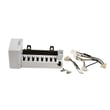
| No ice | Ice maker assembly - refrigerator ice maker by whirlpool 4317943 | Ice production and harvest cycle |
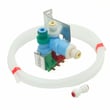
| Weak/no water to dispenser or ice maker | Refrigerator inlet valve W10408179 | Water supply into the refrigerator |
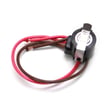
| Frost or warm temps from defrost issues | Refrigerator defrost bi-metal WPW10225581 | Defrost heater control and cycling |
| Cooling issues tied to defrost timing | Refrigerator defrost timer W10822278 | Defrost schedule and compressor run pattern |
Why it matters
Catching airflow, water supply, and door-seal problems early helps prevent temperature swings, food spoilage, and heavy frost buildup that can strain the sealed refrigeration system.
Last updated: February 2026
What causes a side-by-side refrigerator to stop cooling?
A Kenmore 10659262990 side-by-side refrigerator usually stops cooling because airflow is blocked, the temperature controls are set incorrectly, or a cooling/defrost component is failing (such as the evaporator fan, defrost system, or compressor). Start with vents, settings, and door sealing before replacing parts.
Quick checks we recommend first
- Confirm the refrigerator has power and the interior lights turn on.
- Make sure food packages are not blocking the air vents between the freezer and fresh food sections.
- Verify the refrigerator and freezer controls are not set too warm; wait at least 24 hours after any adjustment to judge results.
- Limit door openings and confirm doors close fully (warm air quickly raises temperatures).
- If you hear the evaporator fan running but temperatures rise, check for heavy frost on the freezer back wall (a defrost problem).
Most common causes (and what to look for)
| Symptom | Likely cause | What you can check safely |
|---|---|---|
| Freezer cold, fridge warm | Blocked vents or airflow issue | Clear vents; avoid packing items against the top vent/returns |
| Both sections warm, unit runs a lot | Dirty condenser area or sealed-system issue | Clean accessible condenser area; listen for compressor running |
| Frost buildup, weak airflow | Defrost system problem | Look for frost blanket on evaporator cover; defrost timer may be involved |
| No ice and no water dispense | Water supply or valve issue | Check house water supply; inspect for kinked line |
Parts that commonly fix “not cooling” symptoms
If troubleshooting points to a failed component, these model-compatible parts are common fixes:
- Refrigerator defrost timer W10822278 (defrost cycle timing issues)
- Refrigerator defrost bi-metal WPW10225581 (defrost termination/temperature sensing)
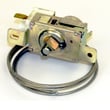
- Refrigerator thermostat WP2198202 (temperature control/cycling)
- Refrigerator compressor W10309990 (cooling system not pumping refrigerant)
Why it matters
This refrigerator circulates cold air between the freezer and refrigerator sections; when vents are blocked, temperatures can rise even if the unit is running. Also, turning controls colder than recommended will not cool faster, so targeted checks save time and prevent food spoilage.
For model-specific control guidance and airflow diagrams, use the owner's manual.
Last updated: February 2026
Where is the model number on a Kenmore side by side refrigerator?
On Kenmore side-by-side refrigerator model 10659262990, the model number is printed on the model and serial number label located on the inside wall of the refrigerator compartment. Open the fresh food door and look along the interior side wall for the sticker-style label; it lists both the model and serial number.
How to find the label quickly
- Open the refrigerator (fresh food) door, not the freezer door
- Look on the inside wall near the front edge of the cabinet liner
- Check both left and right interior side walls if you do not see it immediately
- Use a flashlight; the label can be hard to read in low light
- Wipe the label gently with a damp cloth if dust makes it unreadable
What you should write down
Record these items exactly as shown on the label (we recommend taking a photo too):
- Model number (for this unit: 10659262990)
- Serial number
- Purchase date (if you still have it)
| Item on label | What it’s used for | Example for this refrigerator |
|---|---|---|
| Model number | Matching the correct parts diagrams and parts | 10659262990 |
| Serial number | Identifying production details for service and compatibility | Varies by unit |
Why it matters
The model number is the key to getting the right Kenmore refrigerator parts and instructions. Even small model-number differences can change which ice maker, water inlet valve, thermostat, or door gasket fits.
For model-specific diagrams and documentation, use the owner's manual.
Last updated: February 2026