Installation guide
 Owner’s manual
 Error Codes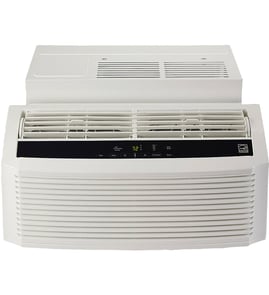



How big of a room can a 10,000 BTU portable air conditioner cool?
A 10,000 BTU portable air conditioner typically cools about 300 to 450 sq. ft. in average conditions. For the Kenmore 25370121011 (a compact window-mount unit in the 10,000 to 12,000 BTU class), real coverage depends most on heat load, insulation, sun exposure, and airflow; use the sizing guidance in the 25370121011 owner's manual to match capacity to your room.
Quick sizing guidance (what changes the number)
We see the biggest performance swings from these factors:
- Ceiling height: rooms over 8 ft need more BTUs
- Sun exposure: west-facing, sunny rooms need more capacity
- Insulation and windows: older windows and poor insulation reduce effective coverage
- Occupancy and appliances: more people, cooking, and electronics add heat
- Airflow and layout: open floor plans and long hallways are harder to cool evenly
Portable vs. window unit: why the rating can feel different
Even at the same BTU number, a portable unit often feels weaker because it sits inside the room and must exhaust hot air through a hose.
| Type | Typical real-world cooling feel | Common reason |
|---|---|---|
| Portable AC (10,000 BTU) | Moderate for a medium room | Exhaust hose adds heat and reduces efficiency |
| Window AC (10,000 to 12,000 BTU class) | Stronger for the same room size | Hot side stays outside the room |
How to estimate your room size fast
- Measure length x width (in feet).
- Multiply to get square feet.
- Use this rule of thumb:
- Up to ~300 sq. ft.: 10,000 BTU is usually plenty
- ~300 to 450 sq. ft.: 10,000 BTU works best with good insulation and limited sun
- Over ~450 sq. ft.: you typically need a higher BTU unit or supplemental cooling
Why it matters
If the BTU capacity is too small, the air conditioner can run constantly and still struggle to pull down temperature. If it is too large, it can cool quickly but cycle more often and may not manage humidity as well. The troubleshooting section in the 25370121011 owner's manual also notes that room size and heat load affect cooling performance.
Related help for Kenmore room air conditioners
- Use Kenmore error codes if your display shows an error and cooling performance suddenly changes.
You can also look up replacement parts for Kenmore 25370121011 by model number on the parts list, or search our full catalog on Sears PartsDirect.
Last updated: February 2026
What are the most common issues with 25370121011?
The most common issues we see with the Kenmore 25370121011 room air conditioner are weak or no cooling, water leaking indoors, noisy operation, and the unit not turning on. Most problems trace back to airflow restrictions, drainage setup, or electrical supply and controls.
Common symptoms and what usually causes them
- Not cooling or cooling poorly: dirty air filter, blocked front grille, dirty evaporator/condenser coils, incorrect mode/temperature setting, or low airflow from a failing fan motor
- Water leaking into the room: unit not tilted slightly outward, clogged drain path, or a mis-seated chassis in the window kit
- Won’t turn on: tripped breaker, loose plug, failed power cord/LCDI, or a control board issue
- Runs but shuts off quickly: restricted airflow, iced evaporator coil, or thermostat/sensor problems
- Unusual noise or vibration: loose mounting, fan blade rubbing, or debris in the blower wheel
Quick checks we recommend first
- Set the unit to Cool and lower the set temperature; confirm the fan is on.
- Clean or replace the air filter; make sure the intake and discharge are not blocked by curtains or furniture.
- Verify the unit is installed with a slight outward tilt so condensate drains outside.
- Reset the power (unplug for 1 minute, then plug back in); check the home breaker.
- If you suspect an electrical issue, use safe test methods from how to use a multimeter to test electrical parts video.
What to do based on the symptom
| Symptom | Best first action | Next step if it continues |
|---|---|---|
| Weak cooling | Clean filter; clear airflow | Clean coils; check fan operation |
| Indoor leaking | Confirm outward tilt | Clear drain path; re-check window kit fit |
| No power | Check breaker; reset plug | Test cord/LCDI; inspect control wiring |
| Icing | Run fan-only to thaw | Improve airflow; check sensor/thermostat |
Why it matters
Airflow and drainage issues make a room air conditioner work harder, raise energy use, and can lead to icing or water damage around the window. Catching these early helps prevent bigger repairs.
For model-specific operating steps, error indicators, and installation requirements, use the 25370121011 owner’s manual and the 25370121011 installation guide.
Last updated: March 2026
What is the average lifespan of 25370121011?
A Kenmore room air conditioner like model 25370121011 typically lasts 10 years with normal seasonal use and basic maintenance. Keeping airflow unrestricted, cleaning the filter regularly, and storing the unit properly in the off-season helps it reach that expected service life.
Typical lifespan and what affects it
Most room air conditioners fall into a predictable range; usage and maintenance determine where yours lands.
- Typical lifespan: 10 years
- Heavy use (long cooling seasons): tends to wear parts faster
- Dirty filter or coils: reduces airflow and strains the compressor
- Low voltage or frequent power interruptions: can damage electrical components
- Poor installation or air leaks around the sleeve: increases run time and wear
Maintenance that extends life
Use these habits for the Kenmore 25370121011 to reduce stress on the compressor, fan motor, and controls.
- Clean or replace the air filter on a regular schedule
- Keep the front grille and air intake clear of dust and furniture
- Clean the evaporator and condenser coils seasonally
- Make sure the unit drains correctly and the base pan is not holding water
- Confirm the unit is installed level and sealed per the installation guide
Quick decision guide: repair vs. replace
| What you’re seeing | Most common cause | Best next step |
|---|---|---|
| Runs but weak cooling | Dirty filter/coils, airflow restriction | Clean filter/coils; verify airflow |
| Trips breaker or won’t start | Power supply issue, wiring, control problem | Check outlet/breaker; inspect cord; test safely |
| Loud vibration/rattle | Loose mounting, fan contact | Re-seat unit; tighten mounting; inspect fan |
| Water leaking indoors | Drain issue, tilt, clogged channels | Re-level; clear drain path |
Why it matters
A room air conditioner near the end of its lifespan often runs longer to cool the same space, which increases energy use and can lead to compressor or fan failures. Following the maintenance steps in the owner's manual helps keep performance steady and prevents avoidable breakdowns.
Last updated: March 2026