
Can I use my jointer as a planer?
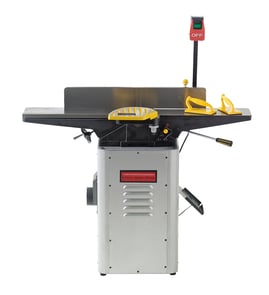
No. On the Delta 37-190 6" deluxe jointer, the jointer’s job is to flatten and straighten one face (and one edge) of a board; a planer’s job is to make the opposite face parallel and bring the board to a consistent thickness.
A jointer and a thickness planer solve different problems in stock prep.
- Jointer: creates one flat reference face; can also square one edge to that face
- Planer: makes the second face parallel to the reference face and reduces thickness evenly
- Key difference: a planer follows the reference face you give it; it does not reliably “flatten” a twisted or cupped board by itself
| Tool | Primary purpose | Typical output |
|---|---|---|
| Jointer (Delta 37-190) | Flatten one face; straighten one edge | One true face; one square edge |
| Thickness planer | Make faces parallel; size thickness | Uniform thickness; parallel faces |
Even if you can remove material on a jointer, you cannot safely or accurately use it to create two parallel faces across a full board width the way a planer does.
- No thickness reference system like a planer’s bed and feed rollers
- Limited control over keeping the second face parallel to the first
- Higher risk of tapering, snipe-like effects, and inconsistent thickness
- Safety concerns increase when trying to “thickness” stock on a jointer
For most woodworking, this sequence gives predictable results:
- Joint one face flat
- Joint one edge square to that face
- Plane the opposite face until it’s parallel and the board reaches target thickness
- Rip to final width (then lightly joint the sawn edge if needed)
If you skip the planer step, boards often look smooth but end up wedge-shaped or not parallel, which causes gaps in glue-ups, rocking parts, and inaccurate joinery.
If you’re tuning up your Delta 37-190 (for example, addressing vibration, cutterhead issues, or fence alignment), use the parts list for this model to match components correctly, or search by model number on Sears PartsDirect.
Last updated: February 2026
How much is a Delta 37-190 jointer?
A used Delta 37-190 6-inch deluxe jointer typically sells in the $250 to $600 range, depending on condition, included accessories (stand, guard, fence), and local demand. For a clean, fully working unit, around $360 is a reasonable mid-range price.
- Condition of the cutterhead and knives (nicks, rust, missing hardware)
- Fence accuracy and ease of adjustment (locks tight, stays square)
- Tables and ways (flat, minimal pitting, smooth infeed adjustment)
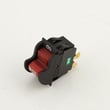
- Motor and switch health (starts quickly, no burning smell, no excessive vibration)
- Included extras (mobile base, spare knives, push blocks, dust hood)
- Unplugged: rotate the cutterhead by hand; it should turn smoothly without scraping.
- Check table flatness with a straightedge; small cosmetic marks are fine, twists are not.
- Verify the fence locks at 90 degrees and holds position.
- Power on: listen for bearing noise (growl or rumble) and watch for excessive vibration.
- Confirm the guard returns freely and fully covers the cutterhead.
| Condition | What you’re likely getting | Typical price |
|---|---|---|
| Needs work | Rust, missing guard, noisy bearings, unknown wiring | $150 to $300 |
| Working, average | Normal wear, usable knives, fence OK | $250 to $450 |
| Clean, ready to use | Smooth adjustments, quiet bearings, good tables | $400 to $600 |
With a jointer like the Delta 37-190, the “cheap” unit can quickly become expensive if it needs knives, bearings, switch parts, or table work. Paying a bit more for a smooth-running machine usually saves time and setup frustration.
If you’re comparing listings or trying to match the exact model number for parts diagrams, use how to find your appliance model number (and what it means for parts) and then search by model on Sears PartsDirect.
Last updated: February 2026
What size is a Delta jointer 37-190?
Delta model 37-190 is a 6-inch deluxe jointer. Its designed cutting capacity is 6 in. (152 mm) width with up to 1/2 in. (13 mm) depth of cut; it also supports rabbeting up to 1/2 in. x 6 in. (13 x 152 mm).
A 6-inch jointer size refers to the maximum board width you can joint in one pass. On the Delta 37-190, that means you can flatten and straighten stock up to 6 inches wide (wider boards require ripping and re-gluing or using other methods).
| Spec | Delta 37-190 designed capacity |
|---|---|
| Max jointing width | 6 in. (152 mm) |
| Max depth of cut | 1/2 in. (13 mm) |
| Rabbeting capacity | 1/2 in. x 6 in. (13 x 152 mm) |
Even though the jointer is rated for a 1/2-inch depth of cut, most users get smoother results with lighter passes.
- Use light cuts (commonly 1/32 in. to 1/16 in.) for better finish and less tear-out.
- Confirm the infeed and outfeed tables are coplanar to avoid taper.
- Set the outfeed table to match the knife height at top dead center.
- Keep knives sharp; dull knives cause chatter and burning.
- Use push blocks and keep hands clear of the cutterhead.
Knowing the 6-inch capacity helps you plan lumber prep and project workflow. It also guides setup choices (knife height, fence alignment, and depth-of-cut settings) so you get straight edges and flat faces without snipe or taper.
To match parts correctly, always use the full model number 37-190 when searching. We list model-specific parts when available, and you can also search by model on Sears PartsDirect.
Last updated: February 2026