Installation guide
 Owner’s manual


How many cubic feet is my Kenmore 11027087603 washer?
The exact tub capacity (cubic feet) for Kenmore Elite washer model 11027087603 is listed in the product specifications section of the owner's manual. If you are shopping for a replacement washer, most Kenmore Elite top-load washers of this style are typically about 3.5 to 5.0 cu. ft.
Use these quick checks to get the right number for your specific washer:
- Look for a “Specifications” or “Product data” section in the owner's manual
- Check for wording like “basket volume”, “tub capacity”, or “capacity (cu. ft.)”
- If the manual lists dimensions only, use them to compare against replacement models (capacity is often grouped with dimensions)
- Match the capacity to your needs: larger capacity helps with comforters and bulky loads
- Keep your model number 11027087603 handy when comparing specs to avoid mixing similar Kenmore 110-series models
If you are comparing washers by size, these ranges are the most useful:
| Washer type | Typical capacity range | Best for |
|---|---|---|
| Standard top-load | 3.0 to 3.8 cu. ft. | Everyday mixed loads |
| High-efficiency top-load | 4.0 to 5.0+ cu. ft. | Bulky items, fewer loads |
| Front-load | 4.0 to 5.2+ cu. ft. | Large loads, high spin extraction |
Capacity affects more than “how much fits.” It impacts cycle performance, water usage, and how well the washer can tumble or circulate items without overloading. Using the correct capacity also helps you choose compatible accessories and plan for laundry room space.
Last updated: February 2026
How to force a Kenmore 11027087603 washer to drain?
To force your Kenmore Elite washer model 11027087603 to drain, we recommend canceling the cycle and running a Drain/Spin (or Spin) cycle first; if the washer will not pump out, you can manually drain through the drain hose and then check for a drain restriction or a failed drain pump.
- Cancel the cycle and select Drain/Spin (or Spin) to command the pump to run.
- If the tub stays full, unplug the washer before touching hoses or wiring.
- Lower the drain hose into a shallow pan or bucket to let gravity drain the tub (go slowly to avoid spills).
- Check the standpipe or laundry tub for a backup that prevents draining.
- Inspect the drain hose for kinks, crushing, or clogs.
A mis-installed drain hose can cause siphoning, slow drain, or repeated refilling. For model 11027087603, the installation guide specifies these key points:
| What to check | What “correct” looks like | Why it matters |
|---|---|---|
| Standpipe height | At least 39 in. (99 cm) | Helps the pump drain properly |
| Hose insertion depth | No more than 4 1/2 in. (11.4 cm) into the standpipe/drainpipe | Prevents siphoning |
| Drain hose form | Drain hose form installed and secured | Maintains proper hose shape |
Use the steps and diagrams in the installation guide to confirm your drain hose form and standpipe setup.
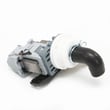
If the hose and drain path are clear but the washer will not pump out, the most common failure points are the drain pump or a blockage at the pump inlet.
- Listen for the pump: humming with no water movement often indicates a jam.
- Check for small items (coins, socks) that can lodge in the pump area.
- If the pump is noisy, seized, or leaking, replacement is typical.
Relevant part for this model:
A washer that cannot drain will not spin correctly, can leave clothes soaking wet, and can trigger out-of-balance behavior. Correct drain hose installation plus a clear pump and hose path restores normal drain and spin performance.
Last updated: February 2026
Is Kenmore 11027087603 high end?
Yes. Kenmore Elite model 11027087603 is part of Kenmore’s higher-tier washer lineup; it’s built around higher-efficiency washing, more cycle/option control, and premium performance features compared with basic Kenmore washers (for example HE detergent dispensing and advanced cycle options). See the owner's manual for the exact feature set and cycle list for this model.
In practical terms, “high end” usually shows up as better cleaning performance, more control over cycles, and convenience features that protect fabrics and improve results.
Common high-end traits you’ll see on this model family include:
- High Efficiency (HE) wash system; designed to use HE detergent and optimize water use
- Preset cycle programming with the ability to adjust modifiers/options for many cycles
- Specialty options such as 2nd Rinse, Stain Treat, and Auto Soak/Prewash (options vary by cycle)
- Lid lock and Add A Garment capability during certain points in the cycle
- Energy-saving options (for example “Save Energy Plus” on specific cycles)
| Feature area | Kenmore Elite 11027087603 | Typical basic top-load washer |
|---|---|---|
| Detergent system | HE detergent dispensing guidance | Standard detergent guidance |
| Cycle control | More modifiers and options | Fewer options |
| Convenience | Add A Garment window, lid lock logic | Limited mid-cycle access |
| Performance focus | Optimized cleaning with preset programming | Simpler wash action |
A “high-end” washer is usually worth it when you want better stain removal, more fabric care control, and fewer re-washes. It also means repairs tend to be more component-specific; when performance drops (drain, spin, lid locking), replacing the correct part restores normal operation.
If your washer stops draining, won’t lock, or vibrates excessively, these model-matched parts are often involved:
- Drain issues: pump-water W10536347
- Lid won’t lock or won’t start: washer lid lock WPW10619844
- Excessive shaking or off-balance: suspension W10820048
Last updated: February 2026
Is it worth repairing a Kenmore washing machine?
For a Kenmore Elite washer like model 11027087603, repairing is worth it when the problem is a common, replaceable part (drain pump, lid lock, suspension) and the washer is otherwise in good shape. Replacement makes more sense when multiple major drive or tub components are failing.
We use these practical checkpoints before buying a new washer:
- Repair it when the issue is isolated (won’t drain, won’t lock, out-of-balance) and the tub is quiet and leak-free.
- Repair it when the fix is a common part swap you can confirm with basic troubleshooting.
- Replace it when you have repeated breakdowns in different systems (drain, spin, fill, control).
- Replace it when you see tub bearing noise, major leaks from the tub area, or severe corrosion.
- Replace it when the repair estimate is around half the cost of a comparable new washer.
For model-specific operating and care guidance (including loading and monthly cleaning), use the owner's manual.
These are frequent, targeted fixes that often restore normal washing without replacing the machine:
- Won’t drain or drains slowly: check the drain path; a failed pump is a common cause (see pump-water W10536347).
- Lid won’t lock or washer won’t start: lid lock problems can stop the cycle (see washer lid lock WPW10619844).
- Shaking, banging, or walking: worn suspension can cause imbalance and vibration (see suspension W10820048).
- Spin issues tied to drive components: rotor or stator problems can be higher-cost; confirm symptoms carefully before replacing parts.
| Situation | Typical outcome | Usual recommendation |
|---|---|---|
| Single symptom, washer otherwise runs normally | One-part repair | Repair |
| Multiple symptoms across different cycles | Ongoing repairs likely | Lean replace |
| Loud roaring during spin (bearing-type noise) | Major teardown | Lean replace |
| Simple no-drain or no-start condition | Straightforward diagnosis | Repair |
A targeted repair can extend the life of your Kenmore washer and avoid the cost and hassle of replacement. On the other hand, major tub or drive-system failures often require extensive labor and can turn into repeat repairs.
Last updated: February 2026
What model is my Kenmore 11027087603 washer?
Your washer’s model is 11027087603 (Kenmore Elite). To confirm it on the appliance, match that number to the model/serial label, which is typically on the cabinet opening under the lid, on the back of the control panel, or on the side of the main cabinet near the bottom. For diagrams and model identification details, use the owner's manual.
Check these common spots on Kenmore top-load washers like model 11027087603:
- Under the lid, around the tub opening or on the underside of the lid
- On the back of the control console/control panel
- On the left or right side of the cabinet near the bottom edge
- Near the rear panel area (upper back)
- On a label that also lists the serial number and electrical ratings
Use this quick checklist so you order the correct Kenmore washer parts (lid lock, drain pump, suspension, etc.):
- The label should show 11027087603 exactly (all digits, no extra characters)
- Write down the serial number too; it helps confirm production details
- If the label is worn, take a clear photo and zoom in to read it
- Compare the model number to the one printed on your paperwork (if available)
| What you see on the label | What it’s used for | Example format |
|---|---|---|
| Model number | Identifies the exact washer design for parts lookup | 11027087603 |
| Serial number | Identifies the individual unit and production run | Letters and numbers |
Kenmore model numbers can look similar, but small differences change which parts fit. Confirming 11027087603 before ordering helps ensure you get the correct replacement part the first time.
Last updated: February 2026