Installation guide
 Owner’s manual
 Error Codes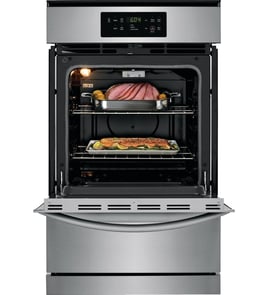



Are wall ovens hardwired or plug in?
For the Kenmore 79030172400 gas wall oven, the oven uses a 3-prong grounding plug and is designed to be plugged directly into a properly grounded wall receptacle (not hardwired). We also recommend avoiding adapters and extension cords for safe grounding.
What to use for power (and what not to use)
- Plug the oven into a properly grounded 3-prong receptacle.
- Do not cut or remove the grounding prong.
- Do not use a 2-prong adapter.
- Do not use an extension cord.
- Unplug (or disconnect power) before servicing.
Why some wall ovens are hardwired
Many electric wall ovens are hardwired because they often use higher-voltage, higher-amperage circuits. This Kenmore model is a gas wall oven, so it still needs electricity for controls and ignition, but it is set up to use a grounded plug.
Quick check: plug-in vs hardwired
| What you see | What it usually means | What to do |
|---|---|---|
| 3-prong cord and plug | Plug-in installation | Use a grounded receptacle |
| No plug, wires into a junction box | Hardwired installation | Follow the wiring instructions |
| Adapter or extension cord in use | Unsafe connection | Remove and correct the power connection |
Why it matters
Proper grounding helps reduce shock risk and supports reliable oven ignition and control operation. A poor connection can also lead to intermittent power symptoms that look like a control problem.
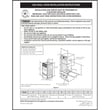
For installation details specific to this model, follow the 79030172400 installation guide.
Last updated: February 2026
Does anyone make a 30 gas wall oven?
Yes. 30-inch gas wall ovens are made by several manufacturers, and your Kenmore model 79030172400 is itself a 30-inch class built-in gas wall oven. The key is matching the cabinet cutout, gas hookup location, and required clearances to the oven you choose.
What to check before you buy (fit and safety)
Use the installation guide to confirm the opening and clearance requirements for a 30-inch gas wall oven installation.
- Cabinet opening dimensions and whether the support surface is solid and level
- Door swing clearance (the guide calls out clearance for the door to open fully)
- Venting location requirements (the oven vent is through the upper control panel trim)
- Gas supply shut-off valve access and gas hookup hole location
- Electrical grounding (3-prong grounded receptacle; do not remove the grounding prong)
- Never install a wall oven beneath a countertop (called out in the installation instructions)
Typical “30-inch gas wall oven” sizing (what “30-inch” really means)
“30-inch” usually describes the overall width class, not the exact cabinet cutout. Always match the cutout specs.
| Item | What to match | Why it matters |
|---|---|---|
| Overall width class | 30-inch class | Ensures the oven face/frame covers the opening |
| Cutout dimensions | Exact cutout width/height/depth | Prevents gaps, binding, or unsafe installation |
| Gas and electric location | Shut-off valve and receptacle placement | Avoids kinks, strain, and service issues |
If you are replacing an existing oven
- Compare your current cutout to the new oven’s cutout requirements
- Confirm the fuel type (natural gas vs. LP) and any conversion requirements are handled by a qualified servicer
- Plan for safe removal: shut off gas, disconnect gas and electric, then remove mounting screws
Why it matters
A 30-inch gas wall oven can look like it “should fit,” but the cabinet cutout, venting, and door clearance determine whether it installs safely and operates correctly.
Last updated: February 2026
How do I know if my wall oven is 27 or 30?
To tell whether your Kenmore 79030172400 wall oven is a 27-inch or 30-inch model, we measure the cabinet cutout opening width (inside edge to inside edge), not the oven door. The installation dimensions in the 79030172400 installation guide confirm the cutout-based approach.
How to measure the cutout width (the reliable method)
- Turn power off to the oven at the breaker for safety.
- Open the oven door.
- Measure inside the cabinet opening, from the left inside cabinet edge to the right inside cabinet edge.
- Measure in at least 3 places (top, middle, bottom) and use the smallest measurement.
Tips for accurate measuring
- Measure to the wood cabinet edges, not to trim pieces.
- If there is a face frame, measure the true opening behind it.
- Write down width, height, and depth; wall ovens are sized by the cutout.
What the numbers usually mean
Most wall ovens are sold as “27-inch” or “30-inch,” but the actual cutout is typically a little larger than the nominal size.
| Nominal oven size | Typical cutout width you’ll measure | Best use |
|---|---|---|
| 27-inch wall oven | About 27 inches (often slightly over) | Replacing a 27-inch unit |
| 30-inch wall oven | About 30 inches (often slightly over) | Replacing a 30-inch unit |
Quick cross-checks (helpful, not primary)
- Model/serial plate: On this model, the serial plate is on the left side inner trim of the oven (useful when confirming exact replacement fit). See the 79030172400 installation guide.
- Height matters too: The installation guide notes some models allow height adjustment with an extension panel; always confirm height and door clearance before ordering.
- Door clearance: Plan for the door to open fully; the guide calls out clearance needs for operation.
Why it matters
A 27-inch oven will not properly mount in a 30-inch cutout (and vice versa) without cabinet modification. Measuring the cutout first prevents gaps, mounting issues, and heat or airflow problems around the oven frame.
Last updated: February 2026