Installation guide
 Owner’s manual


What is the life expectancy of a Kenmore washer?
Most Kenmore washers typically last 10 to 15 years with normal household use. For Kenmore model 11024932202, lifespan depends most on load size, leveling, water quality, and keeping wear items (like the lid switch and drain pump) in good working order; routine care helps you reach the upper end of that range.
- Usage: daily loads shorten life compared to a few loads per week.
- Overloading: strains the drive system, clutch, and gearcase.
- Out-of-balance loads: increase wear on suspension and drive components.
- Water and detergent habits: too much detergent can cause buildup and extra stress.
- Maintenance and timely repairs: replacing small parts early prevents bigger failures.
Use these habits to reduce wear on the motor, coupling, and drain system:
- Keep loads evenly distributed (mix small and large items).
- Avoid consistently washing heavy, single items (like one rug) by themselves.
- Leave the lid open after use to help the tub dry.
- Check fill and drain hoses for kinks and leaks.
- Follow the care and use guidance in the 11024932202 owner's manual.
These are typical repair categories as a washer ages:
| Repair type | What you may notice | Example part for this model |
|---|---|---|
| Small wear item | Won’t spin or stops when lid opens/closes | Washer lid switch WP3949238 |
| Drain-related | Won’t drain, water left in tub | Drain pump and hoses |
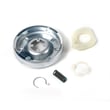
| Drive-related | Agitation/spin issues, burning smell, loud operation | Coupling, clutch, gearcase |
A Kenmore washer that is maintained and repaired early often stays reliable longer because inexpensive wear parts can prevent secondary damage to higher-cost assemblies.
Last updated: January 2026
How to hard reset a Kenmore Elite washer?
For the Kenmore washer model 11024932202, a “hard reset” is simply a power reset: unplug the washer (or turn off the breaker) for 1 minute, then restore power and restart the cycle. This clears many temporary control and cycle-stall issues.
- Press the Cycle Control knob in to stop the washer.
- Unplug the washer (or switch the circuit breaker off).
- Wait 60 seconds.
- Plug the washer back in (or switch the breaker on).
- Close the lid and pull the Cycle Control knob out to restart.
- If the washer pauses, allow the cycle to continue (some pauses are normal).
These checks fix the most common “looks dead” or “won’t spin” complaints on 11024932202.
- Confirm the lid is fully closed; this model will not agitate or spin with the lid open.
- Avoid extension cords; plug directly into a wall outlet.
- Check for a normal cycle pause (some cycles pause for about 2 minutes).
- Reduce load size if overloaded; overloaded loads can stall agitation/spin.
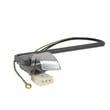
- If the washer stops when the lid closes or opens, inspect the washer lid switch WP3949238.
| Symptom | What to check first | Common next step |
|---|---|---|
| Won’t agitate or spin | Lid fully closed | Test/replace lid switch |
| Stops mid-cycle | Normal pause, overload | Restart cycle after 2 minutes |
| Won’t drain or spin | Drain hose height/clog | Check pump and hose |
A power reset clears minor control interruptions, but repeated no-spin/no-agitate problems usually point to a safety interlock (lid switch), a drain issue, or an overloaded/unbalanced load. For model-specific operating steps and cycle behavior, use the 11024932202 owner's manual.
Last updated: January 2026
How many cubic feet is a Kenmore washer 11024932202?
The Kenmore washer model 11024932202 has a 3.4 cu. ft. wash basket capacity. This is a standard-capacity, top-load washer size that works well for everyday mixed loads and helps you avoid overfilling, which can reduce cleaning performance.
| Model | Washer type | Capacity |
|---|---|---|
| 11024932202 | Top-load (agitator style) | 3.4 cu. ft. |
A 3.4 cu. ft. top-load Kenmore washer cleans best when the load can move freely around the agitator.
- Load items loosely; do not pack them down
- Keep the load height at or below the top row of holes in the basket
- Mix large and small items to help balance during spin
- Use the correct water level setting for the load size
- For bulky items (comforters, jackets), wash fewer pieces per cycle
The most reliable place to verify capacity and other specifications (water levels, cycle guidance, installation clearances) is the documentation for this exact model.
- Check the specifications or product information section in the 11024932202 owner's manual
- If you are planning laundry room fit or clearances, use the 11024932202 installation guide
- The model and serial label is located under the washer lid (helpful when matching parts)
Knowing the 3.4 cu. ft. capacity helps you size loads correctly, improves wash action around the agitator, and reduces out-of-balance spinning and wear on drive components.
Last updated: January 2026
How to unclog drain hose on Kenmore washer?
To unclog the drain hose on your Kenmore washer model 11024932202, unplug the washer, remove standing water, then disconnect and flush the drain hose to clear debris. Reinstall the hose fully on the drain connector to the ribbed stop and secure the clamp as shown in the 11024932202 installation guide.
- Unplug the washer.
- Turn off both water faucets.
- Keep towels and a shallow pan ready.
- Wear gloves; small sharp items can be in the hose.
- Remove water: Bail out the tub or siphon into a bucket if possible.
- Access the drain connection: Pull the washer forward; find the drain hose connection at the bottom of the cabinet.
- Disconnect the hose: Use pliers to open the clamp; twist the hose back and forth while pulling it off.
- Clear the hose:
- Flush with running tap water.
- Push a flexible brush or plastic drain snake through.
- Check the hooked end for lint and small items.
- Check the pump inlet: Look into the pump port for coins, socks, or debris.
- Do not straighten the hooked end.
- Rotate the hook to eliminate kinks.
- Do not force excess hose into the standpipe; keep an air gap.
- Push the hose on until it contacts the ribbed stop; place the clamp over the marked clamp area.
| What to verify | Correct setup | Prevents |
|---|---|---|
| Hose routing | No kinks, smooth curve | Slow drain, backups |
| Standpipe placement | Hooked end seated, air gap | Backflow, overflow |
| Clamp position | Tight, in marked area | Leaks, hose blow-off |
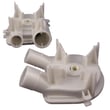
If the hose is clear but the washer still drains slowly or not at all, the pump is the most common failure point; replace the washer drain pump WP3363394.
A restricted drain hose causes standing water, odors, and poor spinning. Correct hose routing and clamping also protects floors from leakage.
Last updated: January 2026