 Installation guide
 Owner’s manual
 Error Codes



What is the average lifespan of a Whirlpool dryer?
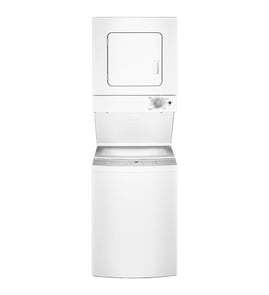
A Whirlpool dryer typically lasts about 13 years. For the dryer in your Whirlpool WET4124HW0 stacked laundry center, consistent airflow maintenance (lint screen and venting) is the biggest factor in reaching that lifespan without repeated no-heat or long-dry-time problems; see the WET4124HW0 owner's manual.
What affects dryer lifespan the most
- Lint screen cleaning every load; restricted airflow makes the heater and motor work harder.
- Exhaust vent cleaning; lint buildup in the vent system increases heat stress and cycle time.
- Load size; overloading strains the drum support system and belt.
- Heat and power supply stability; repeated breaker trips and low/incorrect voltage shorten component life.
- Wear parts; belts, rollers, and idler pulleys wear gradually and can be replaced.
Maintenance schedule we recommend
| Task | How often | Why it matters |
|---|---|---|
| Clean lint screen | Every load | Keeps airflow strong and drying times normal |
| Check outside vent hood airflow | Monthly | Confirms the vent is not restricted |
| Remove lint from cabinet and exhaust vent (service) | About every 2 years (more with heavy use) | Reduces overheating risk and improves efficiency |
Common “end-of-life” symptoms vs. fixable wear
| Symptom | Often caused by | Typical fix |
|---|---|---|
| Dryer runs but won’t tumble | Belt or idler issue | Replace drum belt 3394652 or dryer idler pulley WP691366 |
| Long dry times | Airflow restriction | Clean lint screen, confirm venting, service vent |
| No heat but drum turns | Electrical supply or heater circuit issue | Check breakers/fuses, then diagnose heater circuit |
Why it matters
A dryer can run for years past its average lifespan when airflow stays clear. The WET4124HW0 manual specifically calls out lint screen cleaning before each load and periodic lint removal from the cabinet and exhaust vent; those steps reduce overheating, shorten cycle times, and protect high-cost parts like the motor and controls.
Last updated: February 2026
What is the downside of a washer/dryer combo?
A washer/dryer combo (one machine that washes and dries in the same drum) trades convenience and space savings for slower laundry turnaround, smaller effective drying capacity, and more compromises in drying performance. With your Whirlpool WET4124HW0 stacked laundry center, you avoid most of those combo-specific drawbacks because the washer and dryer are separate systems.
Key downsides of an all-in-one washer/dryer combo
- Longer total time per load: wash plus dry often takes much longer than moving clothes to a separate dryer.
- Smaller drying capacity: many combos dry less than they can wash, so you may need to split loads.
- More damp results on bulky items: towels, hoodies, and bedding can finish warm but still damp.
- Harder to run back-to-back loads: you cannot wash the next load while the first one is drying.
- More disruption when something fails: one breakdown can take out both washing and drying.
Combo vs stacked laundry center (like WET4124HW0)
| Feature | All-in-one combo | Stacked laundry center (WET4124HW0) |
|---|---|---|
| Wash while drying | No | Yes |
| Typical drying capacity | Often lower than wash | Matched to the dryer section |
| Cycle time flexibility | Limited | Better (separate controls/cycles) |
| Repair impact | One unit affects both | One side can fail without the other |
What matters most for drying performance
Even with separate machines, drying complaints usually come from setup and airflow. For best results, we follow the WET4124HW0 installation guide to keep the unit level (sensor cycles can act up if it is not) and to avoid cold-location operation that can extend drying.
- Keep the unit level to reduce vibration and help automatic cycles behave normally.
- Avoid operating the dryer below 45°F (7°C); automatic cycles can run long.
- Clean the lint screen every load.
- Use the right cycle for the fabric and load size.
Why it matters
If you need fast laundry turnaround for a household, the ability to wash and dry at the same time is the biggest practical advantage of a stacked laundry center over a true combo. It reduces bottlenecks and makes multiple loads in a day much easier.
Last updated: February 2026
What is the most common problem with Whirlpool washers?
For Whirlpool washers like the washer in our Whirlpool WET4124HW0 stacked laundry center, the most common issues customers report are out-of-balance vibration, water leaks at hoses or drains, and “won’t start/fill” problems caused by power supply or the lid not being fully closed. For model-specific operating checks, use the WET4124HW0 owner's manual.
Most common issues we see (and what they usually mean)
- Vibration, rocking, or “walking”: leveling feet not locked, unit not level, or an unbalanced load.
- Vibration during spin or cycle stops: load distribution issue (single bulky item, wet items added mid-cycle).
- Water leaks: loose fill-hose connections, missing/shifted hose washers, drain hose not secured, or a household drain backing up.
- Washer won’t run or fill: no power at outlet, tripped breaker, blown fuse, or lid not closed.
- “Not enough water” concerns: normal HE low-water operation; the load will not be fully submerged.
Quick checks for Whirlpool WET4124HW0 before replacing parts
- Confirm it is level: all feet firmly on the floor; lock the feet after leveling.
- Fix load balance: load items in loose heaps evenly around the washplate; avoid washing single heavy items.
- Stop leaks at the source: tighten fill hoses; confirm flat washers are seated; secure the drain hose to the standpipe or tub.
- Verify power and lid: use a grounded 3-prong outlet (no extension cord); reset breaker; close lid fully.
- Do not add extra water: adding water can reduce cleaning by lifting items off the washplate.
Symptom-to-fix guide
| Symptom | Most likely cause | Best first action |
|---|---|---|
| Walking or banging in spin | Not level or unbalanced load | Level unit; redistribute load |
| Water on floor | Hose connection/washer, drain hose, or clogged household drain | Tighten hoses; seat washers; secure drain |
| Won’t start/fill | Power issue or lid open | Check outlet/breaker; close lid |
| Clothes not fully underwater | Normal HE sensing | Let it run; do not add water |
Why it matters
Most “common problems” are installation or use conditions (leveling, loading, hose connections). Fixing those first prevents repeat leaks, reduces noise, and helps the washer reach proper spin speed for better water removal.
For error-code driven problems on this Whirlpool laundry center platform, use Whirlpool wet and ywet error codes.
Last updated: February 2026