Owner’s manual
 Error Codes



How to hard reset a Kenmore dryer?
To hard reset your Kenmore Elite dryer model 79691982410, unplug the dryer (or switch off the breaker) for about 1 to 5 minutes, then restore power and try starting a cycle with START/PAUSE. This clears many temporary control glitches, but it will not fix airflow or heating failures.
Hard reset steps (79691982410)
- Turn the dryer off.
- Unplug the power cord (or turn the dryer circuit breaker off).
- Wait 1 to 5 minutes.
- Restore power.
- Press POWER, select a cycle, then press START/PAUSE.
- If the dryer was paused, you can resume by pressing START/PAUSE again (or opening and closing the door, then pressing START/PAUSE).
For control and cycle behavior details, use the 79691982410 owner's manual.
If the reset does not help, check these common causes
A “reset” often seems to work because the dryer cools down or the load shifts. If the problem returns, focus on the root cause:
- Restricted venting (long dry times, overheating, shutdowns)
- Lint buildup in the lint screen area or blower housing
- Door not fully closed or a failing door switch
- Heating system issue (gas ignition or electric heat circuit)
- Overheat protection opening (high-limit thermostat trips)
Quick heating check from the manual
The manual’s heating test is a fast way to confirm heat output:
- Close the door, press POWER.
- Select a Normal cycle.
- Press START/PAUSE.
- After about 3 minutes, open the door and check whether the air inside feels warm.
Parts that commonly relate to “won’t start” or “no heat” symptoms
These are model-matched parts we often see involved when a reset does not solve the issue:
| Symptom | Common area to inspect | Example model-matched part |
|---|---|---|
| Dryer will not start | Door circuit | Dryer door switch EBF61496102 |
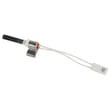
| Dryer runs but no heat (gas models) | Ignition system | Lg dryer burner igniter 5318EL3001A |
| Overheats or shuts down | Safety thermostats | Dryer high-limit thermostat AGM30045804 |
Why it matters
A hard reset only clears the control’s temporary state. If airflow is restricted or a safety device is opening, the dryer can keep stopping, take too long to dry, or fail to heat until the underlying issue is corrected.
Last updated: January 2026
How much does it cost to replace a heating element in a Kenmore dryer?
For a Kenmore Elite dryer like model 79691982410, replacing a heating element typically costs about $20 to $100 for the part, and about $100 to $350+ total if a technician does the repair (part plus labor). Exact pricing depends on the heater style and what else is replaced during service.
What affects the total cost?
- Dryer type: electric dryers use a heating element; gas dryers use an igniter, gas valve, and sensors.
- What failed: a heater can fail alone, or it can fail because airflow is restricted.
- Related parts replaced: thermostats or thermal cutoffs are often replaced with the heater.
- Labor and access: stacked installs, tight closets, or vent routing can increase labor time.
- Vent condition: a clogged vent can cause repeat overheating and extra parts.
Quick checks before buying parts
Use these steps to avoid replacing the wrong component:
- Confirm whether your 79691982410 is electric or gas (the manual and rating plate inside the door help).
- Clean the lint screen and check airflow at the outside vent hood.
- If the dryer runs but won’t heat, check common heat-control parts such as a high-limit thermostat.
- If the dryer shuts off from overheating, address vent restriction first.
- Match parts by model number and the exact symptom.
Common heat-related parts you may see for this model
| Symptom | Common suspect | Example part on this model page |
|---|---|---|
| Runs but no heat (gas models) | Ignition system component | Lg dryer burner igniter 5318EL3001A |
| Overheats or cycles heat oddly | High-limit thermostat | Dryer high-limit thermostat AGM30045804 |
| Long dry times | Airflow restriction or blower issue | (inspect venting and blower area) |
Why it matters
A failed heater (or gas ignition part) is often a symptom of restricted airflow. Fixing venting and lint buildup helps prevent repeat failures, reduces dry time, and protects temperature-control parts.
For model-specific operating and care guidance, use the 79691982410 use and care guide.
Last updated: January 2026
Where is the moisture sensor in a Kenmore Elite dryer?
In Kenmore Elite dryer model 79691982410, the moisture sensor is mounted inside the drum area on the lint filter housing (the grille/duct assembly just inside the door opening). You access it from the front by removing the lint screen and taking out the screws that secure the sensor assembly.
How to find it (quick location guide)
- Open the dryer door and pull out the lint screen.
- Look at the lint filter housing (the grille/duct area at the front of the drum opening).
- The moisture sensor is typically a small bar-style sensor mounted on that housing.
- It is held in place with screws and connected with two wires.
- Use the 79691982410 owner's manual to confirm the exact access steps and any model-specific panel removal notes.
What you will see when you reach it
| Item | What it looks like | What it does |
|---|---|---|
| Moisture sensor | Metal bar(s) or strip(s) on the lint duct/housing | Detects remaining moisture so Auto Dry cycles can stop at the right dryness |
| Wire leads | Two small wires on the sensor holder | Sends the humidity signal to the control |
| Lint duct/housing | Plastic or metal grille near lint screen | Directs airflow and supports the sensor mount |
Why it matters
If the moisture sensor is coated with dryer sheet residue or lint, the dryer can shut off too soon or run too long because the control is not getting an accurate “wet vs. dry” reading.
Tips before you start
- Unplug the dryer before removing any panels or touching wiring.
- Clean the sensor bars with rubbing alcohol on a soft cloth (avoid abrasives).
- Check airflow issues first; a restricted vent can cause poor drying and confusing sensor behavior.
- If you see an “HS” humidity sensor failure code, follow the troubleshooting guidance in the Kenmore elite dryer error codes reference.
Last updated: January 2026
What are the codes for Kenmore Elite dryer?
Kenmore Elite dryer model 79691982410 uses display codes to point you to a specific problem area such as power issues, control lock, wiring, gas supply, or a failed sensor/control. Start by matching the exact code on your display to the troubleshooting steps in the 79691982410 owner's manual.
Common Kenmore Elite dryer codes and what they mean
Here are codes customers most often see on Kenmore Elite dryers like 79691982410:
- PF: Power failure during a cycle
- CL: Control lock is turned on (buttons disabled)
- PS (electric models): Power cord connected incorrectly (wiring at terminal block)
- nP: Incorrect power cord connection (often a wiring/voltage issue)
- gAS (gas models): Gas supply or shutoff is turned off
- tE1 to tE7: Temperature sensor (thermistor) failure
Quick checks we recommend before replacing parts
Many codes are caused by power, airflow, or setup issues. Before ordering parts, check these basics:
- Reset the breaker (dryers often use a 2-pole breaker) and try a new cycle
- If PF appears, confirm the outlet is supplying steady power
- If CL appears, press and hold the CHIME button for 3 seconds to toggle Control Lock
- If PS/nP appears, recheck the terminal block wiring and cord strain relief
- If gAS appears, confirm both the house gas shutoff and dryer gas shutoff valves are fully open
- Clean lint buildup and confirm strong airflow at the outside vent hood
When a code points to a heating or sensor problem
If the dryer runs but won’t heat, or you see temperature-related codes, these parts are commonly involved:
| Symptom or code | Most likely area | Example part for this model |
|---|---|---|
| tE1 to tE7 | Temperature sensing circuit | Thermostat/thermistor circuit (diagnose per manual) |
| Dryer overheats or shuts heat off | Safety limit control | Dryer high-limit thermostat AGM30045804 |
| Heat is inconsistent on gas models | Ignition sensing/ignition | Lg dryer burner igniter 5318EL3001A |
Why it matters
Using the correct code definition prevents unnecessary part replacement. For example, CL is a setting, PF is a power event, and PS/nP often points to wiring, while tE codes typically indicate a failed sensor circuit that needs diagnosis.
Last updated: January 2026