Installation guide
 Owner’s manual
 Error Codes

Is a side-by-side or bottom freezer better?
A bottom-freezer refrigerator is usually better for everyday convenience and energy efficiency because the fresh-food section sits at eye level and cold air naturally settles downward. A side-by-side like the Frigidaire GLHS36EJSB0 is often better when you want narrow door swing and easy access to ice and water.
| Feature | Side-by-side (like GLHS36EJSB0) | Bottom freezer |
|---|---|---|
| Fresh-food access | Good, but shelves are narrower | Best, most-used items at eye level |
| Freezer space | Tall, narrow; large boxes can be tricky | Wider drawers; easier for bulky items |
| Door swing clearance | Often better in tight kitchens | Can need more clearance depending on design |
| Ice and water access | Common and convenient | Varies by model |
- Choose side-by-side if you have a tight aisle and want narrower doors.
- Choose bottom freezer if you use the refrigerator section most and want less bending.
- Choose based on what you store most: pizza boxes and wide items usually fit better in bottom-freezer drawers.
- If you rely on filtered water and ice, compare filter type and replacement routine.
- If you are replacing an existing unit, measure opening width, depth, and door clearance before deciding.
The “better” layout is the one that matches how you cook and how your kitchen is laid out. A side-by-side can be a great fit when space is tight, while a bottom freezer often feels more ergonomic for daily use.
Your GLHS36EJSB0 installation guidance calls for proper clearances and leveling to help doors seal correctly and run efficiently. We recommend confirming your space and setup details in the GLHS36EJSB0 installation guide. If your model uses a water filter, the how to replace the water filter in a Frigidaire refrigerator guide helps you plan filter changes and improve dispenser performance.
Last updated: January 2026
What are the most common issues with GLHS36EJSB0?
The most common issues we see with the Frigidaire GLHS36EJSB0 side-by-side refrigerator involve cooling performance, ice and water dispensing, and door sealing. These problems usually trace back to airflow (evaporator fan), defrost components, water filtration or ice path parts, or worn gaskets.
- Warm refrigerator section but freezer seems OK: restricted airflow or evaporator fan issue
- Frost buildup on the back wall of the freezer: defrost system problem
- Ice maker not making ice or small cubes: water supply restriction, filter, or ice maker components
- Dispenser not dispensing ice: ice chute door not sealing, auger drive issue, or ice clumping
- Water tastes bad or flow is slow: clogged water filter or air in the water line
- Doors not sealing, moisture or sweating: gasket not sealing or door alignment issue
Use these steps before replacing parts; they solve many GLHS36EJSB0 complaints.
- Confirm temperature settings: 0°F in the freezer, 37°F in the fresh food section
- Make sure vents are not blocked by food packages
- Check the condenser area for dust buildup and clean it
- If water flow is weak, replace the filter and purge air from the dispenser
- Inspect door gaskets for gaps, tears, or hardened sections
These are frequently related to the symptoms above.
| Symptom | Commonly involved part | Example from this model’s parts list |
|---|---|---|
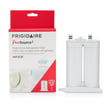
| Bad taste or slow water | Water filter | Frigidaire puresource2 refrigerator water filter WF2CB |
| Frost buildup, warm temps | Defrost control components | Refrigerator defrost bi-metal thermostat 5303918214 |
| Poor airflow, warm fridge | Evaporator fan components | Refrigerator evaporator fan blade 5308000010 |
| Door not sealing | Door gasket | Frigidaire refrigerator door gasket (black) 241786015 |
Cooling, ice maker, and dispenser problems often cascade. For example, a weak water flow can cause hollow cubes that jam the ice path, and a leaking door gasket can create frost that reduces airflow and raises temperatures.
For GLHS36EJSB0 troubleshooting steps, temperature recommendations, and component locations, use the owner's manual and the installation guide.
Last updated: March 2026
What is a standard size side-by-side refrigerator?
Most standard side-by-side refrigerators, including models similar to the Frigidaire GLHS36EJSB0, are about 30 to 36 inches wide, 67 to 70 inches tall, and 29 to 35 inches deep. Exact dimensions vary by model and door/handle style, so confirm measurements in the GLHS36EJSB0 owner's manual.
Side-by-side refrigerators are built to split storage between the fresh food and freezer sections, so their overall footprint is usually consistent across brands.
- Width: 30 to 36 inches (36 inches is very common)
- Height: 67 to 70 inches (some are taller with hinges)
- Depth: 29 to 35 inches (deeper with handles)
- Door swing clearance: needs extra space beyond depth
- Ventilation clearance: plan for airflow around the cabinet
For the GLHS36EJSB0, the installation guidance calls for these minimum clearances for air circulation and connections:
| Location | Typical minimum clearance |
|---|---|
| Sides and top | 3/8 inch |
| Back | 1 inch |
For step-by-step placement, leveling, and door clearance guidance, use the GLHS36EJSB0 installation guide.
Measure the opening before ordering a replacement refrigerator or moving the unit.
- Measure width at the top, middle, and bottom of the opening
- Measure height to the lowest cabinet/trim point above the refrigerator
- Measure depth from the back wall to the front edge of counters
- Add room for doors to fully open (especially near walls or islands)
- Include space for the water line if you have an ice maker or dispenser
A refrigerator that “fits” by cabinet width can still bind on door swing, run hot from poor airflow, or be hard to service if clearances are too tight. Planning for door opening and ventilation helps prevent cooling and sealing problems.
Last updated: January 2026