Installation guide
 Owner’s manual
 Error Codes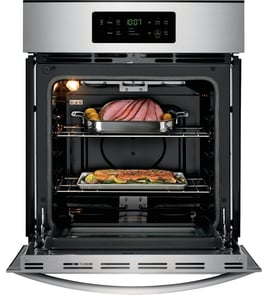



How to unlock Fisher and Paykel wall oven?
To unlock the control panel on your Fisher & Paykel OS301 electric wall oven, turn the oven off, then press PUSH TO CLEAR and hold it for 5 seconds. Repeat the same press-and-hold to toggle the control panel lock. Details are in the OS301 owner's manual.
- Set the oven mode dial to OFF (the control panel lock works only when the oven is off).
- Press PUSH TO CLEAR.
- Keep holding for 5 seconds.
- Confirm the controls respond again.
- If needed, repeat the 5-second press-and-hold once more.
A locked door is usually related to Self Clean, not the control panel lock.
- If Self Clean is running, the door lock engages automatically.
- If the cycle ended, the door stays locked until the oven cools to a safe temperature.
- To end Self Clean and return to normal operation, turn the oven mode and temperature dials to OFF.
- Keep power on during cooldown; the fans are needed to cool the oven.
| What is locked | Common symptom | What to do |
|---|---|---|
| Control panel (buttons/dials) | Controls unresponsive | Hold PUSH TO CLEAR 5 seconds |
| Oven door | Door will not open, Self Clean messages | Wait for cooldown; set dials to OFF |
The control panel lock prevents accidental button presses during cleaning and helps stop unintended oven operation. The door lock protects you during high-temperature Self Clean by keeping the door secured until it is safe.
Last updated: February 2026
What are common Fisher & Paykel oven problems?
Common problems on the Fisher & Paykel OS301 electric wall oven include a dead or unresponsive display after a power cut (clock not set), the oven not heating or not baking evenly, the door not locking or unlocking after self-clean, and the oven light not working. Use the owner's manual troubleshooting steps first.
- Oven won’t turn on or display is unresponsive: power supply issue, blown fuse/breaker, or wiring problem
- Display shows “OFF” after an outage: clock needs to be set before the oven will operate
- Oven won’t heat or seems weak: preheat not completed, door not fully closed, or a heating circuit issue
- Uneven baking or poor results: shelf position, pan size/spacing, frequent door opening, or foil liners
- Door won’t unlock after self-clean: oven is still hot; it unlocks after cooling to a safe temperature
- Oven light doesn’t work: light bulb is blown
- Confirm the oven has power at the breaker and that the unit is properly connected.
- If the display is flashing or shows “OFF” after a power cut, set the clock (the oven may enter setup mode until you do).
- Make sure the door is fully closed; elements and fans can shut off when the door switch is open.
- For baking issues, preheat fully (many models indicate readiness when the temperature indicator changes color).
- Remove any aluminum foil liners; they can reflect heat and create unsafe conditions.
| Problem you notice | Common cause | What to do |
|---|---|---|
| Food browns unevenly | Pans too large or crowded | Use correct pan size; leave about 1 inch (3 cm) clearance |
| Cookies bake unevenly | Items different sizes or spaced poorly | Make items uniform; spread evenly |
| Top overbrowns | Shelf too high or temp too hot | Move rack lower; reduce temperature |
| Takes too long | Not fully preheated | Preheat until the oven indicates it is ready |
Many “not working” complaints on the OS301 are setup or operating conditions (power restored but clock not set, door not fully closed, not preheated, foil liners). Fixing those first saves time and prevents unnecessary electrical testing.
Last updated: February 2026
What kind of outlet does a wall oven need?
The Fisher & Paykel OS301 wall oven is typically hardwired to a junction box, not plugged into a standard receptacle. It connects to a dedicated 240-volt supply and must be properly grounded; the exact wiring method (3-wire vs 4-wire) follows local electrical codes.
Most wall ovens like the OS301 are installed as a direct connection from the home wiring to a junction box near the cabinet cutout.
- Dedicated 240V branch circuit
- Junction box located near the oven opening (often to the right side, behind the oven, or slightly below the support surface)
- Copper cable with an equipment grounding conductor
- Conduit connector at the junction box
- No extension cord
The OS301 installation instructions describe connecting hot legs and grounding, with neutral handled based on the type of electrical system.
| Home wiring system | Conductors you’ll see | Key point |
|---|---|---|
| 3-wire | L1 (hot), L2 (hot), combined neutral/ground (per code) | Neutral and ground may be bonded only where permitted by code |
| 4-wire | L1 (hot), L2 (hot), neutral, ground | Neutral and ground stay separated |
- Confirm the oven circuit is dedicated and sized to the oven’s nameplate rating
- Verify the junction box location allows the oven cable to route without pinching
- Turn off power at the breaker before opening the junction box
- Use a qualified installer/electrician for the final connection
Wall ovens draw high current. A dedicated 240V circuit and correct grounding prevent overheating at connections, nuisance breaker trips, and shock hazards.
For OS301-SPECIFIC junction box placement and connection steps, use the installation guide.
Last updated: February 2026