 Installation guide
 Owner’s manual
 Error Codes




What's the average lifespan of a Kenmore refrigerator?
A Kenmore refrigerator typically lasts 10 to 15 years. For your Kenmore 25364702402 top-mount refrigerator, lifespan depends most on basic care (cleaning, good door sealing, stable temperatures) and fixing cooling or defrost issues early using the maintenance guidance in the owner's manual.
Most refrigerators fail early from heat stress, airflow problems, or moisture and ice buildup. These factors have the biggest impact:
- Condenser coil cleanliness (dust makes the compressor run hotter and longer)
- Door gasket seal quality (warm air leaks cause longer run times and frost)
- Airflow inside the cabinet (blocked vents reduce even cooling)
- Defrost system health (ice buildup can restrict airflow and warming happens fast)
- Room conditions (hot garages and tight enclosures shorten life)
We recommend these routine steps for a top-mount refrigerator like model 25364702402:
- Vacuum and brush dust from the condenser area regularly
- Keep food packages from blocking air vents in the freezer and fresh-food section
- Wipe door seals and confirm the doors close fully (no gaps)
- Keep temperatures steady; avoid frequent large dial changes
- If you have an ice maker, turn it off during long vacations and shut off the water supply
| Task | Good interval | What it prevents |
|---|---|---|
| Clean condenser area | Every 6 to 12 months | Overheating, long run times |
| Check door seal and alignment | Every 3 to 6 months | Frost, warm temps, compressor strain |
| Clean interior and spills | Monthly | Odors, blocked drains, mold |
| Prep for long vacation | As needed | Odors, water leaks, ice maker issues |
A refrigerator that runs longer to maintain temperature wears out the sealed refrigeration system faster. Simple airflow and sealing checks reduce run time, stabilize food temperatures, and help your Kenmore refrigerator reach the full 10 to 15 year lifespan.
Last updated: February 2026
How many cubic feet is my Kenmore refrigerator by model number?
Your Kenmore refrigerator model 25364702402 has a specific cubic-foot capacity listed in the product specifications for that exact model; the most reliable place to confirm it is the model and serial plate inside the fresh food compartment and the specs section in the 25364702402 owner's manual.
- Check the serial plate inside the refrigerator compartment; it lists the model and other key specs used to identify the correct capacity.
- Look in the specifications/features section of the 25364702402 owner's manual.
- If you still need confirmation, match your exact model number (including all digits) to the parts and documentation for 25364702402 to avoid mixing capacities from similar 253-series units.
Kenmore model numbers help identify the platform and parts, but the capacity is not always encoded in a way that can be reliably calculated from the digits alone. For top-mount refrigerators, capacity is a published spec, not a number we recommend estimating.
| Method | What you need | Accuracy |
|---|---|---|
| Serial plate inside fridge | Flashlight, model number | Highest |
| Owner’s manual specs | Manual access | High |
| Estimating by dimensions | Tape measure | Medium (not exact) |
Cubic-foot capacity affects how you compare refrigerators and can also influence expectations for cooling recovery and storage layout. Using the exact 25364702402 spec prevents ordering mismatched shelves, bins, or door rails for a similar-looking model.
Last updated: February 2026
How to read Kenmore model numbers?
Kenmore model numbers are read as a full prefix plus the rest of the model identifier; the prefix helps identify the original manufacturer, and the complete model number is what we use to match the correct parts and documentation. For Kenmore refrigerator model 25364702402, the model and serial tag is located inside the fresh food compartment (refrigerator section). See the owner's manual for the exact label location and recording details.
We use the model number to ensure parts like a door gasket, air damper, or light bulb fit correctly. On this Kenmore top-mount refrigerator, the manual specifies the serial plate is inside the refrigerator compartment.
- Open the refrigerator door (fresh food section)
- Look along the inside walls near the crisper area or upper liner
- Write down the full model number and serial number exactly as shown
- Keep the numbers with your purchase records for future part lookups
Kenmore model numbers often follow a pattern where the first 3 digits (the prefix) indicate who built the unit for Kenmore, and the remaining digits identify the design and production variation.
- Prefix (first 3 digits): manufacturer identifier (varies by product line)
- Middle digits: base design series
- Last digits: feature or production variation
| What you see on the tag | What it means for parts lookup |
|---|---|
| 25364702402 | Full model number we use to match diagrams and parts |
| 253 | Prefix used to group compatible Kenmore refrigerator designs |
A single digit difference can change fitment for common refrigerator parts such as door shelf rails, gaskets, or electrical items. Using the full model number helps us match the correct replacement part the first time.
- Prevents ordering the wrong door shelf rail style
- Helps match the correct gasket profile and door closure parts
- Ensures electrical parts (like a light bulb) match socket and rating
- Improves troubleshooting accuracy when using diagrams and guides
Last updated: February 2026
How old is my Kenmore refrigerator serial number?
To estimate the age of your Kenmore refrigerator model 25364702402, we use the serial number from the serial plate inside the fresh food (refrigerator) compartment; the serial number contains the manufacturing date code. Your owner's manual also points you to the serial plate location so you can record the model and serial for future reference.
Look for the serial plate inside the refrigerator compartment (fresh food section), not on the outside cabinet.
- Open the refrigerator door and check the interior side walls
- Check near the crisper area or upper interior liner
- Write down the full serial number exactly as shown
- Record the purchase date too (helpful for warranty and service history)
Kenmore refrigerators commonly use a serial format where the first characters are a date code (often letters and numbers). Once you have the full serial number, match the leading characters to the manufacturer date code chart for your unit.
- The first 1 to 2 letters often represent the month
- The next character(s) often represent the year
- The remaining digits are typically the production sequence
| Serial starts with | Often indicates | What you do next |
|---|---|---|
| 1 to 2 letters | Month code | Convert letter(s) to month |
| Next letter or number | Year code | Convert to a calendar year |
| Remaining digits | Build sequence | Not needed for age |
Knowing the manufacture month and year helps us choose the correct refrigerator parts (like a light bulb, door gasket, or evaporator fan blade) and confirm compatibility when there were mid-series design changes.
- Use the serial number, not the model number, to date the refrigerator
- Do not confuse purchase date with manufacture date
- If the serial plate is dirty, clean it gently with soap and water (avoid harsh cleaners)
Last updated: February 2026
What are the most common problems with Kenmore refrigerators?
The most common problems we see on Kenmore refrigerators like model 25364702402 are cooling issues (often airflow or defrost related), water leaks (usually a drain or door-seal issue), ice maker problems, and unusual noises. Many are resolved with basic cleaning, correct temperature settings, and targeted part checks from the 25364702402 owner's manual.
- Not cooling or warm temperatures: dirty condenser coils, restricted airflow, evaporator fan issues, or a defrost problem causing ice buildup.
- Refrigerator runs but temperatures swing: controls set too warm/cold, frequent door openings, or poor door sealing.
- Water puddles or leaks: clogged/iced defrost drain or door gasket not sealing.
- Ice maker not working (some models): water supply turned off, low water pressure, freezer not cold enough, or the shutoff arm in the UP position.
- Noises (gurgling, hissing, popping, fan noise): often normal refrigerant flow, defrost heater activity, or airflow from the evaporator fan.
- Confirm power and settings: make sure the plug is fully seated; verify the temperature control is not set to “0” (compressor off).
- Give temperatures time to stabilize: after an adjustment, allow 24 hours for temperatures to settle.
- Reduce moisture and door openings: cover foods and minimize how often the doors are opened.
- Level the cabinet: a refrigerator that is not level can be noisy or vibrate.
- For ice maker issues: confirm the water valve is open and the wire signal arm is down.
If troubleshooting points to a failed component, these model-matched parts are commonly involved:
| Symptom | Likely area | Example part on this model |
|---|---|---|
| Warm fridge/freezer, weak airflow | Evaporator airflow | Refrigerator evaporator fan blade 5308000010 |
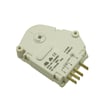
| Frost buildup, warming over time | Defrost system | Refrigerator defrost bi-metal thermostat 5303918202 |
| Door not sealing, moisture, temp swings | Door seal | Refrigerator gasket (match by section and color) |
| Light not working | Lighting | Refrigerator light bulb 316538904 |
Cooling, leaks, and ice maker complaints usually trace back to airflow, defrost performance, or door sealing. Fixing the root cause protects food temperatures, reduces compressor run time, and prevents recurring ice buildup or puddles.
Last updated: February 2026