Installation guide
 Owner’s manual
 Error Codes



Can you use a downdraft vent with a gas range?
Yes. A downdraft vent can be used with a gas range, and your Jenn-Air JGS9900CDS01 is designed for downdraft venting through the wall, floor, or left side when installed to the venting requirements in the installation guide.
What to know for JGS9900CDS01 downdraft venting
For this model, the installation instructions call out specific duct sizing and equivalent-length limits so the blower performs correctly and the gas flame stays stable.
- Use 6-inch (15.2 cm) round metal duct for common venting runs
- Plan the route: wall venting, floor venting, or side venting are supported
- Keep total equivalent duct length within the rated limit (up to 60 ft straight duct)
- Convert the dual-range blower to high range only when equivalent length exceeds 30 ft
- Avoid oversizing airflow beyond what is specified for your locale; consult an HVAC professional for local make-up air requirements
Equivalent duct length quick reference
Use this table to estimate your vent system length before you cut openings or set the range in place.
| Vent piece | Equivalent length (adds to total) |
|---|---|
| 6" round 45° elbow | 2.5 ft |
| 6" round 90° elbow | 5.0 ft |
| Wall cap | 0.0 ft |
| 3-1/4" x 10" to 6" transition | 4.5 ft |
| 6" to 3-1/4" x 10" transition | 1.0 ft |
Why it matters (especially on gas)
Downdraft airflow that is too high for the installation can pull on the burner flame, increase noise, and waste conditioned air. Following the JGS9900CDS01 duct-length and blower-range guidance helps the downdraft capture smoke while keeping burner performance consistent.
Parts that commonly relate to downdraft performance
If the vent is weak, noisy, or not running, these model-compatible parts are often involved:
- Downdraft vent blower fan assembly WPW10273267 (complete fan assembly)
- Range downdraft vent blower motor WPW10201322 (motor only)
Last updated: February 2026
How to tell if a gas igniter is bad?
On your Jenn-Air JGS9900CDS01 gas range, a bad oven igniter usually shows up as an oven that will not heat, heats very slowly, or lights inconsistently even though the control is set to Bake. In many cases the igniter will not glow at all, or it glows but still does not open the gas valve reliably.
Quick checks you can do safely
- Confirm the range has power; a tripped breaker or blown fuse can stop ignition.
- Set the oven to Bake and watch through the openings (without disassembling) for igniter glow.
- If you smell gas, follow the safety steps in the installation guide and stop troubleshooting.
- For surface burners, listen for clicking when turning a knob on; no clicking can point to a power or ignition issue.
- If the igniter glows but the burner does not light within about 60 to 90 seconds, the igniter is typically weak.
What “bad igniter” looks like (symptoms)
| What you observe | What it usually means | Common next step |
|---|---|---|
| No glow from igniter | Open igniter, wiring issue, or control issue | Inspect wiring connections; test igniter circuit |
| Glows, but no flame or delayed flame | Weak igniter (not drawing enough current) | Replace the bake igniter |
| Oven lights sometimes | Igniter failing intermittently | Replace igniter before it fails completely |
| Surface burner will not spark | No power to spark module or failed module | Check power; inspect spark module |
Parts that commonly fix ignition problems
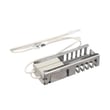
If your bake burner is not lighting, the most common repair is replacing the igniter: whirlpool range bake igniter W11596211. If multiple surface burners are not sparking, the spark ignition module is a common suspect: module- sp WPW10475147.
Why it matters
A weak igniter can allow gas flow delays and cause poor baking performance. Catching it early helps restore normal preheat times and more consistent oven temperatures.
Last updated: February 2026
Why is my JennAir Gas Range oven not igniting?
If your Jenn-Air JGS9900CDS01 gas range oven will not ignite, the most common causes are no power to the range (this model uses pilotless ignition), air in the gas line after installation, or a failed bake igniter. Start with power and gas supply checks, then inspect and test the igniter circuit.
Quick checks first (fastest fixes)
- Confirm the range has power; this oven will not operate during a power failure with pilotless ignition (a match will not light it). See the owner's manual.
- Make sure the oven control settings are correct and the display is not showing a power-failure condition.
- If this is the first time using the oven (or after a gas shutoff), turn on a surface burner for 30 to 60 seconds to purge air from the gas line.
- Listen during a bake start: normal ignition often includes clicking, a brief “poof/whoosh,” and cycling sounds.
- If you smell gas but never get ignition, stop and ventilate; do not keep retrying.
Parts that commonly cause “no ignition”
For the JGS9900CDS01, these parts are frequent suspects when the oven will not light:
| Symptom | Most likely cause | What to do |
|---|---|---|
| No heat, no ignition sounds | No power or control not set | Verify power and settings; reset if needed |
| Clicking but no flame | Weak/failed igniter or gas not opening | Test igniter circuit; inspect wiring |
| Long preheat, then no flame | Igniter not drawing enough current | Replace the igniter |
| Surface burners OK, oven not | Oven ignition component issue | Focus on bake igniter and related wiring |
If the bake burner is not lighting, replacing the whirlpool range bake igniter W11596211 is a common repair.
How we recommend diagnosing it (safe, practical steps)
- Disconnect power before accessing internal components.
- Inspect the igniter and harness for damage, loose connections, or burned spots.
- Use a multimeter to check continuity where appropriate; a failed igniter often tests open.
- If the range was recently moved or installed, confirm the gas shutoff valve is fully open.
Why it matters
A pilotless ignition oven depends on electrical power and a working igniter to open the gas valve and light the burner. When the igniter is weak, the oven can fail to light or heat inconsistently, which affects cooking results and can lead to repeated ignition attempts.
Last updated: February 2026