Installation guide
 Owner’s manual
 Error Codes



Are wall ovens hardwired or plug-in?
For the Frigidaire PLEB27S8CCC electric wall oven, the power connection is hardwired (direct-wired) to a junction box, not plugged into a standard outlet. Installation instructions call out a 208/240-volt junction box for the built-in oven.
A hardwired wall oven uses a flexible armored cable (or approved wiring method) that connects inside an electrical junction box in the cabinet cutout.
Typical requirements include:
- A dedicated 208/240V circuit sized for the oven’s electrical rating
- A properly grounded connection per electrical code
- Power shut off at the breaker before making line connections
- A junction box located where the oven’s cable can reach without strain
- Installation by a qualified installer or service technician
For the exact wiring method and junction box placement guidance for your unit, follow the installation guide.
| Connection type | What it uses | Common for wall ovens? | Notes |
|---|---|---|---|
| Hardwired (junction box) | Direct wire connections in a junction box | Yes | Most built-in wall ovens are installed this way |
| Plug-in (cord and receptacle) | Power cord and matching outlet | Uncommon | More typical on some ranges, not most built-in wall ovens |
Hardwiring affects cabinet cutout planning, junction box location, and safe servicing. It also helps prevent overheating and loose connections that can cause intermittent power loss to the oven controls.
- Keep the junction box accessible and within the allowed area shown in the install instructions
- Confirm the cabinet support surface is level and can support the oven’s weight
- Use anti-tip brackets when specified for the installation
- Verify operation after install using the control checks described in the literature package
Last updated: February 2026
Are wall ovens hard to repair?
Wall ovens like the Frigidaire PLEB27S8CCC are usually more challenging to repair than a freestanding range because most components are behind trim panels and the oven often has to be pulled from the cabinet for access. Many fixes are still straightforward once power is safely shut off and the unit is accessible.
- Access is limited: key parts are behind the control panel, rear panels, or inside the cabinet cutout.
- Removal can be required: some repairs mean sliding the oven out, which is heavier and awkward.
- Electrical safety is critical: the installation guide specifies shutting off power while line connections are made.
- Cabinet fit matters: tight cutouts and anti-tip brackets can add steps during removal and reinstallation.
- More time in setup: protecting cabinetry and supporting the oven adds labor compared to a range.
These are often manageable with basic tools and careful handling:
| Repair type | Typical difficulty | Common symptom |
|---|---|---|
| Replace oven light bulb | Low | Light out, oven heats normally |
| Replace temperature sensor | Medium | Overheats, underheats, temperature swings |
| Replace bake or broil element | Medium | Won’t heat in bake or broil, uneven cooking |
| Replace convection fan motor | Medium to high | No convection, noisy fan |
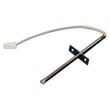
Model-matched parts that are commonly involved include the range oven light bulb 316538904, Frigidaire range oven temperature sensor 316217002, and bake element 318255100.
- Turn off the breaker; confirm the oven is fully de-energized.
- Let the oven cool completely.
- Protect the floor and cabinet edges before sliding the unit out.
- Keep track of screws and trim pieces; lengths can vary.
- Follow the cabinet and anti-tip bracket guidance in the installation guide.
Wall ovens are built into cabinetry, so a “simple” part replacement can turn into a removal and reinstallation job. Planning for access, support, and safe electrical handling prevents cabinet damage and reduces the chance of repeat failures.
Last updated: February 2026
How do I reset my Frigidaire electric range?
To reset your Frigidaire PLEB27S8CCC electric wall oven, turn the power off at the circuit breaker (or remove the fuse) for about 30 seconds, then restore power and set the clock. A power interruption commonly makes the display flash until the clock is set.
- Press CANCEL to stop any beeping or clear a fault display.
- Turn OFF the oven circuit at the home breaker panel.
- Wait 30 seconds.
- Turn the breaker ON.
- Set the clock and reprogram any cooking settings (the oven will not program until the clock is set).
- If the display shows an F1 through F10 code again after the reset, write it down before pressing CANCEL.
A reset restores the control, but it will not fix a power supply or wiring problem. Check these common causes first:
- Breaker is tripped or not fully reset (switch it fully OFF, then ON)
- Loose or incomplete wiring at the junction box (common right after installation)
- House fuse blown
- Control settings not set correctly
- A failed heating component such as the bake element 318255100 or a temperature sensing issue with the range oven temperature sensor 316217002
| What you see | What it means | What to do |
|---|---|---|
| Display flashes | Power was interrupted | Set the clock, then try Bake |
| Beeping with F-code | Control detected a fault | Press CANCEL; reset power; note code if it returns |
| No display at all | No power to oven | Check breaker, fuse, junction box wiring |
Resetting clears temporary electronic control glitches and restores normal programming. If the oven repeatedly loses power, flashes the display, or returns an F-code, the underlying issue is usually power supply, wiring, or a failing component that needs diagnosis.
For model-specific control and clock-setting steps, use the owner's manual.
Last updated: February 2026
Why is my wall oven not turning on?
If your Frigidaire PLEB27S8CCC wall oven will not turn on, the most common causes are a tripped breaker or blown fuse, an incomplete or loose power connection at the junction box, or control settings that prevent operation until the clock is set. See the owner's manual for the exact startup and control steps.
- Confirm the house circuit breaker is fully reset (turn it OFF, then ON) or replace the fuse if blown.
- Check that the oven’s electrical cord/conduit connections are tight in the junction box (power must be OFF before touching wiring).
- If the display is flashing after a power interruption, set the clock; the oven will not program until the clock is set.
- Verify the oven controls are set correctly for Bake or Broil (not just the timer or clock screen).
- Look for signs of a power issue in the home (other lights or outlets affected).
If the display works but the oven does not heat, focus on heating and temperature-sensing parts.
Common suspects include:
- Failed bake element (no heat in Bake)
- Failed broil element (no heat in Broil)
- Bad temperature sensor causing incorrect temperature feedback
- Control board or wiring issue
| Symptom | Most likely area | Example part for this model |
|---|---|---|
| No heat on Bake, Broil works | Bake circuit | Bake element 318255100 |
| Oven heats poorly or erratically | Temperature sensing | Frigidaire range oven temperature sensor 316217002 |
| Oven light out (not a heat issue) | Lighting | Range oven light bulb 316538904 |
A wall oven that will not power up is usually an electrical supply or setup issue, while an oven that powers up but will not heat is usually a failed heating component or sensor. Separating “no power” from “no heat” prevents unnecessary part replacement.
Last updated: February 2026
What does code 278 mean?
On a Frigidaire PLEB27S8CCC electric wall oven, “278” is not a standard oven fault code; it is most often a display readout (such as a temperature value) or a non-error indicator. For true error codes, use the code list and troubleshooting steps in the owner's manual.
- If the oven is heating or preheating, 278°F can simply be the current cavity temperature.
- If “278” appears with beeping, flashing, or the oven stopping, treat it like a control/display issue.
- If it appears right after a power outage or breaker trip, it can be a control reset symptom.
- If other keys do not respond, the control panel may be locked or the control is confused.
- Cancel/clear the cycle: Press Cancel/Off once, then wait 30 seconds.
- Power reset: Turn the breaker off for 2 minutes, then back on.
- Confirm actual heating: Set Bake to 350°F and see whether the oven begins heating normally.
- Look for additional codes: Many Frigidaire ovens show an “F” style code when a real fault is detected.
If the oven will not heat correctly, heats erratically, or the displayed temperature is clearly wrong, these parts are common suspects:
| Symptom | Common cause | Part to check |
|---|---|---|
| Oven won’t heat or heats weakly | Failed bake circuit | Bake element 318255100 |
| Temperature swings, over/underheats | Sensor out of range | Frigidaire range oven temperature sensor 316217002 |
| Light out only | Burned-out bulb or socket | Range oven light bulb 316538904 or range oven light socket 316116400 |
Treating “278” as an error can send you chasing the wrong fix. Confirming whether it is a temperature readout, a stuck display, or a real fault helps you avoid unnecessary parts replacement and gets your wall oven back to reliable baking faster.
Last updated: February 2026