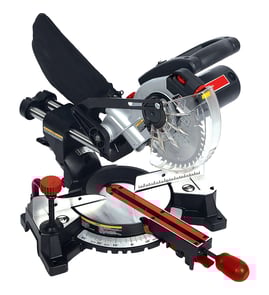


Can you cut a 4x4 with a 12 inch miter saw?
Yes. A 12-inch miter saw typically cuts a 4x4 (actual size about 3-1/2 in. x 3-1/2 in.) in one pass at 90 degrees; if it does not, you can finish the cut by flipping the board. For your Craftsman 113234630 10-inch miter saw, a 4x4 usually requires a flip-cut.
What to expect by saw size (capacity)
Most 12-inch miter saws have enough vertical cut capacity to crosscut a 4x4 at 90 degrees without repositioning. Most 10-inch miter saws (including many non-sliding models) do not.
| Saw type | Typical 4x4 cut at 90 degrees | Notes |
|---|---|---|
| 12-inch non-sliding miter saw | Often 1 pass | Capacity varies by design and fence height |
| 12-inch sliding miter saw | 1 pass (and more width) | Sliding helps with wide boards, not just thickness |
| 10-inch miter saw (like Craftsman 113234630) | Usually flip-cut | Plan on careful alignment for a clean, square cut |
How to flip-cut a 4x4 safely and accurately
- Unplug the saw before adjusting the fence, bevel, or miter settings.
- Mark a cut line on at least two faces of the 4x4 (top and one side) to help you realign.
- Make the first cut as deep as the saw allows without forcing the blade.
- Rotate the 4x4 180 degrees (keep the same face against the fence) and align the blade to the kerf.
- Complete the cut slowly to avoid pinching and tear-out.
Common reasons a 4x4 will not cut in one pass
- Blade diameter and guard design limit vertical capacity.
- Fence height or workpiece position reduces clearance.
- Dull blade or wrong tooth count causes burning and slows the cut.
- Warped lumber rocks against the fence and changes the effective thickness.
Why it matters
A clean, square 4x4 cut is mostly about capacity and control. Forcing a too-small saw through a thick cut increases binding risk and can pull the workpiece off the fence. If you need frequent 4x4 cuts, we recommend matching the saw size and blade to the job.
For parts and accessories that fit your Craftsman 113234630, start with the parts list for this model, or search by model number on Sears PartsDirect.
Last updated: February 2026
Is a 10 or 12 inch miter saw better?
A 10-inch miter saw like the Craftsman 113234630 is the better all-around choice for most DIY and trim work because it’s lighter, easier to move, and uses less expensive blades; a 12-inch miter saw is better when you regularly need maximum cut capacity for wider boards and taller molding.
Quick comparison: 10-inch vs 12-inch
- Choose 10-inch for portability, everyday crosscuts, baseboard and casing, and lower blade cost.
- Choose 12-inch for wider stock, taller crown molding, and fewer “flip the board” cuts.
- Both sizes can deliver clean, accurate cuts when the fence is square and the blade is sharp.
- Blade cost and availability usually favor 10-inch.
- Weight and footprint usually favor 10-inch, especially for jobsite use.
| Feature | 10-inch miter saw (your Craftsman 113234630) | 12-inch miter saw |
|---|---|---|
| Typical use | DIY, trim, light framing | Larger trim, wider boards, heavier-duty work |
| Cut capacity | Moderate | Larger |
| Portability | Easier to carry and store | Bulkier and heavier |
| Blade cost | Typically lower | Typically higher |
How we recommend choosing
Use these practical “yes/no” checks:
- You often cut wide shelving, 2x stock, or large baseboard and want fewer workarounds: go 12-inch.
- You move the saw often, have limited space, or want a lighter setup: go 10-inch.
- You want the best value for general home projects: go 10-inch.
- You plan to add a sliding saw later for capacity: a 10-inch can still make sense now.
Why it matters
The “better” saw is the one that matches your most common cuts. Oversizing can mean extra cost and a heavier tool you use less; undersizing can mean more repositioning and more chances for small accuracy errors on wide material.
Parts and support
For Craftsman 113234630 repairs, we recommend matching parts by the exact model number and diagram callouts; you can also search by model number on Sears PartsDirect. For general site features and account benefits, see how to enjoy all the online benefits we offer on our Sears PartsDirect.
Last updated: February 2026
What should you never cut with a miter saw?
You should never use a Craftsman 113234630 10" miter saw to cut materials it is not designed for (like masonry or ferrous metal), or to make unsafe cuts (like freehand cuts or tiny pieces held close to the blade). These situations greatly increase kickback and contact risk.
Materials you should not cut
- Ferrous metals (steel, iron): sparks, blade damage, and binding risk
- Masonry (brick, concrete, tile): dust and improper blade design for the saw
- Large sheet goods you would normally rip-cut (plywood sheets): a miter saw is not a rip saw
- Anything thicker or wider than the saw’s capacity: forces the cut and increases binding
Cuts and setups to avoid (even on wood)
- Freehand cuts (no fence support, no clamp, no stable workpiece)
- Very small pieces where your fingers end up near the blade path
- Warped, twisted, or bowed boards unless they are firmly clamped and fully supported
- Cuts with the workpiece not flat against the table and fence
- Reaching under or across the blade path to hold or retrieve offcuts
Safer alternatives (quick comparison)
| If you need to do this | Use this instead | Why it’s safer |
|---|---|---|
| Rip-cut with the grain | Table saw or circular saw with a guide | Better control and proper guarding for ripping |
| Cut steel/iron | Metal-cutting saw with the correct blade | Correct RPM and blade type |
| Cut brick/tile | Masonry saw with dust control | Designed for abrasive cutting |
| Hold tiny parts | Clamp, stop block, or a purpose-made jig | Keeps hands away from the blade |
Why it matters
A miter saw is built for controlled crosscuts and miter/bevel cuts with the work supported by the fence and table. When the material or setup is wrong, the blade can grab and throw the workpiece (kickback) or pull your hands into the danger zone.
Parts and help for your model
If a guard, fence, switch, or power cord is damaged, replace the worn components before using the saw again. We list model-specific parts when available, and you can also search by model number on Sears PartsDirect.
Last updated: February 2026
Why is 31.6 on a miter saw?
The 31.6° marking is a common “crown molding” reference angle used for compound cuts; it’s paired with a bevel angle (commonly 33.9°) to help produce tight 90° corner joints when crown has a typical spring angle. On a Craftsman 113234630 10-inch miter saw, it serves as a quick setup target when your saw’s scale includes that mark.
What 31.6° is for
31.6° is used when you cut crown molding laid flat on the saw table (not nested against the fence) and you need a compound miter and bevel to form a clean corner.
- Speeds up setup for repeated inside and outside corner cuts
- Works with common crown “spring angles” (the angle crown sits between wall and ceiling)
- Reduces math and trial-and-error when you are using the laid-flat method
- Still requires a quick test cut because molding profiles and installation angles vary
Common compound settings (quick reference)
Use these as starting points; always verify with scrap.
| Crown spring angle | Miter setting | Bevel setting |
|---|---|---|
| 38° (very common) | 31.6° | 33.9° |
| 45° (less common) | 35.3° | 30.0° |
How to use the mark accurately
- Confirm your method: laid flat uses compound settings; nested typically uses 45° miter with 0° bevel
- Keep the same face orientation every cut; mark “ceiling” and “wall” edges on the molding
- Lock the miter and bevel firmly before cutting; recheck the pointer alignment on the scale
- Make two short test pieces to form a corner; adjust miter in small increments if the joint opens
Why it matters
Crown molding magnifies small angle errors; a 0.5° mismatch can create visible gaps. The 31.6° reference exists because it matches common crown geometry, helping you get repeatable results faster.
For model-based diagrams and replacement parts (guards, switches, brushes, hardware) for Craftsman model 113234630, search by model number on Sears PartsDirect.
Last updated: February 2026