Installation guide
 Owner’s manual
 Error Codes



What are the common problems with Bosch ranges?
Bosch cooking appliances most often have heating, temperature accuracy, and control issues; on a Bosch HBL8650UC electric wall oven, the most common symptoms we see are the oven not heating properly, uneven baking, or error codes tied to temperature sensing, airflow, or door locking. Use the HBL8650UC manual to match your symptom to the correct checks.
Most common symptoms and likely causes
- Oven will not heat or heats weakly: failed heating element, wiring issue, or control problem
- Inaccurate temperature or long preheat: failed temperature sensor or airflow/door seal issues
- Uneven baking: convection fan or airflow channel problem, rack position, or calibration
- Self-clean problems or door won’t unlock: door latch/lock mechanism issue
- Oven shuts down or overheats: high-limit safety thermostat opening due to overheating or restricted airflow
Quick checks we recommend before replacing parts
- Power reset: turn the breaker off for 1 minute, then back on.
- Confirm the mode: Bake vs Convection Bake vs Broil; settings can change heat behavior.
- Look for visible damage: blistered element, loose connectors, burned wiring.
- Check airflow: blocked vents or heavy grease buildup can trap heat.
- Run a simple test: preheat to 350°F and note whether it reaches temp and holds it.
Parts that commonly solve these problems (when testing confirms failure)
| Symptom | Part to suspect | Example part for this model |
|---|---|---|
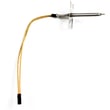
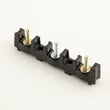
| Temperature swings, error codes, under/overheating | Oven temperature sensor | Sensor 00642855 |
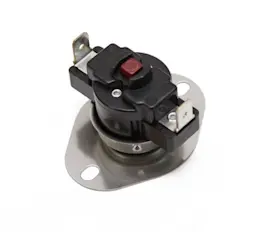
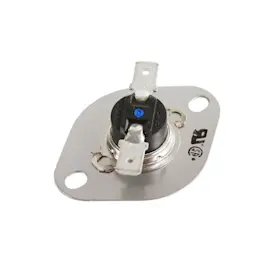
| Oven overheats or shuts off mid-cycle | High-limit thermostat | Temperature limit 00617877 |
| Door won’t lock/unlock for self-clean | Door latch | Latch 00751505 |
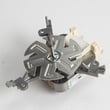
| Uneven convection results, noisy airflow | Convection fan | Fan 00643600 |
Why it matters
Accurate temperature control and proper airflow protect the control board and wiring, improve baking results, and prevent nuisance shutdowns. When a sensor or high-limit device is failing, the oven can cycle incorrectly even if it still “turns on.”
For model-specific diagnostics, wiring diagrams, and safe access guidance, follow the HBL8650UC installation guide.
Last updated: January 2026
What is the life expectancy of a Bosch oven?
A Bosch electric wall oven like model HBL8650UC typically lasts 15 to 20 years with normal household use, proper installation, and routine cleaning. Heavy use, frequent self-clean cycles, and overheating conditions can shorten that lifespan.
What affects how long an HBL8650UC oven lasts
- Usage frequency: daily baking and roasting wears heating and control components faster.
- Self-clean habits: frequent high-heat self-cleaning accelerates stress on door lock and electronics.
- Ventilation and fit: correct cabinet clearances and support reduce heat damage and vibration.
- Power quality: repeated surges can damage the control system.
- Maintenance: keeping the cavity, door seal area, and vents clean helps prevent overheating.
Typical lifespan expectations (quick guide)
| Appliance type | Typical life expectancy | What usually ends life first |
|---|---|---|
| Electric wall oven (Bosch class) | 15 to 20 years | Heating system, temperature sensing, controls |
| Door components | 10 to 15 years | Hinges, glass, latch/lock |
| Convection/venting components | 10 to 15 years | Fan or motor wear |
Signs your oven is nearing end-of-life (and what to check)
- Temperature swings or underbaking: check the sensor 00642855 and calibration steps in the HBL8650UC owner’s manual.
- Long preheat times: inspect heating performance and airflow; a weak element can cause slow heat-up.
- Overheating or shutting down: a high-limit safety device can trip if airflow is restricted.
- Door won’t lock/unlock: the lock mechanism can wear; avoid forcing the door.
Why it matters
Knowing the 15 to 20 year lifespan helps you decide whether to repair or replace. If your HBL8650UC is within that range, replacing a common wear part (like a temperature sensor) often restores reliable baking without replacing the entire wall oven.
Last updated: January 2026
What makes Bosch Series 8 ovens special?
Bosch Series 8 ovens (including the Bosch HBL8650UC family) stand out for precision cooking features that help automate results, especially through sensor-driven programs that monitor cooking progress and adjust heat and time for you. For the exact features and modes on your unit, use the HBL8650UC owner's manual.
What “special” usually means on Series 8
Series 8 is positioned as a premium Bosch cooking line; the biggest day-to-day benefits are consistent results, convenience features, and a more guided cooking experience.
Common Series 8 advantages include:
- Sensor-controlled cooking programs that adjust settings as food cooks
- Convection cooking support for more even baking and roasting
- Multiple cooking modes (bake, broil, convection variations) for flexibility
- Better temperature management for repeatable results
- Built-in design options for wall installations and under-counter installs (when installed to spec)
How this applies to your Bosch HBL8650UC installation
A “special” oven only performs like it should when it is installed with the right clearances and cabinet support. Bosch’s built-in oven installation guidance for this model family includes:
- Allowing about 1/4 inch side clearance when next to a wall or cabinet door
- Using a solid, level support base (often with 2x4 supports front-to-back)
- Ensuring the cabinet base can support at least 193 lb (87 kg)
- Maintaining required gaps when installed under a cooktop (especially induction)
For the exact cutout dimensions and placement rules for 27-inch vs 30-inch configurations, use the HBL8650UC installation guide.
Quick comparison: “basic oven” vs Series 8 experience
| Feature area | Basic electric wall oven | Bosch Series 8 approach |
|---|---|---|
| Cooking control | Manual time and temp | Sensor-guided programs plus manual control |
| Consistency | More trial-and-error | More repeatable results across dishes |
| Convenience | Fewer automated options | More automatic adjustments and guided modes |
| Installation impact | Standard requirements | Standard requirements, but clearances and support are critical |
Why it matters
Sensor-driven cooking and convection performance depend on accurate temperature sensing and stable installation. If the oven is not level, not properly supported, or lacks clearance, you can see uneven baking, longer preheat, or heat-related shutdowns.
Last updated: January 2026