Owner’s manual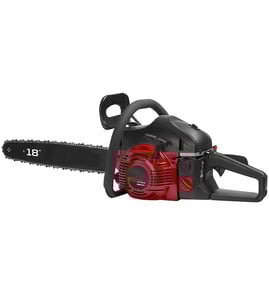



Where is the model number on a chainsaw?
On the Craftsman gas chainsaw model 316380900, the model number is typically printed on the product identification label or tag on the saw body. Check the housing near the rear handle, starter cover area, or the side of the main chassis; these are the most common label locations.
Where to look on the Craftsman 316380900
Look for a sticker, foil label, or stamped ID tag in these spots:
- On the main housing (side of the saw body)
- Near the rear handle or trigger handle area
- Around the recoil starter housing (pull-cord side)
- Near the bar mounting area (clutch cover side)
- On the underside of the saw body, close to the fuel or oil tank area
If the label is dirty or oil-stained, wipe it gently with a rag and mild cleaner so the numbers are readable.
What the model number looks like
For this unit, the model number format is shown in the documentation as 316.380900 (you may also see it without the dot as 316380900).
| You see this on the label | It means |
|---|---|
| 316.380900 | Model number (with dot formatting) |
| 316380900 | Model number (without dot formatting) |
Why it matters
We use the model number to match the correct parts and specifications for your exact chainsaw, such as the correct guide bar length, chain pitch, and maintenance procedures.
Helpful reference
- Use the 316380900 operator's manual to confirm the model number format and find the “Know Your Unit” section for label and component identification.
Last updated: January 2026
What model number is a Craftsman 316380900 chainsaw?
The model number for this Craftsman gas chainsaw is 316.380900 (often written without the dot as 316380900). You can confirm it on the unit’s model tag and in the 316380900 operator's manual.
Where to find the model number on the saw
Most Craftsman gas chainsaws list the model number on a label or plate on the powerhead. Check these common spots:
- Near the rear handle or trigger area
- On the starter housing (recoil starter side)
- Around the bar mount area (behind the clutch cover)
- On the bottom of the saw body
- In the manual cover page and specifications section
Why the number matters (316.380900 vs. other Craftsman models)
Craftsman chainsaws can look similar across model families, but parts like the guide bar, saw chain, ignition module, and carburetor vary by model. Using the exact model number helps match the correct Chainsaw parts and avoids fit issues.
Quick comparison
| What you see | What it means | What to do |
|---|---|---|
| 316.380900 | Full model format used in the manual | Use this to confirm specs and procedures |
| 316380900 | Same model number without punctuation | Use this when searching parts |
| 358.xxxxxx | Different Craftsman model family | Do not cross-order parts without verifying |
Helpful next steps for parts and service
Once you confirm 316.380900, use the manual and parts list to stay aligned with the correct Craftsman configuration:
- Follow the fuel/oil ratio and starting steps in the manual
- Match bar and chain specs before ordering replacements
- Replace routine maintenance items on schedule (air filter, spark plug)
- Use low-kickback chain types recommended for this model
- For hard-start symptoms, follow tips for a hard to start chainsaw
Last updated: January 2026
Is 40 1 or 50 1 better for chainsaws?
For the Craftsman chainsaw model 316380900, 40:1 is the correct fuel mix; it is better because it matches the engine’s required lubrication ratio. Using 50:1 reduces oil in the mix and can increase wear and overheating risk in a 2-cycle engine.
What 40:1 vs 50:1 means
A ratio is gasoline : 2-cycle oil.
- 40:1 = more oil per gallon of gas (more lubrication)
- 50:1 = less oil per gallon of gas (leaner on oil)
- The right ratio is the one specified for your engine, not the one that “smokes less”
Refer to the 316380900 operator's manual for the exact fuel/oil ratio and fuel handling guidance.
Quick mixing chart (common batch sizes)
| Mix ratio | 1 gallon gas | 1/2 gallon gas | 1 liter gas |
|---|---|---|---|
| 40:1 | 3.2 oz oil | 1.6 oz oil | 25 mL oil |
| 50:1 | 2.6 oz oil | 1.3 oz oil | 20 mL oil |
What happens if you use the wrong mix
Using the wrong 2-cycle mix can cause starting and running problems and shorten engine life.
- Too little oil (example: 50:1 in a 40:1 engine): hotter running, faster piston and cylinder wear, scoring, seizure risk
- Too much oil: more smoke, carbon buildup, fouled spark plug, rough idle
- Old or stale fuel: hard starting, surging, poor acceleration
If your saw is already hard to start after a fuel change, use tips for a hard to start chainsaw to narrow down fuel, spark, and air-flow checks.
Why it matters
Your 316380900 is a 2-cycle chainsaw; the oil in the fuel is the engine’s primary lubrication. Matching the specified ratio protects the crank bearings, piston, and cylinder while keeping performance consistent.
Last updated: January 2026
How many horsepower is a 42cc chainsaw?
A 42cc chainsaw does not have one fixed horsepower rating; it depends on the engine design and tuning. For the Craftsman model 316380900, the operator documentation lists 42 cc displacement, but it does not publish a horsepower number; use displacement and bar length as the best spec comparison in the 316380900 operator's manual.
What you can use instead of horsepower
When horsepower is not listed, these specs tell you how the saw is set up to perform:
- Displacement: 42 cc (2.56 cu. in.)
- Guide bar length: 18 in.
- Fuel/oil mix: 40:1 (2-cycle)
- Approx. weight (dry): 14 to 15 lb
- Chain pitch and gauge: 3/8 in. pitch, 0.050 in. gauge
Typical horsepower range for 42cc gas chainsaws
Most homeowner-grade 42cc 2-cycle chainsaws are commonly marketed around 2.0 to 2.5 HP (or roughly 1.5 to 1.9 kW). Use this as a shopping comparison, not as a guaranteed rating for your exact saw.
| Spec | What it tells you | Why it helps |
|---|---|---|
| cc (displacement) | Engine size | Best apples-to-apples comparison when HP is missing |
| Bar length | Intended cutting capacity | Longer bars generally need more torque to stay efficient |
| Chain pitch/gauge | Cutting system match | Ensures you buy the correct chain and bar |
Why it matters
Horsepower is often used in advertising, but cc, bar length, and chain setup are more reliable for choosing compatible parts (chain, bar, spark plug) and for setting expectations on cutting speed and load handling.
Parts that affect real-world power (and starting)
If the saw feels weak or bogs down, these maintenance items often make the biggest difference:
- Clean or replace the air filter (restricted airflow reduces power)
- Check the spark plug condition and gap
- Use fresh, correctly mixed fuel (40:1)
- Inspect the muffler and spark arrestor screen for blockage
- Service the carburetor if it runs lean/rich or surges
For step-by-step troubleshooting, use tips for a hard to start chainsaw.
Last updated: January 2026