

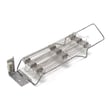
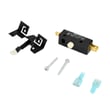
Can I replace a dryer heating element myself?
Yes, you can replace the heating element in your Kenmore dryer model 11086863100 yourself if you’re comfortable working with wiring and panels. The job is straightforward, but you must disconnect power first and reassemble the heater housing and wire connections exactly as found.
Before you start (safety and prep)
- Unplug the dryer; for electric models, also switch both breaker poles off.
- Let the dryer cool completely.
- Take photos of every wire connection before removing anything.
- Use a nut driver/screwdrivers, work gloves, and a vacuum for lint.
- If you see burned terminals, plan to replace damaged wiring, not just the heater.
What you typically do during the repair
Most Kenmore dryers of this style require you to open the cabinet (often from the back or front), remove the heater housing cover, swap the element, then reinstall thermostats/sensors exactly where they were.
Common steps include:
- Remove the rear or front access panel (varies by design).
- Disconnect heater wires and remove the heater housing.
- Transfer any mounted safety devices (high-limit thermostat/thermal cut-off) to the new assembly if applicable.
- Reinstall the housing, reconnect wires, and reassemble panels.
- Run a timed heat cycle and confirm strong airflow at the vent.
Parts that often matter when a dryer won’t heat
A failed heating element is common, but overheating and poor airflow can also open safety fuses.
| Symptom | Most likely cause | What to check next |
|---|---|---|
| Runs but no heat | Heating circuit open | Element, thermal cut-off, thermostat |
| Heats then stops | Overheating | Vent restriction, lint buildup, cycling thermostat |
| Burning smell | Lint or overheated wiring | Heater housing, terminals, blower airflow |
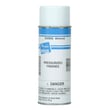
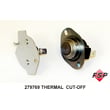
If your dryer overheated, replacing the safety fuse kit along with airflow cleanup prevents repeat failures; the cut-off 279769 is a common fix path on this model family.
Why it matters
A new heating element can fail quickly if the vent is restricted or lint is packed in the blower and lint chute. Restoring airflow protects the heater, thermostats, and wiring and improves dry times.
For airflow and general dryer component orientation, we use the guide what are the main parts of a clothes dryer.
Last updated: February 2026
How do I know if my dryer start switch is bad?
If your Kenmore dryer model 11086863100 will not start (or only starts intermittently), the most reliable way to confirm a bad start switch is a multimeter continuity test: the switch should show continuity only while it is pressed. If it never shows continuity, the switch is bad.
Quick checks before testing
- Confirm the dryer has power (breaker not tripped; outlet working).
- Make sure the door fully closes and the door switch clicks.
- Try a different cycle and firmly press and hold Start for 2 to 5 seconds.
- Listen for a click at the console when you press Start.
- If the drum light stays on with the door closed, suspect the door switch.
How to test the start switch with a multimeter
- Unplug the dryer (or switch off the breaker).
- Access the console and locate the start switch terminals.
- Pull the wire connectors off the switch (grab the connector, not the wire).
- Set the meter to continuity (or the lowest ohms setting).
- Test across the switch terminals:
- Not pressed: no continuity (OL or no beep)
- Pressed and held: continuity (near 0 ohms or beep)
What the readings mean
| Test result | What it indicates | Next step |
|---|---|---|
| Continuity only when pressed | Switch is working | Check door switch, thermal cut-off, motor, timer/control |
| No continuity when pressed | Bad start switch | Replace the start switch |
| Continuity all the time | Switch stuck closed | Replace the start switch |
Other common “won’t start” causes on this model
A start switch can test good and the dryer still will not run. These are frequent culprits:
- Blown thermal cut-off or high-limit issue (often tied to restricted venting); consider the cut-off 279769.
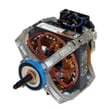
- Failed drive motor; see the motor 279827.
- Door switch not closing electrically (even if it clicks).
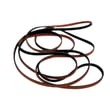
- Broken belt (some designs stop the motor if the belt breaks); inspect the belt 341241.
- Loose or burned power connection at the terminal block (electric dryers).
Why it matters
A correct continuity test prevents replacing the wrong part. If the start switch is fine, focusing next on the thermal cut-off, door switch, motor, and airflow restriction gets your Kenmore dryer running again faster.
Last updated: February 2026
How do I tell if my dryer heating element is bad?
If your Kenmore dryer model 11086863100 runs but produces little or no heat, takes much longer to dry, or trips a thermal safety device, the heating element is a top suspect. We confirm it by inspecting the coil and testing the element circuit with a multimeter for proper resistance and for a short to the heater housing.
Quick symptoms to watch for
- Drum tumbles normally but clothes stay cool or damp
- Dry times suddenly increase (multiple cycles needed)
- Burning smell or visible scorching near the heater area
- Dryer heats briefly, then stops heating (often after a safety opens)
- Breaker trips or dryer shuts down during heat (possible short)
How we test the heating element (safe, reliable method)
- Unplug the dryer (and shut off gas if you have a gas model; many Kenmore 110-series are electric, but always verify your setup).
- Access the heater terminals (location varies by design).
- Set a multimeter to ohms (Ω).
- Test element continuity across the two element terminals.
- Test for a short to ground by checking each terminal to the metal heater housing.
Typical meter readings (what “good” looks like)
| Test | What you should see | What it means if you don’t |
|---|---|---|
| Terminal-to-terminal resistance | Commonly ~10 to 50 Ω | OL/infinite: element is broken; near 0 Ω: possible internal short |
| Terminal-to-housing (ground) | OL/infinite | Any measurable resistance: element is shorted to the housing |
Visual checks (fast clues)
A bad element often shows one or more of these:
- Broken coil or a gap in the heating wire
- Coil touching the metal housing (can cause cycling, overheating, or tripping)
- Burnt terminals or damaged wiring near the heater
If you find heat-related wiring damage, use the correct repair kit for this model, such as the dryer heating element wire kit 279457.
Why it matters
A weak or failed heating element can mimic airflow problems, but a shorted element can also overheat the dryer and open safety devices. Confirming the element with a meter helps you avoid replacing the wrong parts and restores normal cycle times.
For broader Kenmore dryer troubleshooting patterns, we also use the Kenmore 110 series electronic control model dryer error codes guide to interpret control-related symptoms.
Last updated: February 2026
How do I tell what model my Kenmore dryer is?
For a Kenmore dryer, the model number is printed on the appliance’s rating label; for your dryer it will match 11086863100 when you find the tag. The label is usually easiest to spot with the door open, and using the exact model number is the fastest way to get the right parts and diagrams.
Where to look for the model tag
Check these common locations on Kenmore dryers:
- Inside the dryer door opening on the front frame
- On the back panel of the cabinet
- Around the lint screen housing area (near the lint filter opening)
- On the inside of the front panel (visible when the door is open)
What the model number looks like (and what to write down)
Record the full model number exactly as shown, including all digits.
| What to capture | Example for this dryer | Why it matters |
|---|---|---|
| Model number | 11086863100 | Matches the correct parts list and diagrams |
| Serial number | (varies) | Helps identify production run details |
| Type (gas/electric) | (varies) | Ensures you choose compatible heating parts |
Quick tips to avoid ordering the wrong part
Once you have the model number, match parts to that exact model and symptom.
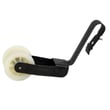
- If the drum will not turn, start with the belt 341241 and the idler system
- If the dryer hums but will not run, check the drive system such as the motor 279827
- If the door must be slammed to start, inspect the door switch and latch area
- If drying is slow, clean the lint screen and confirm the vent is clear before replacing parts
Why it matters
Kenmore model numbers can look similar across different series, but small design changes affect fit and wiring. Using 11086863100 ensures you get the correct Kenmore dryer parts, troubleshooting steps, and repair diagrams for your exact machine.
Last updated: February 2026