 Owner’s manual
 Error Codes



What is the average lifespan of a Kenmore Elite refrigerator?
Most Kenmore Elite refrigerators, including model 59673503203, typically last 10 to 15 years with normal use and basic maintenance. Units that get regular cleaning and have good door sealing often reach the high end of that range; major sealed-system failures usually shorten it.
What affects lifespan the most
- Condenser coil cleanliness (dust buildup makes the compressor work harder)
- Door gasket condition (warm air leaks increase run time and frost)
- Room temperature and ventilation around the cabinet
- Ice maker and water system upkeep (clogs and leaks create secondary damage)
- How often doors are opened and how full the compartments stay
Maintenance that helps you reach 15 years
Use these as a simple yearly checklist:
- Vacuum coils and the toe-kick area; reinstall the toe grille securely.
- Keep doors closing squarely; avoid overloading door bins.
- Set stable temps (most households do best around 37°F fresh food and 0°F freezer).
- Replace burned-out interior lighting promptly so you can spot spills and airflow blockages (see bulb replcmt W11447232).
- Follow cleaning and care steps in the 59673503203 owner's manual.
Quick “repair or replace” guide
| What you’re seeing | Common cause | Typical next step |
|---|---|---|
| Warm fridge, freezer OK | Airflow issue, dirty coils, door leak | Clean coils, check gasket, confirm vents are clear |
| Frost buildup, warming temps | Defrost system problem | Diagnose defrost components and controls |
| No water/ice, slow fill | Supply restriction or valve issue | Check line, filter, then test inlet valve |
Why it matters
A refrigerator that runs longer to hold temperature uses more energy and wears out the compressor faster. Simple upkeep (coils, seals, airflow) is the most reliable way to extend the service life of a bottom-mount refrigerator.
Last updated: January 2026
What year did the Kenmore Elite come out?
Kenmore Elite launched as a premium Kenmore line in 1999. Your specific Kenmore Elite bottom-mount refrigerator model 59673503203 was produced later than that; the most accurate way to pin down its exact build year is to decode the serial number using the 59673503203 owner's manual.
How to find the manufacture date for model 59673503203
On most Kenmore Elite refrigerators, the serial/model tag is inside the fresh food compartment (often on a side wall or ceiling), or on the cabinet frame near the door opening.
- Locate the serial number (not just the model number).
- Write it down exactly, including letters.
- Check the manual’s “model and serial number” section for the label location.
- Use the serial format to identify the year and week of manufacture (many Kenmore units use a coded date within the serial).
- If the tag is missing or unreadable, check for a secondary label behind the toe grille.
Quick timeline (what the dates mean)
| What you’re asking about | What it tells you | Typical use |
|---|---|---|
| “When did Kenmore Elite come out?” | Brand-line launch date | Historical reference |
| “When was my 59673503203 made?” | Your refrigerator’s build date | Parts compatibility, service history |
| “How old is my fridge?” | Age in years | Repair vs. replace decisions |
Why it matters
Knowing the build year helps us match the correct refrigerator parts and revisions for your Kenmore Elite, especially for items that change over production runs (controls, lighting, and water system components).
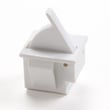
If you’re troubleshooting a symptom while you’re checking the serial tag, common quick-check parts for door and light-related issues include the refrigerator switch W11396033 and the bulb replcmt W11447232.
Last updated: January 2026
What are the common problems with Kenmore Elite refrigerators?
Common problems we see on Kenmore Elite refrigerators like model 59673503203 include warm temperatures (cooling airflow issues), frost buildup (defrost or door-seal problems), water leaks (clogged defrost drain or water line issues), and ice maker or dispenser failures. Use the 59673503203 owner's manual to match symptoms to your control settings and features.
Most common symptoms and what usually causes them
- Not cooling or weak cooling: dirty condenser coils, evaporator fan not running, blocked vents, or a control issue
- Excessive frost/ice: door not sealing, frequent door openings, defrost system problem
- Water under the refrigerator: clogged defrost drain, cracked drain parts, loose water connections
- No ice or slow ice production: water supply restriction, inlet valve issue, ice maker mechanical wear
- Unusual noises (buzzing/clicking/rattling): fan blade hitting ice, failing start components, loose panels
Quick checks we recommend first (safe, high-impact)
- Confirm temperature settings and that vents are not blocked by food packages.
- Clean condenser coils and make sure the toe-kick area has good airflow.
- Check door closing and gasket contact all the way around.
- If there is water, inspect the defrost drain area for ice or debris.
- For ice and water issues, verify household water pressure and look for kinks in the supply line.
Parts that commonly relate to these problems
| Symptom | Part area | Example part for this model |
|---|---|---|
| Interior light stays off or door sensing acts odd | Door switch | Refrigerator switch W11396033 |
| Water dispenser/ice maker not filling | Water inlet system | Refrigerator valve WP12544002 |
| Leaks at tubing connections | Water line fittings | Refrigerator water supply tube union, 5/16 x 5/16-in WP2300868 |
Why it matters
Cooling, defrost, and water systems interact. A simple airflow restriction can mimic a sealed-system problem, and a small water leak can turn into ice buildup that blocks the evaporator fan and reduces cooling.
Last updated: January 2026
Why is my Kenmore Elite refrigerator leaking water out of the bottom?
Water leaking from the bottom of your Kenmore Elite refrigerator model 59673503203 is usually caused by a defrost drain problem (clogged or frozen), a leak in the water supply/dispenser tubing, or water backing up and overflowing into the base. Use the 59673503203 owner's manual to confirm drain access and cleaning steps for your exact configuration.
Most common causes (and what to check first)
- Clogged or frozen defrost drain: Water from normal defrosting cannot flow to the drain pan and spills into the cabinet, then out the bottom.
- Leaking water line connection: A loose fitting or cracked line can drip and run down to the base.
- Ice maker or dispenser supply leak: Small pinhole leaks often show up as a slow puddle that worsens after dispensing.
- Drain tube or grommet issue: If the drain tube is misrouted or not sealing, water can miss the drain pan.
- Door not sealing well: Excess frost can increase defrost water volume and overwhelm a partially restricted drain.
Quick troubleshooting steps (10 to 20 minutes)
- Unplug the refrigerator and pull it out enough to inspect behind and underneath.
- Check the floor and rear lower area for a trail that points to the water line.
- Inspect water line fittings; if you see moisture at a coupling, replace the connector such as the refrigerator water supply tube union, 5/16 x 5/16-in WP2300868 if it matches your setup.
- Look for ice or debris in the drain trough inside the fresh food section (rear wall area); melt ice with warm water and clear sludge.
- Verify the drain pan is seated and not cracked; water should drip into it during/after defrost.
Symptom-to-cause guide
| What you notice | Most likely cause | Best next step |
|---|---|---|
| Puddle appears even if you never use the dispenser | Defrost drain clogged/frozen | Clear drain with warm water and flush |
| Puddle gets worse after dispensing water or making ice | Water line or inlet valve leak | Inspect fittings and tubing for drips |
| Water seems to come from the front corners | Drain backup or door seal issue | Clear drain; check gasket seal |
| Intermittent puddles every day or two | Defrost cycle overflow | Focus on drain path and drain pan |
Why it matters
Bottom leaks can lead to hidden moisture under the refrigerator, ice buildup in the freezer floor, and recurring odors. Fixing the drain path or a small tubing leak early prevents bigger cooling and ice maker problems.
Last updated: January 2026





