Owner’s manual
 Error Codes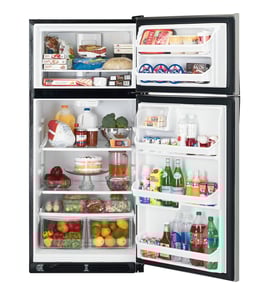





What is the upper part of a fridge called?
On the Kenmore top-mount refrigerator model 10671192101, the upper part is the freezer compartment (often just called the freezer). It’s the section designed to keep foods frozen and it also supplies cold air that circulates to help cool the fresh food section.
What the freezer does in a top-mount refrigerator
In a top-freezer design like model 10671192101, the freezer is more than storage for frozen food; it’s also the starting point for airflow through the appliance.
- Freezes and stores food at a safe, low temperature
- Sends cold air down into the refrigerator section through vents
- Helps maintain overall temperature balance between sections
- Often houses the ice maker (if equipped)
Airflow basics (why the name matters)
Our manual explains that cool air enters through the bottom of the freezer section and moves up; most air recirculates in the freezer and some enters the refrigerator section through a top vent. Keeping vents clear is key to steady temperatures.
Quick reference table
| Term you might hear | What it usually means | Where it is on 10671192101 |
|---|---|---|
| Freezer compartment | Upper frozen-food section | Top of the unit |
| Fresh food compartment | Refrigerator section for chilled foods | Bottom of the unit |
| Air vents/returns | Openings that move air between sections | Freezer and refrigerator vents |
Tips to avoid common freezer-related issues
- Do not block freezer or refrigerator vents with food packages
- Keep items away from the top vent area in the refrigerator section
- Wrap foods tightly to reduce odor transfer between sections
- If you see frost buildup or temperature swings, check for blocked airflow first
Why it matters
When customers call the top section the “upper fridge,” it can cause confusion during troubleshooting or parts lookup. Using the correct term (freezer compartment) helps match the right instructions and parts for cooling, airflow, and ice maker concerns.
For diagrams and section names specific to this model, use the 10671192101 owner's manual.
Last updated: January 2026
What is the life expectancy of a top freezer refrigerator?
A top-freezer (top-mount) refrigerator like Kenmore model 10671192101 typically lasts 13 to 17 years. This style often reaches the higher end of that range because it has a simpler cooling layout, and routine care (airflow, clean seals, clean coils) prevents early wear.
Typical lifespan and what affects it
Most top-freezer refrigerators fall into a predictable lifespan range, but real-world life depends on how hard the sealed system and fans have to work.
- Maintenance: keeping condenser coils clean reduces compressor run time
- Door seal condition: air leaks force longer run cycles and can cause moisture issues
- Airflow habits: blocking vents can create temperature swings and frost problems
- Room conditions: hot garages and tight enclosures shorten life
- Usage: frequent door openings and overloading increase run time
Quick reference: what “normal” looks like
| Item | Typical target | Why it matters |
|---|---|---|
| Expected service life | 13 to 17 years | Common range for top-freezer designs |
| Freezer temperature | 0°F | Protects food and supports ice production |
| Fresh food temperature | 37°F | Slows spoilage without freezing produce |
| Door gasket feel | Firm, even contact | Prevents warm air leaks and frost |
Maintenance steps that extend life
We recommend these practical habits for Kenmore 10671192101 owners:
- Keep food packages from blocking freezer and refrigerator vents (air must circulate between sections)
- Clean spills and odors promptly; odors transfer between compartments when air circulates
- Check door closing and alignment so the gasket seals evenly (adjust hinges if doors look uneven)
- Replace worn door gaskets if you feel cold air leaking or see persistent condensation
- During long vacations, follow the shutdown and ice maker steps in the 10671192101 owner's manual
Why it matters
A refrigerator usually fails early because it runs too long and too often. Good airflow, tight door seals, and clean heat-exchange surfaces reduce run time, which protects the compressor, evaporator fan motor, and defrost system.
Last updated: January 2026
How to tell cubic feet of Kenmore refrigerator by model number?
For Kenmore model 10671192101, the most reliable way to get the exact cubic-foot capacity is to look it up in the specifications section of the 10671192101 owner's manual. If you only have the model number and no spec sheet, you can still estimate capacity by measuring the interior and converting cubic inches to cubic feet.
Best ways to find cubic feet (in order)
- Check the specifications section in the 10671192101 owner's manual.
- Look for a model and serial number label inside the fresh food compartment (commonly on an inside wall); the manual confirms the label location.
- Search the model number on the appliance rating label and compare to similar Kenmore 106 top-mount refrigerators.
- Estimate capacity by measuring the usable interior (not the outside cabinet).
How to estimate cubic feet by measuring
- Empty the refrigerator enough to measure the main interior spaces.
- Measure interior width x depth x height in inches for:
- Fresh food compartment
- Freezer compartment
- Convert each compartment to cubic feet:
- Cubic feet = (W x D x H) / 1728
- Add the two results for an estimated total.
Quick conversion table
| What you have | What to do | Result |
|---|---|---|
| Interior inches | Multiply W x D x H | Cubic inches |
| Cubic inches | Divide by 1728 | Cubic feet |
Why the model number usually is not enough
Kenmore model numbers (including 106-prefix models like 10671192101) identify the product line and configuration, but they do not consistently encode the exact cubic-foot capacity in a way that is accurate across all revisions. The manual is the dependable source for the official spec.
Why it matters
Knowing cubic feet helps us choose correctly sized accessories and storage parts (bins, shelves, crisper pans) and it also helps when comparing energy use and food storage needs for a top-mount refrigerator.
Last updated: January 2026
How to replace kenmore freezer thermostat?
On Kenmore top-mount refrigerator model 10671192101, replacing the freezer thermostat (cold control) typically involves unplugging the refrigerator, accessing the control housing, transferring the sensing tube to the same routing, and reconnecting the wires. Use the 10671192101 owner's manual for the correct access points and reassembly details.
Before you start (safety and prep)
- Unplug the refrigerator to prevent shock.
- Move food to a cooler; keep doors closed as much as possible.
- Use a towel to protect shelves and catch any melting frost.
- Take a photo of wire positions before disconnecting anything.
- If you need door removal for access, support the doors; do not rely on door magnets.
Basic replacement steps (typical Kenmore top-mount process)
- Disconnect power at the outlet.
- Access the temperature control area (usually inside the fresh food section control housing; some designs route the sensing tube toward the freezer/evaporator area).
- Label and remove wires from the thermostat terminals.
- Remove the thermostat from its mounting (screws or clips).
- Carefully transfer the sensing tube/capillary:
- Route it exactly like the original.
- Do not kink, sharply bend, or pinch it.
- Install the new thermostat, reconnect wires, and reassemble panels.
- Restore power and set controls to mid-setting; allow 24 hours for temperatures to stabilize.
What you may need to remove (varies by configuration)
| Area you access | What you remove | Why it matters |
|---|---|---|
| Control housing | Knob, cover, screws | Reaches thermostat terminals and mounting |
| Freezer interior (some designs) | Evaporator cover or air tower area | Reaches sensing tube routing or clips |
| Doors (rare, for major access) | Hinge parts and base grille | Prevents damage when moving the cabinet or panels |
Symptoms that point to a bad thermostat
- Refrigerator runs constantly or not at all.
- Freezer temperature swings widely.
- Clicking from the control area with no compressor start.
- Food freezing in the refrigerator section at normal settings.
Why it matters
The thermostat controls compressor run time. If it sticks open or closed, you can get warm temperatures, excessive frost, or constant running that stresses the compressor and increases energy use.
Last updated: January 2026