Installation guide
 Owner’s manual
 Error Codes


Where is the model number on a Kenmore side by side refrigerator?
On Kenmore side-by-side refrigerator model 10653544300, the model number is printed on the model and serial number label inside the fresh food (refrigerator) compartment, typically on an inside wall. Use that label anytime you’re ordering parts or checking the manual.
Where to look (fast checklist)
- Open the refrigerator (fresh food) door, not the freezer door
- Look along the inside side walls of the refrigerator compartment
- Check near the upper side wall around the light housing area
- Also scan near the crisper/meat pan area on the side wall
- The label usually lists model number and serial number together
What you should see on the label
The label includes both identifiers; they are not the same thing.
| Item | What it’s used for | What it looks like |
|---|---|---|
| Model number | Matching parts and diagrams | Starts with 106 for this Kenmore series |
| Serial number | Production tracking and service history | A longer mix of letters and numbers |
Why it matters
We use the model number to match the exact parts and revisions for your refrigerator. Even small differences can affect fit and function for items like a water filter, ice maker, or water inlet valve.
Tips for using the model number
- Write down the full model number exactly as shown (all digits)
- Keep it with your paperwork and the owner's manual
- When ordering, match parts to 10653544300 to avoid returns
Last updated: February 2026
What are the most common problems with Kenmore refrigerators?
The most common problems we see on Kenmore refrigerators like model 10653544300 are cooling issues, ice maker and water dispenser problems, water leaks, frost buildup, and doors that do not seal or close correctly. Many of these start with airflow blockages, power/control settings, or worn sealing parts; our owner's manual troubleshooting section covers the first checks.
Common symptoms and what they usually point to
- Not cooling or too warm: blocked air vents, dirty condenser area, failed thermostat, or defrost system trouble
- Freezer cold but fresh food warm: airflow restriction between compartments, evaporator fan issue, or frost-clogged evaporator
- Ice maker not making ice: water supply issue, inlet valve problem, or ice maker assembly failure
- Water leaking or puddles: clogged/iced drain, loose water line, or valve seepage
- Noisy operation: fan blade hitting ice, worn fan motor, or vibration from leveling
- Doors hard to open or not closing: dirty/sticky gaskets, cabinet not level, or door hardware wear
Quick checks we recommend first (no parts needed)
The manual’s troubleshooting guidance for this model focuses on basics that solve a lot of calls:
- Confirm the unit is plugged into a grounded 3-prong outlet and the breaker is not tripped
- Make sure controls are not set to OFF; for digital controls, power-cycle OFF then ON to reset
- Clear items away from air vents so cold air can circulate
- Reduce frequent door openings; organize food so doors close quickly
- If doors feel sticky, clean the gaskets and mating surfaces
- Level the refrigerator if it wobbles or doors swing open
Parts that commonly fix these problems on 10653544300
If the quick checks do not help, these are frequent repair paths for this model:
| Problem area | Common suspect part | Example part on this model page |
|---|---|---|
| No ice, no water, weak fill | Water inlet valve | Refrigerator inlet valve W10408179 |
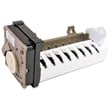
| Ice maker dead or inconsistent | Ice maker assembly | Refrigerator ice maker WPW10190965 |
| Warm temps, poor control | Cold control/thermostat | Refrigerator thermostat WP2198202 |
| Frost buildup, warm temps | Defrost system | Refrigerator defrost bi-metal WPW10225581 and refrigerator defrost timer W10822278 |
Why it matters
Cooling and ice maker complaints often share the same root causes: restricted airflow, incorrect control settings, or a weak water supply. Catching those early helps prevent food spoilage, ice jams, and repeat leaks.
Last updated: February 2026
What's the average lifespan of a Kenmore refrigerator?
Most Kenmore refrigerators last about 12 to 15 years with normal household use. For a Kenmore 10653544300 side-by-side refrigerator, consistent maintenance (cleaning coils, keeping door gaskets sealing, and fixing cooling or ice maker issues early) is what most often determines whether it reaches the high end of that range.
Typical lifespan and what to expect
Here’s a practical way to think about refrigerator life:
| Condition | What you’ll typically see | What to do |
|---|---|---|
| Normal use, basic upkeep | 12 to 15 years | Keep airflow and seals in good shape |
| Strong maintenance habits | 15 to 20 years | Stay ahead of wear items and cleaning |
| Poor airflow or weak door seal | Shorter lifespan | Correct the root cause quickly |
Maintenance that extends life the most
We see these steps make the biggest difference on side-by-side models:
- Clean the condenser coils regularly so the compressor does not run hot.
- Keep door gaskets clean so doors close and seal properly (sticky gaskets can cause warm air leaks).
- Do not block vents with food packages; good airflow prevents temperature swings.
- Replace the water filter on schedule to protect water flow to the dispenser and ice maker.
- Level the refrigerator so doors self-close and do not hang open.
For model-specific care and cleaning guidance, use the owner's manual.
Parts that commonly affect longevity
When cooling performance drops or ice and water issues start, these parts are frequent culprits:
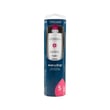
- Refrigerator water filter EDR5RXD1 (restricted filter can reduce water flow)
- Refrigerator inlet valve W10408179 (controls water supply to ice maker and dispenser)
- Refrigerator defrost bi-metal WPW10225581 and refrigerator heater WP2323198 (defrost system problems can cause frost buildup and poor cooling)
Why it matters
A refrigerator that runs longer than it should (due to dirty coils, air leaks, or frost buildup) puts extra stress on the sealed system and compressor. Preventive maintenance helps your Kenmore 10653544300 cool more consistently and reduces expensive breakdown risks.
Last updated: February 2026