Installation guide
 Owner’s manual
 Error Codes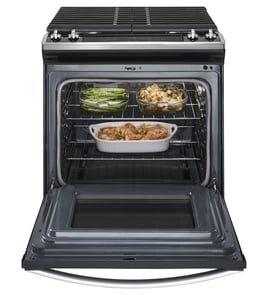




What are the most common issues with PGS950SEF3SS?
Common issues we see on the GE PGS950SEF3SS gas range involve ignition problems (surface burners or oven), uneven heating, and control or display glitches. Many of these symptoms trace back to igniters, burner caps, valves, or the touch control panel; the PGS950SEF3SS owner's manual helps confirm normal operation and settings.
Most common symptoms and likely causes
- Oven will not heat or takes too long to preheat: weak bake igniter, gas safety valve issue, or airflow/deflector problem
- Broil will not light: weak broil igniter or wiring connection problem
- Surface burner clicks but won’t light: dirty/wet burner cap, clogged orifice, spark module issue
- Uneven flame or low flame: mis-seated cap, blocked orifice, burner valve problem
- Touch panel not responding or acting erratically: touch control panel or sensor-related issue
Parts that commonly fix these problems
If your symptoms match, these model-specific parts are frequently involved:
- Range bake igniter WB28X20446 (bake burner ignition)
- Range broil igniter WB13K10043 (broil burner ignition)
- Range oven burner igniter WB13X25262 (oven ignition on some configurations)
- Range surface burner cap (black) WB29K10045 (proper flame pattern and ignition)
- Range spark module WB13X26360 (spark to surface burners)
- Range touch control panel assembly WB27X21183 (display and keypad response)
Quick checks we recommend before replacing parts
- Confirm the right setting (Bake vs. Broil vs. Convection) and allow a full preheat cycle.
- Clean and dry burner caps and bases; moisture and spills commonly cause clicking/no-ignite.
- Watch the igniter (oven): a weak igniter may glow but still not open the gas valve.
- Check flame quality: steady blue flame is normal; lifting/yellow flames point to airflow or burner issues.
Symptom-to-part cheat sheet
| Symptom | Most common part to check first | Why |
|---|---|---|
| Bake not heating | Range bake igniter | Weak igniter prevents gas from lighting |
| Broil not heating | Range broil igniter | Same ignition failure pattern |
| Surface won’t light, keeps clicking | Burner cap or spark module | Poor spark path or no spark output |
| Low/uneven surface flame | Surface burner orifice or valve | Gas flow restriction or control issue |
Why it matters
On a gas range, ignition strength and correct gas flow work together. Fixing the root cause (often an igniter, cap, or valve) restores safe, consistent lighting and stable oven temperatures.
Last updated: March 2026
What is the average lifespan of PGS950SEF3SS?
A GE gas range like model PGS950SEF3SS typically lasts 15 years with normal household use. Keeping burners clean, ensuring proper ignition, and addressing heating issues early helps you reach that lifespan and avoid premature failures.
Typical lifespan and what affects it
Most gas ranges reach their full service life when heat, ignition, and airflow components stay in good condition.
- Heavy daily cooking shortens lifespan; light to moderate use extends it
- Frequent self-clean cycles can stress door parts, wiring, and controls
- Spills and boil-overs can clog burner ports and cause ignition problems
- Poor ventilation can increase heat stress on the control area
- Small issues (slow ignition, uneven baking) become major repairs if ignored
What “end of life” usually looks like
These are the most common age-related problems we see on gas ranges:
| Symptom | Common cause | Example part for this model |
|---|---|---|
| Oven will not heat or takes too long | Weak igniter | Range bake igniter WB28X20446 |
| No broil heat | Failed broil igniter | Range broil igniter WB13K10043 |
| Clicking or no spark at surface burners | Spark system issue | Range spark module WB13X26360 |
| Oven temperature swings | Sensor drifting out of range | Sensor WB23X5340 |
Maintenance that helps you hit 15 years
- Clean burner caps and ports regularly; keep them dry before reassembly
- Avoid lining the oven bottom with foil; it can disrupt airflow and heat
- If ignition is slow, stop using the oven until the cause is corrected
- Use cookware that matches burner size to reduce overheating and soot
- Follow cleaning and operating guidance in the PGS950SEF3SS owner’s manual
Why it matters
Knowing the expected lifespan helps you decide whether to repair or replace. On a 15-year gas range, ignition parts (like igniters and spark modules) are common, cost-effective repairs that often restore reliable heating.
Last updated: March 2026
How do I find the model number on my PGS950SEF3SS?
Your GE gas range’s model number is printed on the appliance’s rating label. On model PGS950SEF3SS, check common label locations around the oven door frame area and the storage or warming drawer area; match the full model number exactly when ordering parts.
Where to look on a GE range
Check these spots first (use a flashlight and look for a silver or white sticker/plate):
- Along the oven door frame (open the oven door and look on the front frame)
- On the lower front frame behind the storage drawer or warming drawer (pull the drawer out)
- On the side trim near the door opening
- On the back panel (if the range is accessible)
For diagrams and model-specific details, use the PGS950SEF3SS installation guide.
What the label looks like and what to copy
The rating label usually includes several identifiers. Copy the model number exactly as shown.
- Model number: PGS950SEF3SS (this is what we use to match parts)
- Serial number: helps identify production run details
- Gas type and pressures: used for safe setup and service
- Electrical requirements: typically 120V, 60 Hz on a dedicated circuit
Quick checklist before ordering parts
Using the correct model number prevents wrong-part returns and fit issues.
- Write down the full model number and serial number
- Confirm every letter and number (no spaces)
- Use the model number to select parts like igniters, valves, and burner caps
- If you are replacing an ignition component, match the part to the correct function (bake, broil, or surface)
Common ignition parts for this model (examples)
| Symptom | Likely area | Example part on this model |
|---|---|---|
| Oven will not bake | Bake ignition | Range bake igniter WB28X20446 |
| Oven will not broil | Broil ignition | Range broil igniter WB13K10043 |
| Surface burners won’t spark | Spark system | Range spark module WB13X26360 |
Why it matters
GE ranges often have similar-looking models with different burner systems, control panels, and orifices. Using the exact PGS950SEF3SS model number ensures the parts list and diagrams match your specific gas range.
Last updated: March 2026