Owner’s manual
 Error Codes


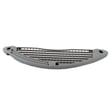

What model is the LG dryer DLGX7601KE?
The LG DLGX7601KE is a gas steam dryer in the DLGX7601* series. It’s a full-size 27-inch dryer with 7.3 cu. ft. capacity, designed to vent to the rear by default and support steam features on applicable cycles (per the model family owner’s manual). See the DLGX7601KE owner's manual for the exact specifications and features for your unit.
Quick model identification (what DLGX7601KE tells you)
- Brand: LG
- Model number: DLGX7601KE
- Fuel type: Gas (DLGX prefix)
- Series covered in the manual: DLGX7601*
- Steam-capable design: Steam dryer model family (water inlet valve on some models)
Key specs for the DLGX7601* family
These are the published specifications in the owner’s manual for the DLGX7601* series.
| Spec | Value |
|---|---|
| Width | 27 in |
| Depth | 28 15/16 in |
| Height | 40 3/16 in |
| Depth with door open | 50 1/4 in |
| Capacity (Normal cycle) | IEC 7.3 cu. ft. |
Why it matters
Confirming the exact model (DLGX7601KE) ensures you get the right dryer parts, follow the correct installation clearances, and match components like the drum belt, thermostats, and lint screen to your LG gas dryer configuration.
Parts that commonly match this model
If you’re identifying the dryer because you need a replacement part, these are common wear items listed for DLGX7601KE:
- LG dryer drum belt 4400EL2001F
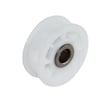
- Dryer drum support roller 4581EL2002H
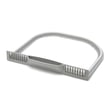
- Dryer lint screen by LG 5231EL1001C
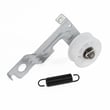
- LG dryer idler pulley 4561EL3002A
You can order replacement parts from the parts list for your model, or search by model number on Sears PartsDirect.
Last updated: February 2026
How do you reset the flow sensor on a LG dryer?
On the LG DLGX7601KE dryer, the Flow Sense indicator resets after you restore proper vent airflow and run several normal drying cycles; there is no single “flow sensor reset” button. Clean the lint filter and venting, then run consecutive cycles until the indicator clears (it can take multiple cycles).
What to do first (the steps that actually reset Flow Sense)
- Clean the lint screen before every load; wash it with warm water if you see residue.
- Check the lint screen housing and grille for lint buildup.
- Inspect the entire exhaust path: dryer outlet, transition duct, wall duct, and outside hood.
- Remove kinks or crushed flex duct; shorten the run and reduce elbows when possible.
- Run 3 to 5 consecutive cycles after clearing restrictions so the dryer can re-evaluate airflow.
What to expect after you clear the vent
Flow Sense is designed to confirm improved airflow over time. If the restriction is cleared, the indicator may still stay on until the dryer sees better performance across multiple cycles.
| Situation | What it means | What to do |
|---|---|---|
| Indicator stays on right after cleaning | Dryer has not “relearned” airflow yet | Run several consecutive cycles |
| Display shows a duct warning (such as d80) | Airflow restriction is still being detected | Recheck duct length, turns, and blockages |
| Indicator turns off after a few cycles | Airflow is back in range | Keep up regular vent and lint maintenance |
Quick power reset (helps clear the display, not the airflow problem)
A power reset can turn off the display message, but it will not fix a blocked vent.
- Turn the dryer off.
- Unplug the dryer (or switch the breaker off) for about 5 minutes.
- Restore power and run a cycle.
Why it matters
Restricted venting makes drying take longer, increases energy use, and can cause overheating. Keeping airflow strong also helps protect key components like thermostats and the moisture-sensing system.
Helpful references for this model
- For cycle behavior and Flow Sense details, use the DLGX7601KE owner's manual.
- If you’re seeing a code along with the indicator, use LG dryer error codes.
- If you need replacement maintenance parts (like the lint screen), order from the parts list for DLGX7601KE or search by model at Sears PartsDirect.
Last updated: February 2026
What is the most common problem with LG dryers?
The most common issue we see on LG dryers, including model DLGX7601KE, is restricted airflow. A clogged lint screen or blocked vent causes long dry times, overheating, and cycles that stop early; it can also make the dryer seem like it “isn’t heating.”
What to check first (fastest fixes)
- Clean the lint screen every load; for heavy-lint loads (new towels), clean it mid-cycle too.
- While the dryer runs, check for strong airflow at the outside vent hood.
- Inspect the vent run for kinks, crushing, long runs, or lint blockage.
- Avoid overloading or underloading; sensor cycles can end too soon with very small loads.
- If the dryer runs but has no heat, confirm the correct power or gas supply is actually available.
If airflow is good, these are the next most common causes
| Symptom | Likely area | Example part for DLGX7601KE |
|---|---|---|
| No heat or heat cuts in and out | Temperature sensing or safety thermostat | Dryer thermistor AGM30045804 |
| Squealing, thumping, rumbling | Drum drive wear items | Dryer drum belt 4400EL2001F |
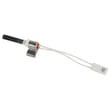
| No heat on gas model | Ignition or gas valve circuit | Dryer burner igniter 5318EL3001A |
Why it matters
Restricted venting traps heat and moisture, so clothes dry slowly and the dryer can overheat and shut down. Fixing airflow first protects thermostats, sensors, and the motor from excess heat.
Use the right reference for this model
- Follow the troubleshooting steps in the DLGX7601KE owner's manual for “does not heat” and “takes too long to dry.”
- If a code appears, use LG dryer error codes to narrow the problem to airflow, heating, or a sensor/control issue.
- You can order replacement parts from the parts list for DLGX7601KE, or search by model on Sears PartsDirect.
Last updated: February 2026
Are LG gas dryers any good?
Yes. LG gas dryers, including LG model DLGX7601KE, are a strong choice because they pair efficient gas heat with features that improve real-world results, such as sensor dry cycles, the EasyLoad two-way door, and Flow Sense duct blockage sensing. Confirm your exact features in the DLGX7601KE owner's manual.
What makes DLGX7601KE a solid pick
These are the practical benefits many owners notice most:
- Sensor dry cycles adjust time based on moisture in the load and in the air.
- EasyLoad two-way door opens hamper-style for loading and swing-style for bulky items.
- Flow Sense indicator helps flag vent restrictions that cause long dry times.
- Steam functions (on steam models) can refresh clothes and reduce wrinkles.
Common complaints and the usual causes
When a gas dryer seems “not that good,” it is typically a setup or maintenance issue:
- Restricted venting (kinks, long runs, lint buildup) causing long cycles and damp loads.
- Lint screen airflow problems from residue buildup or a damaged screen.
- Sensor cycle behavior with small loads or mixed fabrics that do not tumble evenly.
- Heat regulation parts drifting out of spec (thermistor or thermostats).
Quick symptom guide
| Symptom | Check first | Next step |
|---|---|---|
| Clothes damp on sensor cycle | Venting and lint screen airflow | Run a timed/manual cycle to compare |
| Takes too long to dry | Duct restriction and outside vent hood | Clean blower area and lint path |
| Heat seems inconsistent | Airflow restriction | Test/replace heat-sensing parts |
Model-matched parts that often affect drying
If you are troubleshooting airflow or temperature control on DLGX7601KE, these parts are commonly involved:
- Dryer thermistor AGM30045804
- Dryer blower thermostat 6931EL3002M
- Dryer high-limit thermostat 6931EL3003C
- Dryer lint screen by LG 5231EL1001C
Why it matters
Gas dryers dry best when airflow and temperature sensing are correct. Keeping the venting clear and the lint screen clean helps sensor cycles finish dry, prevents overheating, and keeps energy use down.
Last updated: February 2026