Installation guide
 Owner’s manual
 Error Codes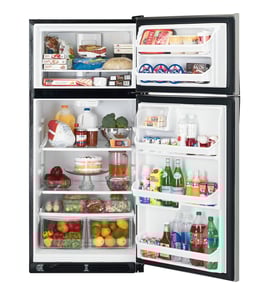




What is the upper part of a fridge called?
On the Frigidaire LFHT1831QP5 top-mount refrigerator, the upper section is typically called the freezer compartment (or simply the freezer). It’s the coldest area of the appliance and is designed to keep foods frozen and support ice-making features on equipped models.
Common names you’ll hear
Depending on the refrigerator style and what you’re referring to, the “upper part” may be called:
- Freezer compartment: the full upper cabinet area where food freezes
- Freezer section: another common name for the same space
- Freezer door: the upper door that seals the freezer compartment
- Freezer shelf or bin: storage components inside the freezer
- Ice maker area (some models): the zone where an automatic ice maker mounts and operates
For the exact terminology used for LFHT1831QP5, we recommend checking the LFHT1831QP5 owner's manual.
What the upper section does (and why it matters)
The freezer compartment is where the refrigerator’s cooling system maintains freezing temperatures. Cold air circulation and good door sealing are critical; if the freezer door does not seal, the refrigerator can struggle to hold temperature and may run longer than normal.
Quick reference: “upper part” terms
| If you mean this… | Most common name | What it includes |
|---|---|---|
| The whole top area | Freezer compartment | Shelves, bins, ice maker (if equipped) |
| The top door | Freezer door | Door liner, handle, gasket |
| The seal around the top door | Freezer door gasket | Prevents warm air leaks |
Related tips for top-mount refrigerators
- Keep the freezer door closed as much as possible to reduce frost and temperature swings.
- Make sure the refrigerator is level so doors close and seal properly.
- Do not block vents inside the freezer; airflow helps maintain even temperatures.
- If your model has an automatic ice maker and no water line is connected, keep the ice maker turned off.
Last updated: January 2026
What are the disadvantages of a top mount fridge?
Top-mount refrigerators like the Frigidaire LFHT1831QP5 are reliable and efficient, but the main disadvantages are less convenient fresh-food access (you bend more), fewer premium organization features than many bottom-freezer designs, and limited dispenser options on many models.
Common disadvantages (what you will notice day to day)
- More bending for fresh food: the refrigerator section is lower, so you reach down more often.
- Freezer at eye level: convenient for frozen items, but it pushes fresh food lower.
- Fewer built-in organization upgrades: many top-mount designs have simpler bins and drawers.
- Less common to have external ice and water: many top-mount models do not include a door dispenser.
- Door swing clearance can be tighter: if the hinge side is near a wall, you may need extra space to open the door wider.
What matters specifically for LFHT1831QP5
This model uses classic top-mount storage features such as crispers and (on some versions) a pantry or Store-More style drawer; these are practical, but they are not the same as the wide, eye-level fresh-food layout you get with many bottom-freezer refrigerators. For operating and setup details, use the LFHT1831QP5 owner's manual.
Quick comparison: top mount vs bottom freezer
| Feature | Top mount (like LFHT1831QP5) | Bottom freezer |
|---|---|---|
| Fresh-food access | Lower, more bending | Higher, easier access |
| Freezer access | Higher, easier access | Lower, more bending |
| Organization | Often simpler | Often more flexible |
| Dispensers | Less common | More common |
Why it matters
Choosing a refrigerator style is mostly about ergonomics and how your household uses food. If you access fresh foods many times per day, the lower refrigerator compartment in a top-mount can feel less convenient even when cooling performance is strong.
Last updated: January 2026
Which is better, top mount or bottom mount refrigerator?
A top-mount refrigerator like the Frigidaire LFHT1831QP5 is usually the better choice when you want strong energy efficiency, simpler design, and lower repair costs; a bottom-mount is usually better when you want fresh-food items at eye level and easier access to the refrigerator section.
Quick comparison
| Feature | Top-mount (freezer on top) | Bottom-mount (freezer on bottom) |
|---|---|---|
| Everyday access | Freezer is easiest to reach | Fresh food is easiest to reach |
| Typical cost | Lower purchase and repair cost | Higher purchase and repair cost |
| Energy use | Often slightly more efficient | Often slightly less efficient |
| Organization | Simpler shelves and bins | Often more drawers and sections |
How to choose for your kitchen and habits
Pick a top-mount if most of your daily use is fresh food but you want a straightforward layout and value:
- You want a simpler refrigerator with fewer complex mechanisms
- You use the freezer often (it is at chest to eye level)
- You want easier door reversal options for your space planning
- You prefer lower long-term maintenance costs
Pick a bottom-mount if you want convenience for fresh-food access and do more meal prep:
- You open the refrigerator section many times per day
- You want less bending to reach produce, dairy, and leftovers
- You like pull-out freezer drawers for organization
Installation and clearance considerations (applies to both)
No matter which style you choose, correct leveling and airflow matter for temperature stability and door sealing. For LFHT1831QP5, the guidance includes allowing clearance around the cabinet and keeping the toe grille unblocked; we also recommend setting the cabinet level and slightly tilted back so doors close and seal properly. See the LFHT1831QP5 installation guide for the exact clearance and leveling steps.
- Leave space for air circulation (especially at the back and toe grille)
- Level the cabinet so all corners sit firmly on the floor
- Tilt the cabinet slightly back so doors self-close and seal
- Allow extra hinge-side clearance if the door swings toward a wall
Why it matters
“Better” comes down to how you use the refrigerator. Door sealing, airflow, and proper leveling affect cooling performance and energy use on any style, so choosing the layout that fits your habits and installing it correctly prevents temperature swings, frost issues, and wasted energy.
Last updated: January 2026
What is the most common problem with a Frigidaire refrigerator?
Cooling problems are the most common issue we see with Frigidaire refrigerators like model LFHT1831QP5, usually showing up as warm fresh-food temperatures, soft ice, or heavy frost. In many cases, the fix is basic maintenance and airflow checks before replacing parts; use the LFHT1831QP5 owner's manual for control settings and operating guidance.
What “cooling problem” usually means
Most “not cooling” complaints fall into one of these patterns:
- Dirty condenser coils causing poor heat release and longer run times
- Frost buildup restricting airflow across the evaporator
- A door not sealing, letting warm air and moisture in
- A fan not moving air between the freezer and refrigerator sections
- Controls set incorrectly after a move or power outage
Quick checks we recommend first
These steps solve a large share of cooling complaints without parts replacement:
- Confirm the refrigerator control is set to Normal initially; allow 24 hours to stabilize after changes.
- After first startup, let the refrigerator run with doors closed for at least 8 hours before loading food.
- Make sure vents inside the compartments are not blocked by packages.
- Check that doors close fully and shelves/bins are not preventing closure.
- Clean dust from the condenser area (unplug first).
Common symptoms and likely causes
| Symptom | Most likely cause | What to check first |
|---|---|---|
| Fresh-food section warm, freezer cold | Airflow problem or frost restriction | Listen for evaporator fan, check for frost on rear freezer panel |
| Heavy frost in freezer | Defrost system issue or door leak | Inspect door seal, look for ice buildup patterns |
| Runs a lot, temps drift | Dirty condenser or poor ventilation | Clean coils, confirm clearance and airflow |
| Water/ice issues (if equipped) | Supply or filter restriction | Water line, shutoff valve type, filter condition |
When a part is commonly involved
If you confirm frost buildup or airflow issues, these model-compatible parts are often involved:
- Refrigerator defrost heater 242044008 (helps clear frost from the evaporator)
- Refrigerator evaporator thermistor 5303918645 (temperature sensing that affects cooling cycles)
Why it matters
Cooling issues can quickly lead to unsafe food temperatures and can also overwork the compressor. Catching airflow, frost, or door-seal problems early helps the refrigerator cool evenly and run efficiently.
Last updated: January 2026