How to tell what year a Husqvarna is?
For a Husqvarna rear-engine riding mower like model 968999220, the most reliable way to tell the year is to read the product identification label (model and serial number tag) and decode the serial number date code. Husqvarna has used more than one serial format over the years, so the “year” is determined by the specific serial pattern on your tag.
On most Husqvarna riding mowers and tractors, we typically see the ID tag in one of these spots:
- Under the seat pan or on the seat support
- On the frame rail near the rear wheels
- Near the engine area (on the frame, not on the plastic hood)
- Near the footrest area on the chassis
Once you have the serial number, look for a date pattern. Common formats include:
- YYxxxx…: first 2 digits are the year (example: 05 = 2005)
- YYMMxxxx…: first 4 digits are year and month (example: 2103 = March 2021)
- YMMxxxx…: first digit is year within a decade, next 2 digits are month (used on some equipment lines)
| Serial starts with | Often indicates | Example meaning |
|---|---|---|
| 05… | Year (YY) | Built in 2005 |
| 2103… | Year + month (YYMM) | Built March 2021 |
| 301… | Year + month (YMM) | Built January 2003 |
If the serial number does not match a clear date pattern, use these practical checks to narrow it down:
- Compare the engine model/type code to the mower’s serial tag (engines are often replaced, so the mower tag is the “year” reference)
- Check whether your mower uses a seat safety switch and PTO/blade engagement style; these features changed across generations
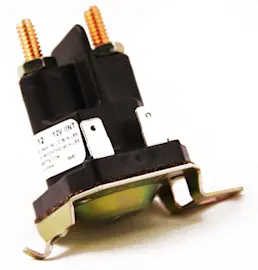
- Match your deck and controls to replacement parts used on your machine (for example, a failed PTO switch can be matched to the correct replacement like the blade switch 582107601)
Knowing the build year helps us match the correct parts list and diagrams for your 968999220, especially for wear items like blades, belts, switches, and deck hardware. That prevents ordering a part that fits a different production run.
Last updated: February 2026
What size yard is the 968999220 good for?
The Husqvarna 968999220 rear-engine riding mower is a strong fit for typical residential yards; most riders in this class are used on about 1 to 2 acres when the terrain is reasonably open and you can mow without constant obstacles.
We size a riding mower to the job based on deck width, turning space, and how often you mow.
- Open lawn with long passes: you can cover more acreage per hour
- Tight landscaping (trees, beds, fences): effective capacity drops because you slow down and turn more
- Hills and rough ground: plan for less acreage per session and slower mowing speed
- Bagging or heavy mulching: reduces productivity compared to side discharge
- Tall or wet grass: requires slower ground speed and may need a second pass
| Yard condition | What to expect | Practical guidance |
|---|---|---|
| Mostly open, flat | Highest productivity | 1 to 2 acres is realistic |
| Moderate obstacles | Medium productivity | Closer to 1 acre per mow |
| Many obstacles or slopes | Lowest productivity | Consider smaller sections or more time per mow |
Matching mower size to yard size helps you avoid long mow times, uneven cutting, and extra wear on the deck drive system (belt, idlers, and mandrel). If you routinely mow heavy grass, keeping the deck in top shape makes a bigger difference than raw horsepower.
If cut quality drops (streaking, clumping, uneven height), these are the first areas we check and service:
- Blades (dull, bent, or installed incorrectly), such as the blade, high lift 532180054
- Deck drive belt condition and tension, such as the belt 539107709
- Spindle and bearing smoothness, such as the mandrel assembly 587125201
- Deck leveling and gauge wheel setup, such as the gauge wheel 532133957
For more setup and cut-quality tips, use our how to level a riding lawn mower deck for an even cut video.
Last updated: February 2026
Is 500 hours a lot for a Husqvarna riding mower?
Yes. For a Husqvarna riding mower like model 968999220, 500 hours is a lot for typical residential use; it usually means key wear items (deck drive, spindles, switches, and steering or chassis hardware) are due for inspection and likely replacement to keep it reliable.
Most residential riding mowers reach 500 hours only after many seasons. At that point, the mower can still be a good machine, but it is no longer in the “low-hour” category.
Common wear areas to expect at or before 500 hours:
- Deck drive belt glazing, cracking, or stretching (slipping under load)
- Idler pulleys getting noisy or wobbly
- Blade spindle or mandrel wear (vibration, uneven cut)
- Safety and PTO switch issues (intermittent blade engagement)
- Tires losing air or showing sidewall cracking
We recommend checking these items on your 968999220:
- Cold start behavior: should crank strongly and start without excessive choke time
- Blade engagement: PTO should engage cleanly without squeal or delay
- Cut quality: look for scalping, streaking, or vibration at mowing speed
- Deck noise: listen for rumbling or chirping from pulleys and mandrels
- Drive feel: consistent forward/reverse response, no surging on hills
If you are planning to refresh the mower, these model-matched parts are typical starting points:
| Symptom | Likely wear item | Example part on this model page |
|---|---|---|
| Blades will not engage or cut out | PTO/blade switch | Blade switch 582107601 |
| Squealing, weak cut, belt smell | Deck/blade drive belt | Belt 539107709 |
| Vibration or uneven cut | Spindle/mandrel wear | Mandrel assembly 587125201 |
| Scalp marks or deck dragging | Deck support rollers | Gauge wheel 532133957 |
| Poor traction or frequent flats | Tire wear | Tire 539106993 |
At 500 hours, reliability becomes more about preventive maintenance than “hours alone.” Replacing a worn belt or idler pulley before it fails helps protect the deck, improves cut quality, and reduces downtime during peak mowing season.
For step-by-step maintenance planning, we use riding mower parts and supplies to stock up on video as a checklist for common service items.
Last updated: February 2026
Is it worth replacing a lawn mower engine?
Yes, replacing the engine on your Husqvarna 968999220 rear-engine riding mower is worth it when the tractor chassis, mower deck, and drive system are still solid and the total engine swap cost stays well below the cost of replacing the entire mower. If the mower has multiple worn systems, replacement usually makes more sense.
- The deck shell is not rusted through and the spindles feel tight (no grinding or wobble)
- The transmission drives smoothly (no slipping, surging, or loud whining)
- Steering and front axle are not excessively loose
- You can source the correct engine or a compatible replacement without major fabrication
- You are not also facing major deck-drive repairs (belt, pulleys, mandrels)
We use this guideline for riding mowers like the 968999220:
| If your total engine swap cost is... | Typical recommendation |
|---|---|
| Under ~50% of a comparable replacement mower | Replace the engine |
| Around 50% to 70% | Replace only if the rest of the mower is in excellent shape |
| Over ~70% | Put the money toward a replacement mower |
Even when the engine is the main failure, these related items often determine whether the project stays “worth it”:
- Deck drive belt condition and routing (see belt 539107709)
- Blade engagement electrical switch operation (see blade switch 582107601)
- Deck spindle and housing wear (see mandrel assembly 587125201)
- Idler pulley noise or wobble (see idler pulley 539103257)
- Safety interlock issues that can mimic engine problems (seat switch, PTO switch)
An engine replacement can restore reliability and extend the life of a good mower deck and drivetrain, but it does not fix worn pulleys, belts, mandrels, or safety switches. Checking those systems first prevents spending engine money on a tractor that still will not mow or drive correctly.
If the engine is not cranking or starting consistently, confirm the problem is truly engine-related:
- No crank or only clicking: riding lawn mower engine clicks but doesnt turn over video
- Cranks but will not start: riding lawn mower engine spins but wont start video
Last updated: February 2026
What is the part number for the Husqvarna 968999220 deck belt?
For the Husqvarna 968999220 rear-engine riding mower, the deck (blade drive) belt listed for this model is the belt with manufacturer part number 5391077-09 (Sears PartsDirect part ID 539107709). Use that part number when ordering to match the correct deck belt length and profile.
- Manufacturer part number: 5391077-09
- Sears PartsDirect part ID: 539107709
- Part description on our site: belt 539107709
Deck belts and ground drive belts are often confused on riding mowers. A deck belt:
- Routes around the deck pulleys and mandrels
- Drives the mower blades when the PTO is engaged
- Typically shows wear as slipping, squealing, or uneven cutting
If your mower will not move, that is usually a ground drive belt or transmission issue, not the deck belt.
- Blades engage slowly or stop in heavy grass
- Burning rubber smell near the deck
- Belt squeal when engaging the PTO
- Frayed edges, glazing, or cracking on the belt
- Excessive vibration from the deck area
A new belt can still slip or jump if the deck hardware is worn. These parts are commonly involved:
| What you notice | Common cause | Example part on this model |
|---|---|---|
| Belt keeps coming off | Weak tension or misrouting | Idler pulley wear or binding |
| Uneven cut with good belt | Blade or mandrel issue | Mandrel assembly |
| Loud squeal on engagement | Pulley bearing drag | Idler pulley |
Model-matched examples from this page include idler pulley 539103257 and mandrel assembly 587125201.
Using the correct deck belt part number for model 968999220 helps prevent premature belt wear, poor blade speed, and repeated belt throw-off caused by an incorrect length or belt profile.
Last updated: February 2026