Owner’s manual
 Error Codes



How to remove bottom grille on GE refrigerator?
On the GE GFE28GMKLES bottom-mount refrigerator, the bottom grille (base grille) typically comes off by releasing its fasteners, then pulling the grille forward and away from the cabinet. For your exact fastener locations and handling notes, follow the owner's manual.
Before you start
- Unplug the refrigerator or switch off power at the breaker (safer around wiring and fans)
- If the unit has a water line, avoid pulling or kinking it
- Protect the floor with cardboard or a towel if you need to shift the refrigerator slightly
- Use a flashlight to spot screws or locking tabs along the top edge of the grille
How to remove the bottom grille (most common method)
- Look along the top edge of the grille for screws (often Phillips-head) or quarter-turn fasteners.
- Remove the screws or rotate the fasteners to the unlock position.
- Pull the grille straight forward to disengage the lower clips.
- If it feels stuck, check both corners for hidden tabs; press the tab(s) in while pulling forward.
How to reinstall it
- Align the bottom clips first, then swing the grille into place
- Push until it sits flush with the cabinet
- Reinstall screws or lock the quarter-turn fasteners
Quick checks if it will not come off
- Verify all screws are removed (some models use 2 to 4)
- Check for side tabs near the corners
- Make sure the grille is not catching on the leveling legs
- If you moved the refrigerator, keep it straight to avoid floor damage
| What you see | What it usually means | What to do |
|---|---|---|
| Visible screws | Screw-mounted grille | Remove screws, pull forward |
| No screws, grille feels springy | Clip or tab-mounted grille | Press tabs, pull forward |
| Grille drops slightly then stops | Lower clips still engaged | Pull forward evenly from both sides |
Why it matters
We remove the bottom grille to access the condenser area for cleaning, to inspect for debris, and to reach components near the lower front of the refrigerator. A properly seated grille also helps airflow and keeps noise down.
Last updated: February 2026
What is the most common problem with a GE refrigerator?
For the GE GFE28GMKLES bottom-mount refrigerator, the most common service complaint we see is a cooling problem (fresh food or freezer not staying at the set temperature). Many “problem” reports also turn out to be normal operating sounds or normal recovery time after power loss, as described in the owner's manual.
Most common issues (and what to check first)
- Not cooling or weak cooling: after first plug-in or an extended outage, allow 24 hours to reach set temps.
- Strange noises: fan speed changes, cracking/popping during cool-down, and ice chute motor sounds can be normal.
- Ice maker or dispenser issues: cubes not dispensing, chute behavior, or slow production.
- Water dispenser dripping: air in the water line can cause dripping after dispensing.
- Door not sealing or doors look uneven: loading and floor level can affect alignment.
Quick triage: symptom to likely cause
| Symptom | Most likely cause | First action |
|---|---|---|
| Fridge warm, freezer OK (or both warm) | Normal recovery, airflow blocked, door left ajar | Wait 24 hours; check vents and door seal |
| Clicking/popping, fan noise | Normal cooling/defrost activity | Confirm temps are stable |
| Water drips after dispensing | Air in water line | Dispense water for 5 minutes |
| Doors not aligned | Floor/door loading; needs adjustment | Adjust door using 1/4-inch Allen wrench |
Why it matters
Cooling complaints can be caused by simple, fixable issues (airflow blockage, door seal gaps, or normal temperature recovery). Ruling out normal operation and basic setup first prevents unnecessary part replacement and helps protect food safety.
Model-specific tips from the manual
- Normal sounds include fan speed changes, cracking/popping as the unit cools, refrigerant gurgling, and the ice chute motor closing after dispensing.
- If the refrigerator is not cooling after being plugged in or after a power outage, give it 24 hours to stabilize.
- If water drips after dispensing, purge air by dispensing water for at least 5 minutes.
- If doors look misaligned, the tops are designed to align, but the manual notes alignment can shift due to floor and door loading; adjust using a 1/4-inch Allen wrench.
Helpful DIY guides for common “problem” reports
- GE refrigerator error codes
- How to replace the water filter in a GE refrigerator
- How to reset the door alarm on a GE refrigerator
Last updated: February 2026
Is GE GFE28GMKLES considered high end?
Yes; the GE GFE28GMKLES is considered “high-end” within mainstream, freestanding refrigerators because it’s a feature-forward French-door, bottom-freezer design with electronic controls, filtration, and convenience functions. It is premium mainstream, not a built-in luxury category.
How we classify “high end” for this model
“High end” usually means you’re getting more than basic cooling: better user controls, more convenience features, and more complex systems (ice and water, alarms, filters).
- French-door fresh-food layout with a bottom freezer (premium mainstream style)
- Electronic temperature controls and status indicators
- Door alarm and control lock functions
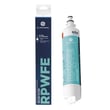
- Filtered water system support (RPWFE water filter cartridge family is listed in the manual)
- Ice maker and dispenser features on many configurations
For the exact feature set on your unit, match your control style and options in the GFE28GMKLES owner's manual.
What “high end” does and does not mean
This helps set expectations when comparing GE lines and price tiers.
| Category | Typical traits | Where GFE28GMKLES fits |
|---|---|---|
| Entry-level freestanding | Basic controls, fewer add-ons | Above this |
| Premium mainstream freestanding | More features, filtration, alarms, electronic controls | This model |
| Built-in luxury | Integrated/built-in designs, luxury branding and pricing | Different category |
Why it matters
Premium mainstream refrigerators like the GE GFE28GMKLES usually deliver day-to-day convenience (alarms, filtration reminders, control lock) but also have more components that need routine upkeep, such as water filters.
Quick comparison tips before you buy or repair
- Confirm the water filter type and replacement interval in the manual
- Check whether your configuration includes an external dispenser
- Use the control panel features (door alarm, lock controls) to prevent temperature swings
- If you’re troubleshooting alarms, follow how to reset the door alarm on a GE refrigerator
Last updated: February 2026