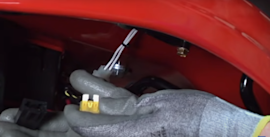
Installation guide
 Owner’s manual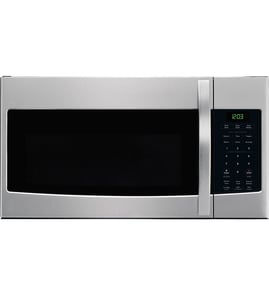



How to remove a Kenmore above range microwave?
To remove a Kenmore over-the-range microwave like model 72163659300, we take the weight off the mounting bracket by supporting the unit from below, remove the upper cabinet mounting bolts, then tilt the front down and lift the microwave off the rear wall bracket. Follow the exact bolt locations and venting setup in the installation guide.
Before you start (safety and prep)
- Turn off power at the breaker, then unplug the microwave if the cord is accessible.
- Protect the cooktop with a thick towel or cardboard.
- Use two people; these units are heavy and awkward.
- If the unit is vented (roof or wall), plan to disconnect the duct as you lower it.
- Keep a container for screws and the upper cabinet bolts.
Removal steps (typical over-the-range process)
- Support the microwave from below (a helper holding it, or a stable support platform).
- Remove the vent grille (front top grille) screws and pull the grille off.
- Disconnect wiring as needed (unplug cord from the upper cabinet outlet; do not pull on the cord).
- From inside the upper cabinet, remove the mounting bolts that go down into the top of the microwave.
- Tilt the front of the microwave downward slowly while a helper supports the weight.
- If ducted, separate the duct connection as the unit lowers.
- Lift the microwave up and off the rear wall mounting bracket, then carry it away.
What changes the steps (venting type)
Your 72163659300 can be set up for different venting paths; that affects what you disconnect during removal.
| Venting setup | What you usually disconnect during removal | What to watch for |
|---|---|---|
| Room-vented (recirculating) | No ductwork | Charcoal filter and grille area clearance |
| Wall-vented | Rear duct transition | Sharp sheet metal edges, damper alignment |
| Roof-vented | Upper duct transition | Cabinet cutout alignment and duct screws |
Why it matters
The upper cabinet bolts and rear wall bracket carry nearly all the load. Supporting the microwave and removing bolts in the right order prevents cabinet damage, bent brackets, and dropped units.
Last updated: February 2026
Is there a reset on a Kenmore microwave?
Yes. On many Kenmore microwave/hood combo models like 72163659300, the practical “reset” is a power reset: cancel the current program, then restore power to clear a control glitch. If the oven still will not run, the issue is usually power, door latching, or a failed safety component.
Quick reset steps (safe, no tools)
- Touch STOP/Clear to cancel any active cooking or timer.
- If the display is frozen or unresponsive, unplug the microwave (or switch the breaker off).
- Wait 1 minute, then restore power.
- Re-set the clock if needed.
- Test with a simple heat test (1 cup of water for 1 minute).
For model-specific control features (clock, child lock, audible signals), use the owner's manual.
If it still will not start after a reset
The troubleshooting guidance for this Kenmore series points to a few common causes when “nothing works” or the microwave “will not run”:
- Power cord not fully plugged into a grounded outlet
- House fuse blown or circuit breaker tripped
- Door not firmly closed and latched
- START not pressed after entering a cook time
- A previous operation is still programmed (use STOP/Clear)
What to check first
| Symptom | Most likely cause | What we recommend |
|---|---|---|
| No display, no lights | No power to unit | Check outlet, breaker, and cord seating |
| Display works, won’t run | Door not latching or control not cleared | Press STOP/Clear, close door firmly, try again |
| Runs but no heat | High-voltage circuit problem | Use our heating diagnosis steps below |
Why it matters
A “reset” clears stuck keypad inputs and cancels programmed cycles, but it will not fix a failed door interlock or high-voltage heating component. Doing the quick checks first prevents unnecessary parts replacement.
Parts that commonly relate to “won’t run” or “no heat”
If basic checks do not solve it, these model-compatible parts are often involved:
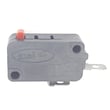
- Door safety circuit: microwave door interlock switch 6600W1K001D or microwave door interlock switch 6600W1K001C
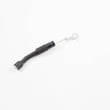
- Heating circuit (advanced repair): high-voltage diode 6851W1A002E and microwave high-voltage capacitor 0CZZW1H004B
For a step-by-step heating diagnosis, use why is my microwave not heating.
Last updated: February 2026
What is the average lifespan of 72163659300?
The average lifespan of a Kenmore microwave/hood combo like model 72163659300 is about 8 to 10 years with normal use and basic maintenance (keeping vents and filters clean, avoiding slamming the door, and fixing small issues early). See the owner's manual for care and operating guidance.
What affects lifespan most
- Grease buildup restricting airflow and overheating the magnetron area
- Running the microwave empty or repeatedly overheating foods
- Door wear that prevents proper latching (can stop heating or starting)
- Power surges and frequent breaker trips
- Heavy daily use (multiple long cook cycles per day)
Maintenance that helps it last longer
- Clean the grease filters regularly; replace charcoal filtration when airflow or odors worsen (recirculating setups)
- Keep the intake and exhaust vents clear; confirm the damper moves freely
- Use microwave-safe cookware and avoid metal trim that can arc
- Close the door gently to protect the latch and interlock system
- Replace failed lights promptly so you can monitor cooking safely
Common “wear” items vs. “major” items
| Type | Examples | What you typically notice |
|---|---|---|
| Wear/maintenance | Charcoal filter, lamps, door latch pieces | Odors, dim/no light, door not closing smoothly |
| Functional/safety | Door interlock switches, thermostats | Won’t start, stops mid-cycle, intermittent operation |
| High-voltage heating | Capacitor, diode | Runs but does not heat, loud hum, burning smell |
Why it matters
Microwave/hood combos rely on airflow for cooling; restricted ventilation and door-latch wear are two of the biggest reasons heating components fail early. Staying ahead of filter cleaning and door issues helps you reach the full 8 to 10 year service life.
Last updated: March 2026